Exercise Balikatan is underway. It is the largest annual bilateral exercise conducted between the Philippines and the US, and this year it includes Australia, Japan, France, Canada, and New Zealand. The Tagalog phrase “Balikatan” means “shoulder-to-shoulder.”

Taking place from 20 April to 8 May across the Philippine archipelago, Balikatan 2026 (BK26) marks the 41stiteration of the exercise. It covers a range of scenarios – from conventional warfare to foreign disaster response – “ensuring all participants remain prepared for a range of contingencies.”
The execution of BK26 enhances planning, command and control systems, logistics, and communication through realistic simulations and war-gaming. The exercise directly supports ongoing efforts to operationalise the 1951 US-Philippine Mutual Defense Treaty (MDT) by ensuring tactical proficiency, interoperability, capability development, and improved military-to-military coordination between US-Philippine forces.
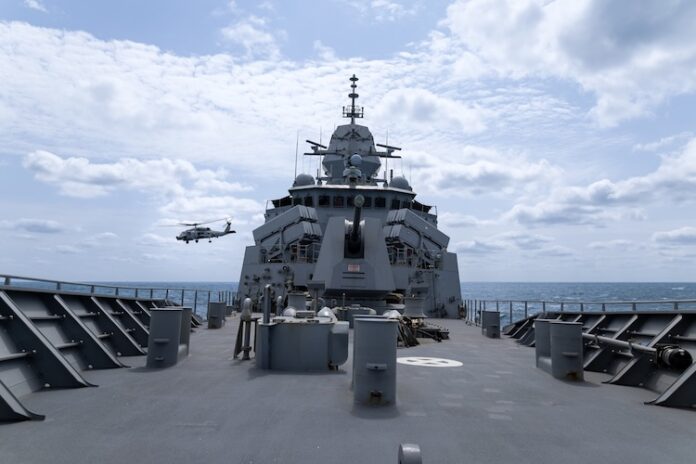
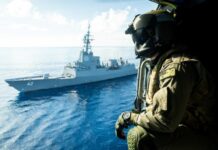
About 400 members of the Australian Defence Force are taking part in BK26. Australia’s contribution to Balikatan includes land forces, medical teams, tactical air and the Anzac-class frigate HMAS Toowoomba.
The exercise brings together more than 16,000 personnel from the Philippines, the US, Canada, France, Japan, New Zealand and Australia. Czechia, Lithuania, the Netherlands, Poland and the UK will participate as international observers, further strengthening multinational collaboration. Participating are training in key mission sets, such as maritime security, targeting, air and missile defence, cyber defence and humanitarian assistance.
The ADF Chief of Joint Operations Vice Admiral Justin Jones said the ADF welcomed the latest opportunity to contribute to Balikatan,
“The Philippines is one of our closest partners and friends, and our defence relationship continues to deepen under our strategic partnership. Exercise Balikatan reflects the depth of our defence relationship with the Philippines and the United States, and our shared commitment to maintaining peace and stability in the region.
The US contribution includes units of Destroyer Squadron (DESRON) 7 and Task Force (TF) Ashland with embarked Marines from I Marine Expeditionary Force.
Commodore DESRON 7,Captain John Baggett embarked in the Whidbey Island-class amphibious dock landing ship USS Ashland (LSD 48) is the Multinational Maritime Exercise Task Group commander. MME units are Ashland, the US Coast Guard cutter USCGC Midgett; Philippine Navy landing platform dock BRP Tarlac, Miguel Malvar-class guided-missile frigate BRP Miguel Malvar and Jose Rizal-class guided-missile frigate BRP Antonio Luna; JMSDF Hyuga-class helicopter destroyer JS Ise, Murasame-class destroyer JS Ikazuchi and Osumi-class tank-landing ship JS Shimokita; Royal Canadian Navy Halifax-class frigate HMCS Charlottetown (FFG 339) and HMAS Toowoomba.
Immediately prior to BK26, Ashland, Toowoomba and Charlottetown conducted a routine multilateral transit through the South China Sea in accordance with international law.
The RAN frigate is undertaking a Regional Presence Deployment in the Indo-Pacific region. The Chief of Joint Operations, Vice Admiral Justin Jones stated,
“We remain steadfast in our commitment to the South China Sea being a peaceful waterway where international law is respected and adhered to, and which remains open for trade. This routine deployment demonstrates Australia’s ongoing commitment to regional security and highlights how we work alongside like-minded allies and partners to uphold a peaceful, stable, and prosperous Indo-Pacific. The Australian Defence Force has operated in the region for decades and our vessels and aircraft continue to uphold international law during freedom of navigation and overflight, particularly the United Nations Convention on the Law of the Sea.”
Sources: The Armed Forces of the Philippines (AFP), ADF & USN