
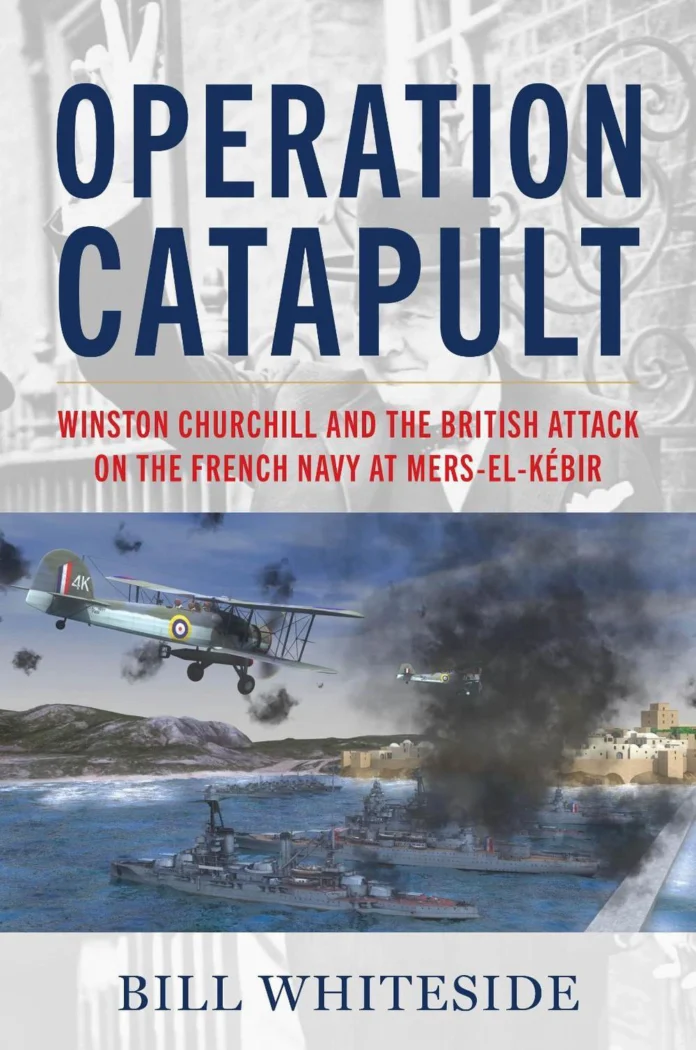
Operation Catapult. Winston Churchill and the British Attack on the French Navy at Mers-el-Kebir. By Bill Whiteside. Naval Institute Press, Annapolis, Maryland, 2026 ISBN 978-1-68247-969-8 (hardcover). ISBN 978-1-68247-968-1 (eBook)
Reviewed by David Hobbs
Bill Whiteside is a member of the International Churchill Society, formerly known as the Churchill Centre, which has offices in the UK and USA. For thirty years he followed a career in sales and marketing before becoming both a writer and researcher, focusing his attention on Winston Churchill and the Royal Navy.
His particular interest, which led him to write this book, is an event known to the British as Operation Catapult, the attack by the Royal Navy on French warships at Mers-el-Kebir, only weeks after Churchill became UK Prime Minister. Whiteside has a BS degree in Management from the University of Notre Dame, Indiana, a private research university founded in 1842 and his home is in Lancaster, Pennsylvania. His book describes a remarkable series of events with skill and enthusiasm and its eleven pages of bibliography testify to the depth of his research.
At 1754 on 3 July 1940 a Royal Navy task force, Force H, opened fire on the French Navy’s Force de Raid moored in Mers-el-Kebir on the Algerian coast just to the west of Oran. Only days before the two navies had been allies but Force H was formed to prevent French ships from falling into German hands. It included the battlecruiser Hood as its flagship together with the aircraft carrier Ark Royal and the battleships Valiant and Resolution. The Force de Raid included the modern battleships Dunkerque and Strasbourg together with older battleships Provence and Bretagne and the seaplane carrier Commandant Teste. All were ‘Mediterranean moored’ with their sterns against the breakwater that ran from the fort that gave the harbour its name with their bows pointing towards the shore, away from the sea. None of the French ships were at short notice for steam or immediately ready for action.
The tragic events that had unfolded on that day followed the German attack on France and the Low Countries in May 1940 which had effectively defeated the French Army by early June with heavy casualties. The French Government collapsed after fleeing Paris and on 9 June 1940 a new French administration under Marshal Philippe Petain asked the Germans for an armistice with the condition that it would only accept if Germany offered honourable terms. It did so regardless of an earlier agreement between the UK and France that neither government would seek peace terms independently without first consulting the other. Petain thought only of ending France’s suffering and probably believed that after the evacuation of the BEF from Dunkirk the UK would itself collapse in the near future. He was not thinking in terms of the undefeated French Navy or of the powerful Royal Navy that Hitler needed to defeat if he tried to invade Britain. Churchill, who had only become Prime Minister on 10 May 1940 was well aware of the potentially disastrous consequences that would follow if modern French battleships such as the Dunkerque and Strasbourg or the incomplete but potentially powerful Richelieu and Jean Bart fell into German hands to be combined with the Kriegsmarine and used against the UK.
Churchill was the driving force behind the immediate steps taken to ensure that this could not happen. The Force de Raid was in a French naval base but other powerful French ships were in British bases and had, until days earlier, been operating alongside the Royal Navy and in many cases under the orders of British senior officers. Different methods had to be evolved to deal with individual situations and in explaining events as they unfolded Whiteside describes the various individuals who became involved with both clarity and understanding. Among these was Admiral of the Fleet Francois Darlan, the charismatic and popular chief of the French naval staff who, amid the turmoil, moved to his birthplace near Nerac, south east of Bordeaux in what was by then France’s free zone unoccupied by the Germans after the armistice. This meant that he had to rely on a radio truck and the local post office as his communications centre, putting him effectively out of immediate touch with the senior officers of his fleet who needed quick answers as events unfolded. In Alexandria Admiral Cunningham managed to agree a deal about the future of the French warships moored there after face-to-face dialogue with Vice Admiral Rene Emile Godfroy, the senior French officer on the spot. In Plymouth and Portsmouth French ships were seized in a series of dawn raids, in one of which one French and 3 British sailors were killed. However, it was the Force de Raid in its defended French base that presented the greatest problem. Vice Admiral Sir James Somerville had been placed in charge of Force H and he chose Captain Cedric ‘Hooky’ Holland RN, the Captain of Ark Royal who had been, until earlier in 1940, the British Naval Attache in Paris to act as his intermediary with the Force de Raid’s commander, Admiral Marcel-Bruno Gensoul. Holland was bilingual in English and French and knew both Darlan and Gensoul well but the straightlaced Gensoul took offence that an officer significantly junior to him in rank had been given the task. Holland was taken close inshore in the destroyer Foresterand entered the harbour in its motor boat. At first Gensoul refused to see him and hours were lost while he waited with his boat tied to a buoy while the French Flag Lieutenant relayed messages back and forth. Meanwhile Churchill demanded that Somerville take action and Gensoul prevaricated, perhaps thinking that the British were bluffing. When time ran out and Force H opened fire Holland was in a motor boat, just making his way out of the harbour having tried to avert disaster until the very last minute.
There are thought provoking passages in this book that are as relevant today as they were in 1940, not least the different interpretations that men on opposing sides may place on cease fire agreements and armistice proposals. The failure of some senior officers to act on their own initiative or to comprehend the wider aspects of conflict are also apparent. One can but wonder what would have happened if Gensoul had accepted one of the British proposals to sail to the UK and carry on the fight or to sail to the French West Indies and gain time for his force to take stock; both were proposals put to him by Holland. Had he done so, might it have been Admiral Gensoul and not Brigadier Charles de Gaulle who came to be revered as the saviour of France’s honour?
In summary, this is a gripping account of one of the most unusual and ultimately tragic actions of the Second World War. Whiteside concludes it by observing that Churchill was fighting an existential war and, given the evidence before him on that fateful day in July 1940 he could not risk powerful French battleships falling into German hands. From that day onwards there was certainly no more talk of a weak Britain having inevitably to seek terms for surrender like France. Operation Catapult now has a place on my bookshelves and I thoroughly recommend it.


Thank you David for this excellent clarification of the events described in the new book. I have always thought that having failed to accept Churchill and Somerville’s honourable and reasonable offers Gensoul bears responsibility for the deaths of France’s sailors. He had an absolute responsibility to evacuate those immobile ships alongside at Mers el Kebir before the time he had been given by Holland expired. That way he would have discovered whether Churchill was bluffing or not without his men being bombarded and killed on board. He lost all sense of proportion and was out of his depth dealing with a matter which was not about his honour and reputation. It was about humanity and the lives of the thousands of men under his command. His failure cost 1297 French servicemen their lives and two crewmen of the RN FAA. All unnecessary deaths had Gensoul sailed to continue the fight with his RN ally. What a contribution those French ships could have made in the years when the RN was so badly stretched and needed more combat capability than it had globally.