By Tom Sharpe*
All eyes watching the Iran war are still, rightly, on the Strait of Hormuz.Tehran has controlled it since March 1, only allowing a handful of chosen ships to pass via a newly laid out shipping route through Iranian territorial waters. Decades of maritime understanding have been rewritten overnight. Now the US has imposed its own blockade and will interdict, by force if necessary, the few ships that the “Tehran tollbooth” has permitted to pass.

A major factor in the discussion is the threat of mines – one of the most significant naval weapons in all wars. Mines were used during the Tanker Wars, have been used by Russia in the Black Sea, and Ukraine has mounted an effective limpet mining campaign in various places.
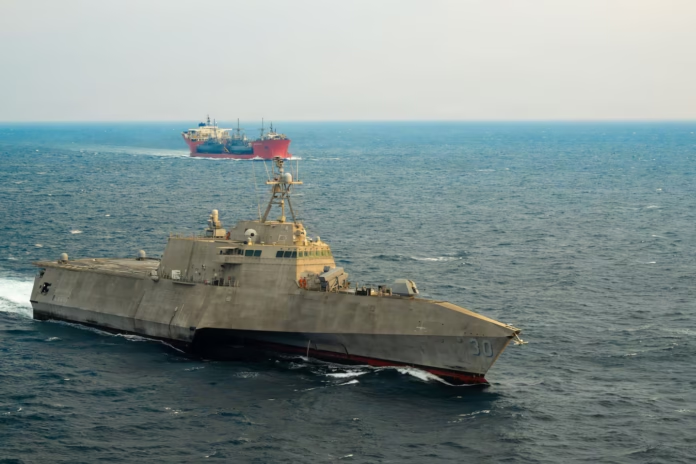
The Avenger-class ships are specialist, if old, mine-countermeasures vessels: 224ft long, displacing 1,312 tons, with wooden hulls sheathed in fibreglass to minimise magnetic signatures. Built in the late 1980s and early 1990s, they are slow (14 knots) but purpose-designed for hunting and destroying moored and bottom mines using sonar and remotely operated vehicles.
They are also capable of old-school sweeping operations. It’s unfortunate that the remaining US Avengers are having to make long voyages to the Gulf: their non-magnetic engines tend not to cope well with long passages.
The Avengers’ age shows – the four that were forward-deployed in Bahrain were decommissioned last year after three decades of Gulf service – yet they remain the US Navy’s best platform for the task. Exactly as we in the Royal Navy did, the US Navy saw the age of these ships and elected not to replace them, instead putting all their efforts into various technological and autonomous solutions. As with us, these new solutions aren’t quite ready come the hour of need.
First, they didn’t need to. They had control of the strait anyway. Save the mines for a rainy day. Second, there is always the risk with an offensive mining campaign that you will sink ships that you didn’t actually want to sink. Why risk that when you have control anyway?
Third, I’m certain that had they laid mines then they would have shown us. A short video of a mine being laid would have been released. Fourth, I’m pretty sure the US Navy wouldn’t have sent two extremely expensive Arleigh Burke-class destroyers with nearly 700 sailors aboard through the Strait the other night if there was a genuine mine threat.
Nevertheless, my believing this and shipping companies believing it are two different things and a greater level of assurance is now required if shipping is to resume.
We now face a double blockade. Iran’s “Tehran toll” – extortion backed by the threat of violence – has slashed daily transits from around 130 to single digits. President Trump’s naval blockade of Iranian ports, announced this week, aims to choke whatever is left over and therefore the regime’s revenue. Tactically it is working with multiple vessels turning around and heading back into the Gulf without the US Navy having to board them.
What happens when one vessel flying the Chinese flag refuses to turn around remains to be seen. It might be even more interesting if it had a Chinese warship escorting it. For now, vessel throughput is zero. The lurking threat of mines plays into this.
Britain is spinning up RFA Lyme Bay, a Bay-class auxiliary, for potential use as a mothership for autonomous mine-hunting drones and uncrewed systems. Like HMS Dragon, the destroyer that would presumably be sent with her for protection, she is doing this from a cold start and is therefore taking her time.
Hopefully we will see her going through Suez and heading to the Gulf of Oman to plug into the US group there shortly. The refrain from the Government that this isn’t our war rings hollow here. Freedom of navigation is absolutely our war as it is the principle on which global trade depends. We are an island and everything comes and goes by sea – often enough via seabed cable or pipeline rather than in a ship, but the principle is the same.
Allow Iran to end freedom of navigation in the Strait and not only will prices spike – we are a long way from seeing the worst of this – but then every other choke-point immediately will become a free-for-all. We should be doing whatever we can to help. The Prime Minister corralling a coalition is a good step in this direction, but he should also be directing the actual hardware we have into the region as soon as possible.
As Jerome Starkey has put it in The Sun – and requoted by President Trump – “If hot air was a weapon, Starmer would have rearmed Britain – but words don’t win wars”. Memes and bumper stickers to follow.
The Avengers assembling, and Lyme Bay’s slow conversion into a possibly capable MCM mothership, shows that both navies were too keen to get rid of their minehunters in favour of unproven and unready new technology. Let’s hope I’m right and this time there isn’t a big mining problem to deal with.
*Tom Sharpe OBE served for 27 years as a Royal Navy officer, commanding four different warships
The article first appeared in The Telegraph.