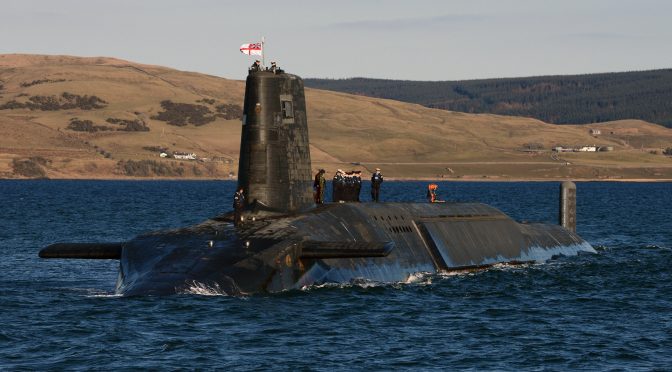
When a Vanguard-class submarine returned to Faslane this week after around 205 days at sea, it was a testament to the endurance and dedication of the crew. However, the more uncomfortable story is what recent record-breaking patrol lengths actually say about the state of Britain’s nuclear enterprise, and it isn’t a flattering picture, UK Defence Journal reports.

Maintenance periods have lengthened significantly, which has forced patrols to extend in order to sustain the Continuous At Sea Deterrent. The arithmetic isn’t complicated here: if one boat is stuck in a delayed refit for longer than planned, the boats that are still operational have to stay out longer to cover the gap.
This is partly because ageing submarines become harder and more expensive to maintain, with unplanned defects becoming more frequent and the schedule margin for everyone else getting thinner as a result. For example, HMS Vanguard’s deep maintenance and refuelling overran by four years, which, again according to the Nuclear Information Service, pushed back the planned maintenance of HMS Victorious and generally piled more pressure onto the other boats, cascading through the whole programme.
What’s being done?
First Sea Lord General Sir Gwyn Jenkins visited Faslane in January 2026 to launch the Submarine Maintenance Recovery Plan, saying that “submarine maintenance throughput needs to drastically improve” and calling for “a radical engine for change in the middle of our enterprise.”
In the short term that’s meant creating deployable engineering workshop space at Clyde using containerised facilities, adding around 90 square metres of additional workshop capacity fairly quickly, alongside further temporary facilities at an undisclosed location elsewhere.
The plan also tries to address a structural problem where multiple teams were working on different parts of the issue without enough authority or resources to actually fix the system as a whole.
Looking further out, the Clyde 2070 infrastructure programme, formally launched in July 2025, is focused on modernising Faslane over the long term to support the Dreadnought class and eventually SSN-AUKUS submarines, with £250 million committed over the first three years of what is expected to be a multi-decade effort.
The Ministry of Defence recently confirmed that the Royal Navy’s long-planned additional fleet docking capability is now formally being delivered through Programme Euston, with the aim of providing new out-of-water engineering capacity at HM Naval Base Clyde in the early 2030s. In a written parliamentary answer, Defence Minister Luke Pollard said Programme Euston is the Navy’s solution to the requirement for additional fleet time docking, a capability seen as increasingly critical to sustaining the UK’s submarine force.
He added that the next major milestone will be the submission of a Programme Business Case in mid-2026, after which timelines will continue to be reviewed through the Ministry of Defence’s major programmes portfolio. The department declined to provide more detailed delivery schedules, citing commercial and operational sensitivities.
The biggest long-term fix is probably the Dreadnought class itself, which is designed from the outset with the lessons of the Vanguard era in mind and is intended to be easier to sustain, with modern infrastructure and a trained workforce ready to support it when it arrives. A new Trident Training Facility Extension opened at Faslane in March 2026, ahead of schedule, which will train up to 130 Royal Navy submariners for each of the new boats, with the first intake expected later this year.
Whether the recovery plan delivers improvements quickly enough to meaningfully shorten Vanguard-era patrols before the class retires is probably the critical question hanging over all of this.
The long-term solutions carry their own risks though. One of the main causes of the current pressure traces back to a decision made in 2010, when the Cameron government delayed main gate approval for the Successor programme by five years, reportedly saving around £750 million in the short term while adding costs running into billions over the longer run and leaving the submarine force under growing strain throughout the 2020s.
The Clyde Infrastructure Programme itself holds an Amber delivery confidence rating, reflecting ongoing problems with resource availability and inflation, and balancing infrastructure work with live submarine operations at the same site is a significant logistical challenge in itself, as is attracting and keeping people with the right expertise in nuclear operations and project management.
The same workforce and capacity pressures that have pushed patrol lengths to record levels are bearing down on the programmes that are supposed to fix them, and while the recovery effort is real and the investment is substantial, the margin for further slippage is pretty thin.