
By CAPT Paul D Pelczar, OAM RAN*
By the year of my enlistment, HMAS Melbourne — the flat top — had already been decommissioned, taking with it my teenage ambition to serve on the flight deck of an aircraft carrier. The Cold War still provided much of the strategic backdrop. Surface combatants and submarines were all-male crews. My first sea posting sailed from the newly established HMAS Stirling, then home primarily to two surface combatants, a lone submarine and a survey vessel as the two-ocean policy began to take shape.
Naval communications involved flags, flashing light and teleprinters. Movies at sea came on VHS tapes, some pirated, watched on recorders strapped atop lockers. A mobile phone wasn’t very mobile and, for most of us, much of the technology commonplace today still belonged to Hollywood science fiction.
Forty years later, much of that Navy has disappeared or, in the case of Fleet Base West, grown exponentially. Information itself has become an operational environment, sailors carry access to the world in their pockets, and many of the technologies and assumptions familiar to me in 1986 have gone with it.
It is tempting to describe those 40 years through ships, postings, deployments and operations. They provide a chronology, but don’t necessarily explain what it felt like to live through the changes.
Curiously, movies do.
Films have been an unlikely thread through my naval service. Some influenced career decisions; others became attached to specific events, particular ships, operational deployments or special interactions with people. A few were the soundtrack to something much more significant occurring external to the superstructure, or the submarine hull.
Even before I joined, The Cruel Sea, Ice Station Zebra and The Sand Pebbles helped create my romantic idea of adventure at sea. BBC’s Warship and ABC’s Patrol Boat added a contemporary tone, reflecting something of my father’s naval world. The Bridges at Toko-Ri, reinforced by nightly coverage of the Falklands conflict, convinced me that an aircraft carrier flight deck was where I wanted to be.
Reality intervened before I enlisted.
With Melbourne gone, another figure familiar from naval films caught my attention: the signalman, usually somewhere on the upper deck close to the bridge and the action — from The Battle of the River Plate and Sink the Bismarck! to the rather less heroic depiction in The Last Detail.
So I aspired to be one and loved it.
The 1980s for me meant regular Southeast Asia rotations in various Destroyer Escorts based out of HMAS Stirling, in a Navy where connection with the world beyond the ship was largely determined by distance. Communications were dominated by chattering rows of teleprinters and telex machines. Then, in late 1987, among dozens of them, appeared a few PCs in the basement of what is now Russell Building 8. Their green text on dark screens looked remarkably like something connected to WOPR in WarGames.
During the first Gulf War, Televising CNN in Navy Office’s Main Signal Office could usually inform us of a significant event before flash traffic arrived through those teleprinters. What seemed novel at the time foreshadowed a fundamental change in the relationship between information and operations.
A Navy News article and the 1990 release of The Hunt for Red October rekindled an interest in submarines and languages. Selection for Russian language training followed, then electronic warfare and signals intelligence. A career that began among teleprinters, flag hoists and flashing lights was moving towards information as both intelligence and operational effect.
The Cold War ended. Russian — together with arcane skills such as barred Morse — briefly seemed destined to become an historical footnote. Events since then have suggested otherwise.
Submarine deployments introduced me to the brevity of the dolphin code, family-grams and reaffirmed the impact on morale by a delayed mail drop. Watching Das Boot while actually submerged in an Oberon-class submarine added a degree of authenticity: Orion and her sisters were only a generation removed from the submarines depicted in the film.
On HMAS Geelong’s South West Pacific deployment, Top Gun competed with True Lies for most-watched movie. Pirated VHS tapes were superseded by equally dubious DVDs, including some poorly dubbed rabbits acquired in Southeast Asian ports. There was Con Air, dubbed in Japanese aboard Isoyuki, and later Star Wars on HMAS Darwin’sflight deck while transiting a becalmed Strait of Malacca — an ephemeral 3D spectacle.
Concurrently, 300 baud was considered high-speed communications. At Canungra, working with the Army, the routine after logging onto the classified system was to lock the terminal, lock the compartment and make a brew while we waited for the system to complete its startup due to starved bandwidth compounded by considerable latency.
The 2000s brought operational deployments to the Middle East Region, especially tours in Iraq, where digital connectivity remained constrained through two one-hour ‘scheds’ daily; Collins-class deployments could now provide brief transmission windows while on station; and USS Blue Ridge, where an American communications technician complained that he had only 256 kilobits rather than 512 to utilise while Australian ships routinely worked with 64 kilobits and still relied heavily on HF rather than satellite for long-range communications.
Some memories required no screenplay. I was submerged during Port Arthur, 9/11 and the Bali bombings, receiving incomplete and delayed information — sometimes for weeks. There was The Last Samurai with a US shipmate in Yokosuka before returning to USS Kitty Hawk with Mt Fuji visible in the twilight; and Baghdad, where an incoming IDF incident interrupted my American colleagues’ viewing of Shrek 2.
The following decade included time in USS Ronald Reagan, including a delayed fulfilment of my teenage ambition to launch from — and land on — an aircraft carrier; and later HMAS Canberra as the Information Warfare Officer on the embarked staff, reflecting the growing importance of information to operational effects.
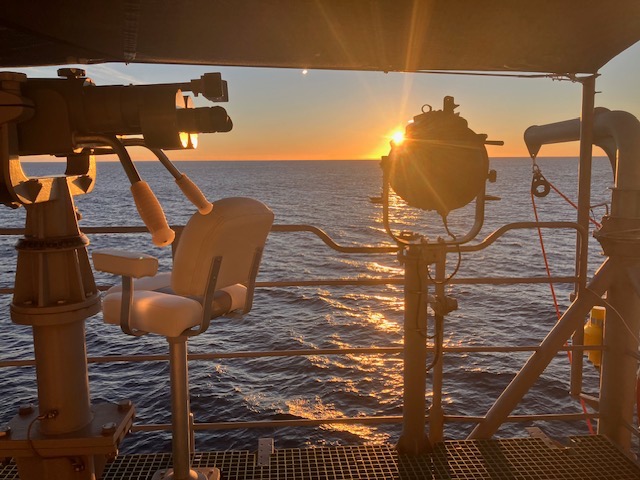
Most recently, HMAS Perth provided my final time at sea. Familiar flag bins and ten-inch signalling lamps remained, if little used; mailbags had disappeared, while I could routinely check personal email through the ship’s Wi-Fi.
Across those decades, the Navy’s relationship with information changed more dramatically than its ships. More recently, my work moved into influence activities: understanding audiences, narratives and how information shapes behaviour and decisions. There is a certain symmetry in moving from communicating information by semaphore and flashing light to working on how information itself can influence human decisions.
The transformation is equally apparent in life at sea. A VHS tape was communal almost by necessity — full messdecks dictated it. Today, shipboard Wi-Fi provides a connection with home unimaginable during my first deployments.
For families the change was greater still. Lost or delayed mail, dated newspapers and expensive, generally extremis, RADPHONE calls transitioned to email, messaging and video calls. Technology shortened the distance, but didn’t remove it. Families still absorb deployments, absences, postings, uncertainty and compromises that don’t appear in a service record. Forty years of naval service aren’t experienced by the member alone.
The RAN of 2026 bears remarkably little resemblance to the Navy I enlisted in September 1986. Surface combatants and submarines are no longer exclusively male. Murray code, carbon copies, overhead projectors and chinagraphs vanished. The signalman category was amalgamated. Semaphore disappeared and flashing light became a rarity. Those few green-screen computers became a world of networks, code, algorithms and machine-speed data exchange, increasingly enhanced by AI.
Information changed from something we struggled to receive quickly enough into something we must understand, verify, protect and contest at speed, scale and frequency.
The movies changed too. VHS became DVD, then streaming. AI is now changing naval power in ways that would have seemed improbable to me as a young sailor in 1986. I doubt today’s young sailors can predict where those technologies will take their careers any more accurately than that young signalman encountering green-screen PCs in late 1987 could have predicted his.
But technology doesn’t make a Navy by itself.
The thread remains people: those who adapt to technology, improvise when it doesn’t work, complain about it when it does, and build relationships in messdecks, cabins and wardrooms that turn individuals into lifelong shipmates.
Movies helped shape some of my earliest impressions of naval service. Over the following 40 years, they became something different: markers of ships, deployments, people and events, and an unlikely thread through a Navy changing around me — and me with it.
* Over 40 years in the RAN, Captain Paul Pelczar’s service has spanned traditional naval communications, signals intelligence, information warfare and influence activities. His writing draws on that experience to examine how technology, information and people continue to shape maritime operations and naval service.



Sincere congratulations on your well deserved promotion to Captain, Paul, I enjoyed reading about your lifes expriences over 40 years service in the RAN. Well done Paul you ave done very well since we first met at Russell Offices in Building D back in your early days.
Congratulations Capt Pelczar, an oustanding career amongst all the change!
Great perspective on the technology changes impacting naval operations over the past 40 years. Your personal insights are shared by many. Thank you for your service, Shipmate.
Congratulations to you Paul. Linguists rock!!
Paul, a great article. Comms and IT have certainly changed. If we explained what we have now to our former selves, we’d think we were talking about Star Trek. Another aspect that has gone the way of the dodo is Pay Day payments in cash. I do remember a certain DE in Tonga on the way back from RIMPAC in the mid-1980s losing most of their AS currency overboard when the LUB (a somewhat less seaworthy vessel than the RHIBs that replaced them) capsized.