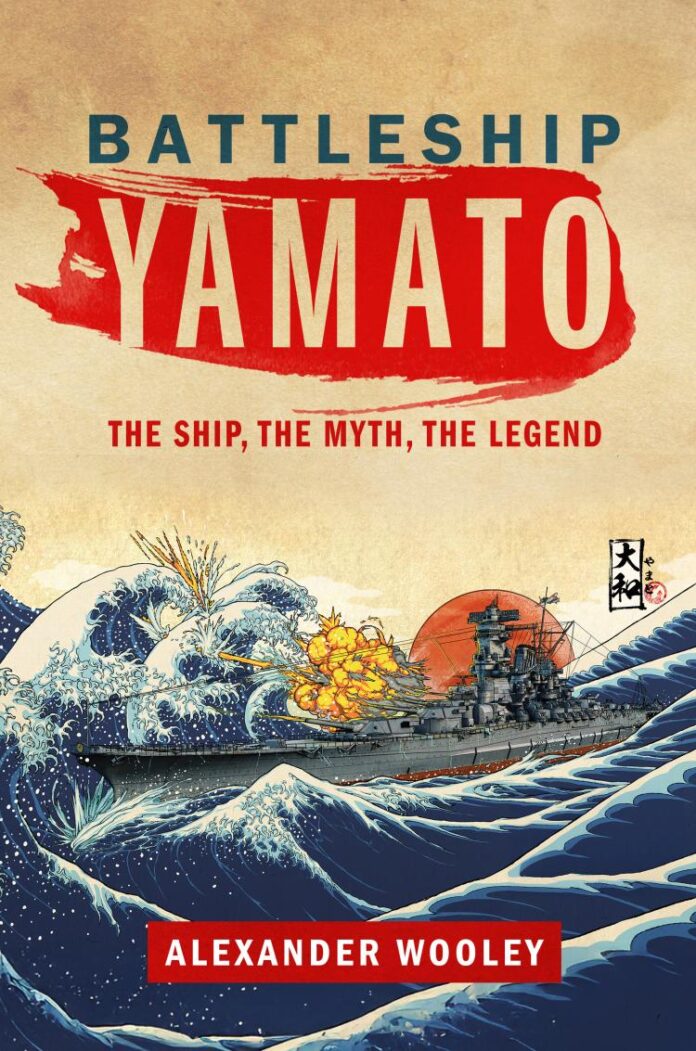
Battleship Yamato.The Ship, the Myth, the Legend. By Alexander Wooley. Naval Institute Press, Annapolis, MD, 2026.ISBN 979-8-89241-020-5 (hardcover). ISBN 979-8-89241-022-9 (eBook)
Reviewed by David Hobbs
The US Naval Institute describes Alexander Wooley as a former Royal Navy officer who is now a director at AidData, an international development research laboratory that forms part of the College of William and Mary at Williamsburg, Va, where he lives.
He has written a number of articles on naval and maritime issues which have been published in The Washington Post, The New York Times and others in addition to the US Naval Institute’s Proceedings. In his acknowledgements Wooley explains how he and his cousin used to assemble plastic model warships of the World War II era in their home town of Bristol, researching old copies of Jane’s Fighting Ships in Bristol’s Central Library to gather authentic details. His interest in the subject has never wavered and he describes the research and compilation that led to the publication of this book as ‘the journey of a lifetime’. In the resulting work Wooley not only covers the life and loss in action of the most powerful battleship ever built but he goes on to offer fascinating insight into the ship’s cultural legacy which survives into twenty-first century Japan with no sign of ending. The book is, therefore, as much about Japanese culture both before and after 1945 as it is about the ship itself and I found a great deal within its pages that expanded my understanding of both the Pacific war and the differing attitudes of the Japanese population towards it after 1945.
Slightly more than half of the book describes the physical ship, starting logically with its conception, design and construction. Wooley makes a number of interesting observations including the possibility that the design of Yamatoand her sister ship Musashi reflected a Japanese reaction against the humiliation it had felt over the terms of the Washington Naval Treaty. Another point well made that these ships were designed when the Imperial Japanese Navy anticipated having air superiority over any sea battle. By the time Yamato was sunk by US carrier-borne aircraft in April 1945 this was no longer the case; despite her carefully designed armour and extensive gun batteries she was vulnerable.
This book differs from other descriptions of this remarkable ship, however, by devoting its later chapters to descriptions of the myths and legends that have grown about its name. Yamato is an ancient name for Japan in much the same way that Albion or Britannia are names applied historically to the British Isles and this may have helped the later image to evolve. Wooley begins the second portion of the book by describing the search for, and discovery of Yamato’s wreck on the bottom of the East China Sea to the north of Okinawa. It is in two sections with the IJN’s chrysanthemum emblem still visible on the bow. This gives him the opportunity to describe how the Japanese seek to commemorate their war dead without glorifying the militaristic regime that held sway between 1931 and 1945. He moves on to describe Japanese commercial model makers such as Tamiya which began to make 1:700 models of IJN warships including Yamato and her sister ship from 1960 to the present day. From there Wooley describes the Kure Maritime Museum which most Japanese identify as the Yamato Museum situated in Kure close to where the ship was built. This $US65 million facility opened in 2005 and its central atrium contains a 1:10 scale model of the ship which 86 feet long and took two years to build. It depicts the ship as she was in April 1945 and can be viewed from several different levels including underneath. In 2023 the museum attracted 800,000 visitors making it one of the most popular naval museums anywhere in the world.
Beyond keeping the memory of its physical structure alive, Japanese culture has absorbed Yamato into a number of art forms including film, literature, art, animated films and the anime and manga genres of animation and cartoon and these are all described and discussed. The team that created the Godzilla film franchise, for instance, have even created Space Battleship Yamato in which the ship is made capable of travelling through space at light speed with orders to save the world from interstellar nuclear radiation. In several of the manga manifestations the ship transforms into sexualised female characters in a manner reminiscent of the Transformer toy story and film franchises. All of these remain hugely popular in Japan and are likely to continue to be so. A digitised Yamato figures prominently in the World Of Warships competitive wargames which have an expanding worldwide reputation.
In conclusion, Wooley notes that while the names of many other IJN warships have been used by today’s Japanese Maritime Self Defence Force, the name Yamato never has been. This book represents an ideal way of describing Japan’s present relationship with its uncomfortable recent past and the author has done an excellent job of describing it from many different viewpoints. This is not an easy thing to do and potential readers must not be deterred by the inclusion of myths and legends in the latter part of this book and the discussion about Yamato’s inclusion in contemporary art forms. They have a part to play in helping readers to understand Japan today in a way that echoes the producers of Star Trek decision to call their space ship the USS Enterprise; a ship name with which the target audience would be familiar. I chose to review this book because, as a student of the Pacific War, I thought it might have something to offer about the most powerful battleship ever built. It certainly had that, and much more than that; it set me thinking about Japan itself and its evolution since Commodore Matthew Perry USN arrived in Tokyo Bay in 1853. This thoughtfully written book has much more than you might imagine to offer a diverse readership and I thoroughly recommend it.