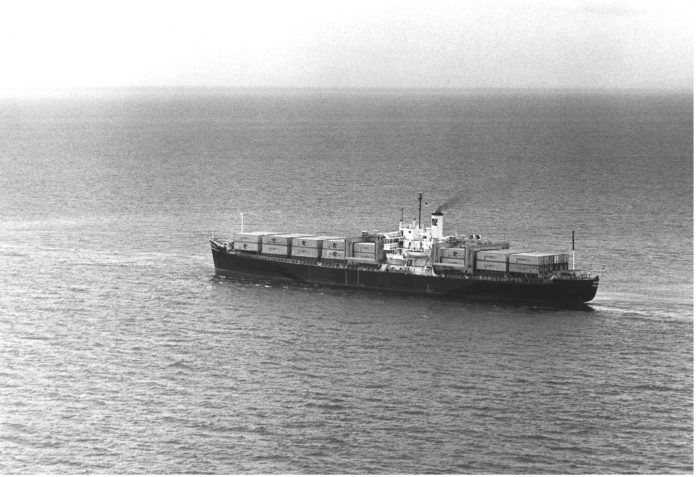
By Clive Wiliams*
In the immediate aftermath of the Vietnam War the United States faced a sudden and unexpected challenge at sea. On 12 May 1975, less than a month after the fall of Saigon and the Khmer Rouge’s occupation of Phnom Penh, Cambodian forces intercepted and boarded the American container ship SS Mayaguez in the Gulf of Thailand.
What followed over the next three days was a hastily assembled American joint operation to recover the ship and its crew. For naval professionals, the incident remains a compelling case study of rapid maritime response, integration of surface, air and amphibious assets, imperfect intelligence, and rushed planning.
The crisis began in the early afternoon of 12 May when Khmer Rouge Swift boats[1] approached the Mayaguez near Poulo Wai island in what Cambodia claimed was Cambodian waters — but which the US claimed was international waters. After firing across her bow, Khmer Rouge boarding parties took control of the Mayaguez and directed her towards Cambodia’s Koh Tang Island, 48 kilometres from Poulo Wai Island[2].
The ship’s mayday call as she was being intercepted was quickly relayed to Washington[3]. US Navy P-3 Orion maritime patrol aircraft from bases in the Philippines and Thailand were scrambled to locate the Mayaguez[4]. They located the vessel in the early hours of 13 May. One aircraft was struck by a Khmer Rouge .50-calibre round. The P-3s continued to monitor the Mayaguez’s position as she was being moved to an anchorage off Koh Tang Island[5].
US naval forces were ordered to converge on the area at high speed. The Knox-class destroyer escort USS Harold E. Holt [6](DE-1074) and the Charles F. Adams-class guided-missile destroyer USS Henry B. Wilson (DDG-7) raced toward the Gulf of Thailand from the Philippine Sea, accepting the risk of arriving low on fuel. The aircraft carrier USS Coral Sea (CVA-43), which was heading toward Australia with Carrier Air Wing 15 embarked, was diverted northward.
By the morning of 15 May an operational concept had taken shape. A party of Marines would board the Mayaguez from the Harold E. Holt while a larger Marine force assaulted Koh Tang Island where the Mayaguez crew was believed to be held. The decision to land US Marines on Koh Tang was made at the highest political level in Washington, with President Gerald Ford giving the final authorisation. Henry Kissinger and the Joint Chiefs of Staff played influential roles. What makes the command arrangement interesting is that political and military leaders in Washington were directing a complex military operation thousands of kilometres away, with imperfect intelligence and a lack of consensus over what action should be taken.
At approximately 0615 on 15 May, three USAF HH-53 helicopters delivered a boarding party of Marines, Military Sealift Command volunteers, explosive ordnance disposal technicians, and a linguist to the Harold E. Holt. The destroyer then closed in on the Mayaguez, which had been saturated with tear-gas munitions by A-7 aircraft. At 0725 the Harold E. Holt came alongside the Mayaguez and the boarding party crossed over. There was nobody on the Mayaguez, her crew having been taken off the ship – and moved to another island – the previous day. The Harold E. Holt subsequently took the Mayaguez under tow.
At the same time the United States planned to land approximately 230 US Marines on Koh Tang Island to rescue the crew of the Mayaguez. The force was drawn principally from Battalion Landing Team 2/9 (2nd Battalion, 9th Marines) to be inserted by USAF helicopters flying from U-Tapao Royal Thai Navy Airfield in Thailand. The aircraft were a mix of CH-53 “Knife” helicopters (from the 21st Special Operations Squadron) and HH-53 “Jolly Green Giant” helicopters (from the 40th Aerospace Rescue and Recovery Squadron).
The geography of the island gave the assault force limited options for gaining access. Koh Tang is a small, heavily forested island. Near its northern tip the land narrows into a thin “neck” or isthmus. On either side of that neck are two small coves with beaches: West Beach (northwest side of the neck) and East Beach (northeast side of the neck). These were the only places suitable for landing large helicopters. The rest of the island is dense jungle, rocky coastline, or otherwise unsuitable for landing helicopters.
At 0615 on 15 May, eight helicopters carried in the first wave of 180 Marines, but intense Khmer Rouge fire prevented some of the helicopters from landing. Approximately 130 Marines and five USAF crewmen were successfully landed in the first assault wave. Helicopters later brought the total landed to 230 Marines. All insertions were carried out by helicopters onto West Beach and East Beach at the northern tip of the island.
The two beaches are about 300–400 metres apart across the narrow northern neck of the island. They were close enough that supporting fire or airstrikes aimed at the Khmer Rouge positions defending one beach could endanger Marines on the other, and the two groups of Marines could not easily link up under fire.
The original plan was for most of the first-wave helicopters to land on East Beach (believed to be nearer the likely Mayaguez crew location) and a smaller force was to land on West Beach to provide a blocking or support force.
It was soon discovered that East Beach was heavily defended by the Khmer Rouge. Several helicopters were shot down or driven off from East Beach, so most of the surviving aircraft diverted to West Beach. As a result the main body of Marines (eventually around 210) ended up at West Beach. A small, isolated group (about 20 Marines and five aircrew) was stranded on East Beach for much of the day.
American estimates later put the Khmer Rouge force on Koh Tang at approximately 200–300 combatants. The force on the island was better armed and in larger numbers than the Americans had anticipated.
The Henry B. Wilson, arrived off Koh Tang shortly after 0700 and assumed a supporting role. Naval gunfire, together with machine-gun fire from the Henry B. Wilson’s gig, proved valuable in suppressing fire from the Khmer Rouge positions.
Meanwhile, the carrier Coral Sea launched airstrikes against military targets around Kompong Som in mainland Cambodia; some missions were initially delayed or recalled amid confusion in Washington about Cambodian intentions. Later sorties struck coastal installations and Cambodian naval craft. P-3 Orions and other aircraft continued to monitor small-boat movements.
Later on the morning of 15 May the Henry B. Wilson intercepted a Thai fishing vessel flying a white flag. Aboard was the entire Mayaguez crew, unharmed. The Khmer Rouge had apparently released the 40-man crew[7] of the Mayaguez because they wanted to avoid an ongoing confrontation with the United States. Even so, American airstrikes against Cambodian targets continued until later in the day.
The recovery of the Mayaguez crew transformed the mission from hostage rescue to the complex task of extracting the 230 Marines from Koh Tang under heavy enemy fire. Sunset at Koh Tang on 15 May 1975 was at approximately 1820 local time. Shortly afterward, “as darkness fell on a moonless night”, the West Beach extractions began. Determined flying by the remaining helicopter crews, persistent American airstrikes, and surface-ship fire support enabled the Marines to be extracted without further losses. The final helicopter departed Koh Tang at approximately 2020.
Three Marines were inadvertently left behind on Koh Tang during the American withdrawal. They were members of an M60 machine-gun team defending the extreme right flank of the American position on West Beach: Lance Corporal Joseph N. Hargrove, Private First-Class Gary C. Hall, and Private Danny G. Marshall.
The withdrawal was confusing because the helicopters were being subjected to heavy ground fire, the American defence perimeter was contracting as troops were evacuated, and there was a mismatch between Marine commanders’ and USAF helicopter crews’ tallies of how many Marines had been extracted.
About two hours later, a roll call aboard the American ships established that a three-man machine-gun team was unaccounted for. Some Americans already knew three Marines were still on Koh Tang. After the last helicopter had left the island, a USAF command aircraft received a radio transmission from one of the Marines still on the island, asking when their helicopter was coming. The aircraft passed the information to American naval command. The USS Harold E. Holt then moved close to the island to encourage the men to swim out to it. However, two of the three reportedly could not swim, and none made the attempt.
The commander of a 14-man Navy SEAL team aboard the aircraft carrier USS Coral Sea repeatedly requested permission to return to the island to locate the missing Marines. His requests were refused because Washington had ordered the cessation of operations following the recovery of the Mayaguez crew.
What happened to the three Marines? According to a subsequent US Naval History and Heritage Command account and later investigations drawing on Khmer Rouge testimony, Hargrove was captured the following morning by Khmer Rouge soldiers. After a wounded Cambodian soldier died, Hargrove was executed in retaliation. Hall and Marshall reportedly survived for more than a week living on food taken from abandoned American ration packs. They were eventually caught by the Khmer Rouge and taken to the mainland where they were executed[8].
The three men were officially declared dead in 1976, but their remains have never been positively identified or returned to the United States. All three are commemorated on the Vietnam Veterans Memorial in Washington.
The most distressing aspect of the operation for the Marine Corps was the Marines left behind – particularly for a service whose ethos places extraordinary emphasis on never abandoning fellow Marines, even dead ones. Although Marines volunteered to return to search for their missing comrades, Rear Admiral R.T. Coogan declined to authorise a rescue operation because their survival could not be confirmed. Subsequent air searches failed to locate them.
Overall US losses related to the Mayaguez incident totalled 41 dead, including 23 USAF personnel killed in a CH-53 helicopter crash in Thailand and 18 US servicemen lost during the Koh Tang operation. Of the 18, 14 were Marines, two were US Navy Corpsmen and two were USAF personnel. Dozens were wounded.
The helicopter losses during the Koh Tang operation were three helicopters destroyed (CH-53s), four helicopters severely damaged, while six sustained minor damage[9].
Khmer Rouge casualties during the Mayaguez operation are uncertain. Some assessments suggest 13–25 Cambodians killed on Koh Tang itself, with additional losses from boat engagements and mainland airstrikes. Total figures of approximately 47 killed and 55 wounded have been cited. The actual total remains unknown.
Several lessons emerge with particular relevance to naval forces:
Maritime domain awareness and the ability to generate permanent surveillance are critical requirements. The rapid deployment of the P-3 Orions provided the essential picture that facilitated subsequent decisions; without them, the response would have been delayed, and American commanders would have been unaware of Cambodian maritime movements.
The value of surface combatants capable of independent high-speed transit and multi-role tasking – as demonstrated by the Harold E. Holt and Henry B. Wilson. Their boarding, interception, gunfire support, and recovery activities showed the utility of versatile surface vessels in contingency operations far from major fleet concentrations.
The delayed arrival of heavier amphibious and carrier assets underscored the importance of forward posture and contingency planning. Had more capable platforms been closer, options for a more deliberate operation might have existed.
Lack of usable intelligence was a major problem. Accurate assessments of enemy strength on Koh Tang did not reach the assault planners in usable form. The result was an understrength landing against prepared defences.
Air and naval gunfire support were poorly coordinated in the initial stages because of communications problems and the absence of an effective forward air controller until late in the piece.
These deficiencies contributed to later reforms, including the Goldwater-Nichols Act and the eventual establishment of US Special Operations Command, both of which sought to improve joint command arrangements and specialised response capabilities.
For the Royal Australian Navy and similar medium-power fleets, the incident reinforces several enduring principles:
Multi-capable surface combatants remain essential for rapid response in the Indo-Pacific’s contested maritime spaces.
Regular maritime air patrols and the ability to fuse surveillance data into actionable intelligence are essential requirements prior to and during operations.
Joint and combined operations need to practise command-and-control arrangements through realistic training, including testing the interoperability of joint service communications.
Political pressure for swift action must be balanced against the operational risks created by acting with incomplete information.
The Mayaguez operation is an example of the problems caused by armchair strategists. President Ford made the political decisions, Secretary of State Henry Kissinger provided the strategic rationale, and the Joint Chiefs recommended the military course of action. The operational commanders then had to act on the orders from Washington under extremely difficult local circumstances. The disconnect between political direction and military command was a significant contributor to the problems that followed.
The Mayaguez operation achieved its objectives, but the high price paid in American lives illustrated that resolve without adequate preparation can be costly. More than 50 years later, the lessons to be learned from the Mayaguezincident are still relevant for any navy charged with protecting its nation’s distant maritime interests.
*Professor Clive Williams MG is a former military intelligence analyst who was working at the US Army Intelligence Center and School in Arizona at the time of the Mayaguez operation. Intelligence lessons learned from the Mayaguez incident were taught at the school after the event.
Bibliography
- Urey W. Patrick, The Mayaguez Operation, Center for Naval Analyses, April 1977. The principal operational reconstruction, commissioned by the US Marine Corps. It is particularly valuable for the landing, force numbers, aircraft losses, naval gunfire data and extraction information.
- Samuel J. Cox, US Naval History and Heritage Command, H-Gram 091, SS Mayaguez Crisis, May 1975. An excellent historical account, particularly for the chronology, political decisions, and information on the three missing Marines.
- US Department of Defense Inspector General, Report DODIG-2018-061, 22 January 2018. Important for the investigation into Hargrove and the subsequent attempts to recover and identify the missing Marines.
- Jordan J. Paust, The Seizure and Recovery of the Mayaguez, 85 Yale Law Journal 774 (1976). For the international-law and territorial sovereignty issues.
- US Government Accountability Office, The Seizure of the Mayaguez: A Case Study of Crisis Management, B-133001, 11 May 1976. Particularly useful for background on the political and administrative handling of the crisis.
[1]During the Cambodian civil war, the United States supplied the US-backed Khmer Republic government of Lon Nol with military equipment, including Swift boats (Patrol Craft Fast, or PCFs). These were originally designed and built for the US Navy’s operations in Vietnam. The Khmer Rouge acquired their Swift boats by capturing them from the Cambodian navy when the Khmer Rouge took control of Cambodia in April 1975.
[2]The sovereignty issue is particularly interesting because the United States maintained that the Mayaguez had been seized in international waters. Cambodia, however, considered the waters around Poulo Wai to be its own. A 1976 Yale Law Journal analysis examined the competing Cambodian, South Vietnamese and Thai claims and questioned the American government’s assertion that the seizure occurred in international waters.
[3]The US Department of Defense’s historical account records that an unnamed Australian vessel received the Mayaguez’s distress call and relayed it to the Americans. This helped alert Washington to the seizure.
[4]There was no Australian P-3 involvement. Australia’s P-3 Orion detachment at Butterworth began operating in February 1981 under Operation Gateway, almost six years after the Mayaguez incident.
[5]Koh Tang Island is approximately 48 kilometres offshore from mainland Cambodia in the Gulf of Thailand. Koh Tang is relatively small, but substantial enough to have made the 1975 military operation difficult. In area it is approximately 5.9 kilometres², length 6.4 kilometres, maximum width approximately 3.2 kilometres, coastline: approximately 20 kilometres. It is heavily forested, with a rocky coastline and several beaches. There were no permanent civilian inhabitants. The Cambodian military maintained a presence there.
[6] The USS Harold E. Holt (DE/FF-1074) was named after Harold Edward Holt, the 17th Prime Minister of Australia (January 1966 – December 1967). Holt was a strong supporter of the Australia–United States alliance. During his short time as prime minister he deepened military cooperation under the ANZUS treaty and significantly increased Australia’s commitment to the Vietnam War. He is remembered for the famous and controversial phrase “all the way with LBJ,” signalling firm Australian alignment with President Lyndon B. Johnson’s policies.
[7]The US Naval History and Heritage Command records 40 crew members, including: the American captain Charles T. Miller; predominantly American merchant seamen; and several Filipino and other Asian crew members.
[8]These accounts are based on subsequent investigations and information obtained about the Khmer Rouge’s actions. Estimates of the precise circumstances and timing of the deaths of Hargrove, Hall and Marshall vary across sources, reflecting the limited and sometimes conflicting testimony available from former Khmer Rouge personnel.
[9] This is the breakdown recorded in the CINCPAC operational history: Knife 21 – ditched approximately one mile offshore after being severely damaged by gunfire; one aircrewman was lost; Knife 31 – hit by RPGs and crashed in the sea near East Beach, with heavy loss of life, and: Knife 23 – hit by an RPG and crashed at the East Beach surf line.