By Tom Lewis*
- What happened?
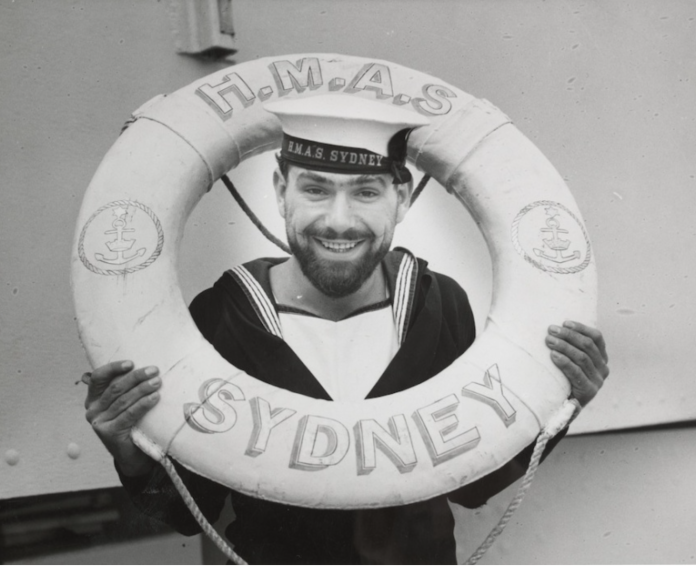
Off Western Australia on 19 November 1941, a large warship, the cruiser HMAS Sydney, disappeared with all 645 on board. German survivors from the raider Kormoran told of a fierce fight where both ships were sunk.
- So some Germans survived and our blokes didn’t. That’s a bit unusual isn’t it?
Very. Sydney was the largest ship, in terms of fatalities on the Allied side, to disappear with all her crew during the war.
- And Sydney was a capable ship?
Very. Sydney was the pride of the fleet, having won a fierce battle in the Mediterranean against a pair of Italian cruisers. Together with five British destroyers, Sydney was well-handled by Captain John Collins in a fight the Italians should have won. She then returned to Australia, and with a new captain, Joseph Burnett, began a program of escort duties and working herself up to full battle readiness.
- What happened, and why should Sydney have won?
Sydney, it appeared, had come very close to the disguised raider, which had had a successful program of sinking or capturing ten Allied ships for nearly a year. Kormoran’s Captain Detmers realised his disguise as a Dutch freighter would eventually be broken, and after intense questioning by Sydney’s flashing light – although not an overflight by her embarked aircraft – dropped his disguising screens and opened fire.
The cruiser’s armament was superior and would have allowed her to hold the raider at extreme range and sink her if necessary. But Sydney came far too close, likely for a visual inspection. Kormoran’s first salvo was lucky: it hit the cruiser’s bridge. But Sydney fought well and both ships eventually sank each other.
- Wasn’t there a story about one deceased man from Sydney being found?
Yes. In her final moments at least one Sydney sailor made it into a Carley float. His body was recovered near Christmas Island, well north of the sinking site about 290 kilometers west-southwest of Carnarvon.
On 6 February 1942 the float was spotted off Christmas Island, then in Allied hands, but expecting attack by Japanese forces. The body was recovered, and buried in the local cemetery, without positive identification.
Many decades later, as the search for the cruiser intensified, pressure grew to connect the ship’s loss with the body, for clues to the mystery. The RAN went to work to find out. In 2006 the remains were exhumed and an incredible 15 year feat of DNA and dental analysis detective work finally identified Able Seaman Thomas Welsby Clark. His duties were likely on the exposed weather deck, explaining why he made it into the remains of the lifesaving equipment, shredded by the intensity of close-range battle.
- So it was a fierce fight, with an unusually high loss of life?
According to Kormoran‘s gunnery officer, Lieutenant Fritz Skeries, over the course of 55 minutes, Kormoran fired 450 rounds from her main armament of 5.9-inch guns, and several hundred from her anti-aircraft batteries. Both ships fired torpedoes: the German claiming a hit, while the Australian’s missed. In the final stages of battle Sydney was being constantly hit by the raider’s gunfire. Soon the cruiser, crippled, limped off to the south-east, on fire, with a flickering glow showing her presence until around midnight, some eight hours after the action had begun.
One aspect of naval service was that if the ship you were serving on was lost suddenly in a heated battle, or in the aftermath as the ship’s company fought desperately to save it, it tended to take a sizeable percentage of its crew with it. This is understandable enough, as many would be “fighting the ship” in combat, or trying to control damage, until suddenly bulkheads, decks, or hatches gave way, and the sea rushed in. The enormous inrush of water added to the dead weight of the ship, and the worse this became the more of a list or pitch there was, which caused more structural collapse, and so on, until a “tipping point” was reached, and the ship suddenly plunged beneath the surface.
- So how was Sydney found?
The federal government supported the HMAS Sydney Search group with wreck hunter David Mearns locating Kormoran on 12 March 2008. Using the survivor accounts of Sydney making off towards Perth in the south-east, the cruiser was found four days later. The wrecks, at a depth of about 2,500 metres, have been extensively visited and photographed.
- Wasn’t there something about the Japanese being involved, three weeks before Pearl Harbor?
Yes. As Sydney had disappeared without trace; she should have won the battle, and as the only witnesses were German survivors – presumed to be lying, for why wouldn’t they? – the rumour-mill went into overdrive. The pace and fury of the developing war pushed such theories to the background, but post-war they accelerated. Matters weren’t helped by hoaxes such as a faked battle diary being found in a bag on a lonely beach – chemically all disproved to be from 1941; but the stories proliferated when a book written by Michael Montgomery, the son of the Sydney navigator, was published in 1981. Who Sank the Sydney? sketched out a variety of German conspiracies, and also suggested the presence of a Japanese submarine.
While Montgomery’s book makes fascinating reading, logic alone scuttles the claims about Japanese involvement. Why would they imperil their planned strike against Pearl Harbor for the sake of one light cruiser? Barbara Winter’s HMAS Sydney: Fact, Fantasy and Fraud was one of the first books to discredit all of the claims through analysis and careful examination of sources. Several others followed.
8.5. Is it all solved now?
Yes. Following the 2008 discovery, a federal inquiry, helmed by Terence Cole AO QC, ran for 36 days and took evidence from 77 witnesses – of which this writer was one. It allowed in every theory, including claims of Sydney bodies buried on the coast; firing under illegal flags; and cover-ups ranging as high as Winston Churchill. Except for those from a few conspiracy theorists, the questions surrounding HMAS Sydney’s loss have been answered.
-o-o-O-o-o-
*Dr Tom Lewis OAM is a military historian, and the author of Who Sank the Sydney, the winner of the 2024 Commodore Sam Bateman Book Prize from the Australian Naval Institute. His latest work is The Battle of the Coral Sea Explained.