By Major General (Dr.) Rambir Singh Mann (Retired), Indian Army
The U.S.-Iran war has provided an operational test of American maritime power. Despite assembling a formidable naval force, conducting extensive strike campaigns and achieving consistent tactical success, the United States failed to control the Strait of Hormuz or sustain freedom of movement in the Red Sea. (From: The Center for International Maritime Security.)
The Islamic Revolutionary Guard Corps Navy (IRGCN), employing distributed fast attack craft, shore-based anti-ship missiles, maritime mines, unmanned aerial vehicles (UAVs) and loitering munitions, along with the Houthis, effectively contest both waterways. In addition to restricting operations of U.S. Carrier Strike Groups, commercial shipping remains disrupted, generating global economic consequences, energy price spikes, supply chain delays and domestic inflation that continues to accumulate political pressure on the American war effort disproportionate to the military situation.
The core failure leading to this dilemma was one of strategic understanding. The United States applied a conventional maritime power-projection model built for adversaries with limited cost-tolerance and permissive maritime approaches, against an adversary fighting what it understood to be an existential conflict in its own littoral territory. Iran did and does not not need to defeat the U.S. Navy. It needs only to make the contest so long and costly that the United States will eventually choose to quit. Compounding this, the attempt to suppress Iran’s denial capability at its source failed structurally; the absence of a genuine alliance architecture from the outset removed the mechanism by which American cost-tolerance could have been collectively sustained. Below, this article discusses the central lessons of the war.
The Cost-Tolerance Asymmetry and Why Conventional Responses Failed
When the decisive variable in a maritime contest is not firepower but the relative willingness of each party to absorb cost, conventional military responses will underperform regardless of their tactical effectiveness. This is the Iran war’s foundational lesson. The IRGCN’s asymmetric instruments – cheap, dispersed, and rapidly reconstituting – were effective because they were difficult to destroy individually and because the aggregate cost of contesting them exceeded what the system, simultaneously absorbing the economic blowback of a contested strait, was prepared to sustain indefinitely. Iran, fighting existentially, had no equivalent constraint. This cost-exchange compounded the problem. Every Standard Missile which intercepted a cheap Iranian drone represented an exchange ratio that, sustained over months of operations, depleted American precision munitions stockpiles faster than industrial production can replenish. Every manned strike sortie against a dispersed fast boat concentration costed orders of magnitude more than the target it neutralized. The mathematics of attrition in asymmetric chokepoint warfare are designed deliberately, to favour the defender over time. A military solution to contested chokepoint warfare cannot be built on this exchange model but must seek to invert it.
The most direct military response to a distributed denial force is to destroy it at the source by striking command nodes, logistics networks, manufacturing facilities and supply chains. The United States and Israel attempted this comprehensively but did not achieve desired outcomes. Iran had spent four decades dispersing, hardening and building redundancy into its critical military infrastructure in anticipation of exactly this campaign. This was not adequately appreciated. The mobile launcher problem that frustrated Scud-hunting in the Gulf War was applied at institutional scale by the IRGCN: dispersed, mobile, and rapidly reconstituting systems are structurally resistant to suppression by strike, regardless of the precision or volume of fires applied.
Alliance Architecture – a Military Necessity
The United States entered the maritime contest without the alliance architecture that sustained chokepoint operations require. By committing to conflict without prior consultation with the allies most affected by the Hormuz Strait’s disruption, the United States created economic grievances among the partners whose naval capacity, basing access and political support were essential to sustaining the campaign. The operational consequence was an American force bearing the overwhelming majority of cost. The naval forces of allies, properly integrated under combined command with shared rules of engagement and equitable distribution of operational cost, would have materially changed the cost-tolerance equation. Alliance-building is therefore a military precondition for sustained chokepoint operations.
The Military Solution: Neutralising the Terrain
If suppression of the source fails and conventional power projection into the contested space is cost-unsustainable, the military solution must operate on a different logic entirely. The answer the Iran war points toward is the active neutralization of the geographic and asymmetric advantages the adversary has built within the contested terrain – contesting the chokepoint itself with instruments that impose on the adversary the same cost-exchange problem it has imposed. Iran achieved its strategic effects by positioning distributed, low-signature denial forces within and adjacent to the strait, making every American attempt to operate there expensive. The military solution is to do the same thing in reverse: make the adversary’s use of the terrain as costly.
Inverting the Cost Exchange: Directed Energy and Attritable Systems
The current exchange model of combat fiscally favours the adversary over any prolonged contest. Two complementary capabilities invert this ratio. Directed energy weapons, shipborne and shore-based laser systems and high-powered microwave emitters intercept drones and fast boat concentrations at a marginal cost once fielded, with no magazine depth constraint. Against the high-volume, low-cost threat that characterized IRGCN operations, directed energy offers the first cost-exchange model that structurally favours the contesting force rather than the denial force. Though these systems are still fledgling, the Iran war provides the operational urgency to field these systems at scale across the fleet and at shore-based positions adjacent to contested waterways.
Attritable unmanned surface vessels (USVs) and UAVs, deployed in large numbers as the primary friction-absorbers within the threat envelope, complete the inversion. When the platforms absorbing adversary fires are unmanned and genuinely expendable, costing a fraction of a destroyer or a manned aircraft, the adversary’s cost-exchange advantage disappears. At sufficient scale and combined with allied production-sharing, this model exhausts adversary precision munitions inventories faster than they can be replenished, reversing the attrition dynamic that has run against the United States throughout the conflict.
The Undersea Domain: Where Geography Cannot Canalize
The undersea domain is the one environment in which the littoral defender’s geographic advantage is most effectively neutralized. Attack submarines operating in the strait and its approaches can conduct surveillance, deliver precision strike and lay minefields without presenting the surface signature that activates adversary anti-access systems. Iran used maritime mines as a cheap denial instrument that imposed uncertainty and economic disruption across the entire commercial shipping community. The United States can apply the same instrument at greater scale and sophistication through submarine-delivered minefields contesting Iranian naval approach routes, complicating IRGCN fast boat operations, and imposing on Iran the same cost of uncertainty it has imposed on others. Unmanned underwater vehicles (UUVs) extend this capability further, operating in the shallowest and most geographically confined sections of the strait where manned submarines cannot easily go.
The undersea domain should be the primary domain of sea control operations in contested chokepoint environments. This is because submarines and UUVs present no viable target to the asymmetric denial systems that have proven most effective, and because the cost of undersea operations does not replicate the devastating exchange ratios that surface and air operations produce. Expanding submarine production capacity is the most direct and durable military response to the chokepoint problem this war has posed. It is a response whose value compounds as adversary Anti-Access/Area Denial (A2/AD) systems become more sophisticated.
Contesting the Terrain: Land-Based Positioned Forces
The most structurally important military solution is also the one most directly derived from Iran’s own operational example. The relevance of small, low-signature Marine and special operations forces, positioned on islands and coastal terrain within or adjacent to contested chokepoints armed with long-range anti-ship missiles, drone swarms, electronic warfare systems and coastal surveillance networks is evident. These will impose a persistent, reconstituting threat on the adversary that cannot be suppressed without costly operations. Such forces positioned ashore within range of Iranian naval routes would cause the IRGCN to expend resources on suppression rather than on denial operations. Drone swarms launched from coastal positions degrade adversary surveillance and force dispersal rather than concentration. Electronic warfare embedded in the terrain contaminates the targeting networks on which adversary precision fires depend.
This concept does not replicate Operational Manoeuvre from the Sea (OMFTS) as it is not about projecting power onto inland objectives from a permissive maritime approach. Nor is it the Stand-in Forces (SIF) concept in its original Indo-Pacific framing. It is terrain contestation using the same geographic logic that Iran has exploited so effectively – presence within the chokepoint, short supply lines, distributed and reconstitutable positioning, but as an offensive denial tool rather than a defensive one. The adversary that has made maritime terrain a weapon must find that terrain has become a shared burden rather than a private advantage.
Together, these three elements constitute an integrated military approach to chokepoint warfare that does not depend on suppressing the source, does not require forward-deploying irreplaceable capital ships into the highest-threat zones, and generates a cost-exchange ratio that can sustain even against an adversary with existential stakes.
Force Structure Implications
The Carrier Strike Group (CSG) remains the most capable maritime task force ever assembled and carrier aviation retains decisive value in permissive and semi-permissive environments. The Iran war does not invalidate that value but it clarifies its limits. In contested chokepoints, the CSG is the wrong primary instrument: too detectable, too valuable to risk and too dependent on approach conditions that asymmetric adversaries are specifically organized to prevent. The CSG should be held in depth, committed only after terrain-contesting and undersea forces have imposed sufficient cost on the adversary’s denial capability to open a corridor of reduced-threat access. CSG employment follows conditions; it does not create them.
Naval force structure for littoral or choke point combat should therefore be rebalanced accordingly around the three priorities brought out above, that this war has validated as operationally decisive. These three capabilities, operating in combination with genuinely integrated allied naval contributions, constitute a cost-exchange model that can be sustained. The Sea Lines of Communication (SLOC) security mission that has organized American naval strategy for generations must be restructured around this model with a tiered approach that prioritizes SLOCs directly serving American economic interests, while building genuine allied burden-sharing for the broader global maritime commons whose security no single navy can now afford to guarantee alone.
The Taiwan Parallel: China’s Existential Calculus
The operational lessons of the Iran war carry their most consequential implications not in the Persian Gulf but in the Western Pacific. Beijing has observed this conflict with the same analytical intensity that military historians apply to transformative wars. The Taiwan question presents a structural parallel for China: a great power attempting maritime force projection against a regional adversary for whom the conflict is existential.
However, the reverse is also true. Taiwan is central to the legitimacy of the Chinese Communist Party’s historical narrative, to the political identity of the People’s Liberation Army (PLA) and to the domestic political standing of the leadership in Beijing. A Chinese leadership that fails to act on Taiwan under sufficient provocation would face an internal political crisis of the first order. This means that in any serious confrontation over Taiwan, China’s cost-tolerance would be structurally elevated and the cost-exchange dynamics of the Iran war would repeat at enormously greater scale.
China’s anti-access and area-denial (A2/AD) architecture in the Western Pacific vastly exceeds the IRGCN’s capabilities in scale, sophistication and depth. The anti-ship ballistic missiles, with ranges exceeding 1,000 nautical miles, hold CSGs at risk well beyond the first island chain. The PLA Navy’s (PLAN) submarine force, land-based aviation massed on the Fujian coast, and an integrated maritime surveillance network combining space, cyber and undersea sensors, create a threat environment that makes the Strait of Hormuz look manageable by comparison. And crucially, as the Iran war has demonstrated, striking the source of this capability will not reliably degrade it. Chinese A2/AD infrastructure is distributed, hardened and redundant in ways that reflect decades of preparation for exactly the kind of suppression campaign would be attempted.
The strategic prescription that flows from the Iran war applies directly: the United States and its allies must prepare for a Taiwan contingency on the basis that CSG-forward operations inside the first island chain represent an unacceptable risk to irreplaceable assets. The only option that does not accept catastrophic risk but maintains credible deterrence requires the following elements: the distributed deterrence model with forward-positioned land-based anti-ship missiles with Japan, the Philippines and Australia; expanded undersea presence within the first island chain; attritable unmanned systems at scale; and Taiwan’s own asymmetric denial capability developed explicitly on the Iranian model.
Taiwan’s investment in land-based anti-ship missiles, coastal defense systems, sea mines and drone swarms – the precise instruments that gave Iran disproportionate leverage in the strait – raises China’s cost of coercion without requiring capital ships to enter the most prepared kill zones on Earth. The Iran war has demonstrated what a determined littoral defender with the right asymmetric instruments can impose on a conventionally superior adversary. The alliance architecture supporting Taiwan’s defense must be built before any confrontation begins, not assembled in its aftermath.
Conclusion: Reading the War Honestly
The Iran war was a failure of strategic understanding of the dynamics of asymmetric cost-tolerance in existential littoral conflict compounded by the absence of an alliance architecture that should have been the precondition for military action.
The military solution that emerges from honest analysis is specific and actionable. Directed energy and attritable unmanned systems invert the cost-exchange ratio that has run against the United States throughout the conflict. Submarine and UUV forces operating in the undersea domain can effectively contest the chokepoint as undersea geography provides no canalization advantage to the defender. Land-based positioned forces within the contested terrain flip the asymmetric logic, making the adversary’s geographic advantage a shared burden rather than a private weapon. And genuine alliance architecture, built before conflict rather than during it, distributes cost-tolerance across the coalition to a level that an existential adversary’s threshold cannot easily exceed.
These prescriptions apply with even greater urgency to the Taiwan contingency, where China’s nationalist cost-tolerance, vastly superior A2/AD architecture and decades of preparation for allied suppression campaigns create conditions that will replicate and exceed the Iran war’s dynamics. The time to build the distributed deterrence model, develop allied land-based strike networks, expand undersea capacity and ensure Taiwan’s own asymmetric denial is the time before the confrontation. The Iran war has provided the template, the warning and the operational data.The question now is its implementation.
Major General (Dr.) Rambir Singh Mann (Retired) is a decorated Indian Army officer with over 37 years of distinguished service. His operational experience included amphibious and littoral warfare in the subcontinent. He has held pivotal operational, strategic and advisory roles in India’s defense establishment and continues to shape discourse in homeland and international security. He is a graduate of premier military education institutions in India and abroad, including the Institute of Advanced Studies in National Defence (IHDEDN) in Paris. Gen. Mann is a Ph.D. from Indian Institute of Technology Delhi, where he researched defense industrial policy, defense offsets and their role in national security.
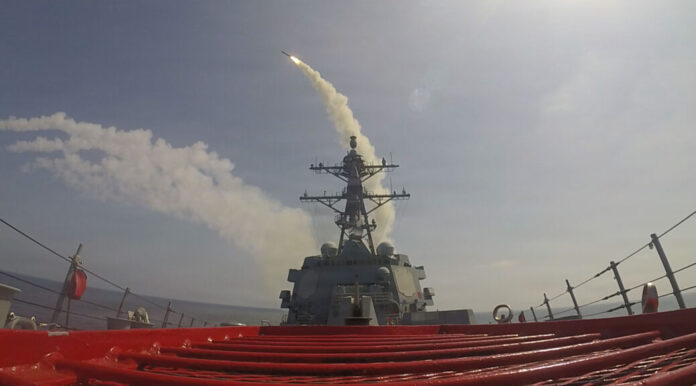
Featured image: Arleigh Burke-class guided-missile destroyer USS Frank E. Petersen Jr. (DDG 121) fires a Tomahawk Land Attack Missile during operations in support of Operation Epic Fury, Feb. 28, 2026. (U.S. Navy Photo)