Should I sustain or should I go: When does a platform cease to be an asset to be sustained and become a liability that should be replaced?
By Thomas Hazel*
I’ve been there when we got it wrong.
We kept a vessel going for as long as we could, and then a little further, and then further still. Reluctant to commit to a new build due to the significant capital cost, lengthy construction timelines and uncertainty surrounding our future work pipeline, we chose instead to wait for a suitable second-hand vessel to appear on the market. It never did.
As we approached our busiest operating period, we found ourselves relying on a platform that was well beyond its prime. Reliability was declining, maintenance costs were increasing and every breakdown carried the risk of disrupting operations in a very competitive market. Faced with that stark reality, we changed course and pursued a new-build replacement.
Identifying the right design, securing funding and selecting a shipbuilder took months. The selected builder presented a highly competitive commercial proposition. Unfortunately, the programme ultimately experienced a series of delays that extended well beyond the original delivery schedule. As the delivery date slipped further into the future, we found ourselves approaching peak operational demand with an ageing vessel whose reliability was declining while simultaneously making milestone payments on a replacement vessel that was still in build.
It was a costly lesson, and not one I’d want to repeat. It also prompted a question that has remained with me ever since:
“When does a platform cease to be an asset to be sustained and become a liability that should be replaced?”
The question is just as relevant to Defence as it is to commercial operators. In fact, it may be even more important. The challenge is not determining how long a vessel can continue operating, it is identifying the point at which continued ownership creates greater operational and financial risk than replacement.
This is because a vessel does not have a single lifespan. Instead, it has four separate but connected lifespans; technical life, class and compliance life, operational life and economic life.
The mistake many owners make is assuming these lives end at the same point. In reality, they often diverge significantly. A vessel might remain structurally sound, be safe to operate and capable of another decade of service. Yet at the same time it may be:
- consuming disproportionate maintenance funding;
- requiring support from obsolete supply chains;
- suffering declining availability;
- constraining operational performance;
- struggling to meet emerging environmental or regulatory requirements; and
- crowding out investment in replacement capability.

Figure 1: Replacement decisions are not driven by age alone, but by the interaction of technical, operational, compliance and economic factors that evolve over time
In such circumstances, the vessels technical life may still be healthy, while its economic life has already ended. So, presented with these four different lifespans, what are the options available to a vessel owner? Discussions around ageing vessels are often framed as a choice between sustainment and replacement. However, in reality, there are usually three options.
Continue Sustaining
The attraction is obvious. The vessel is known and the crew are familiar with its specific wants and needs. The maintenance history is established, and the upfront capital expenditure is avoided. The risk, however, is that costs associated with ageing and depreciation are rarely linear.
Maintenance expenditure may increase gradually for years before accelerating rapidly. Planned maintenance periods become longer. Unplanned maintenance events become more frequent. Days spent operating are progressively replaced by days spent repairing.
Purchase Second-Hand
The brokerage market often appears to offer a compelling solution, which in some circumstances can square the circle. Capital costs are lower, availability may be far sooner, and delivery risk is reduced. However, second-hand vessels come with their own challenges.
Hidden defects, unknown operating histories and unforeseen maintenance demands often emerge only after the vessel enters service. By the time these issues become visible, warranty protections may be limited or unavailable.
Many operators discover they have not solved the original problem. They have merely replaced it.
Commission a New Build
A new build offers the opportunity to design around future requirements rather than historical limitations, with improved reliability, reduced maintenance requirements and capability can be directly tailored to anticipated operating conditions.
The downside is time. Complex vessels require lengthy design, approval and construction periods. Capital expenditure begins long before operational benefits are realised and the asset can be monetised. Shipyard delays, inflation and changing requirements can all contribute to cost and schedule growth.
The challenge is particularly acute when future demand remains uncertain. Operators may recognise the need for replacement while understandably remaining reluctant to commit to the investment required.
Commercial operators often measure procurement delays in months. Defence measures them in years, and sometimes decades. Frigates, submarines and major surface combatants frequently remain in service well beyond their originally intended lives because their replacements are delayed, reduced in number or still making their way through lengthy acquisition processes. Meanwhile, sustainment costs increase, availability declines and capability gaps grow.
The Capability Gap Trap
The uncertainty in all three options above, takes us to a behaviour that logically and systematically results in falling into a capability gap. The cycle is surprisingly common and hard to avoid when your planning horizon demands making a series of short-term tactical decisions.
To start, the replacement is delayed because costs are high, future workloads are uncertain or acquisition appears too complex especially as the vessel is fine, enough. As the vessel ages, sustainment costs increase. Those increasing sustainment costs consume funding and attention that could otherwise be directed to replacement planning.
The replacement decision is therefore delayed even further. Availability declines, reliability deteriorates and support requirements increase as the situation continues to spiral downwards.
Eventually the operator finds themselves paying for both problems simultaneously: escalating sustainment costs on the old vessel and acquisition costs for the replacement.
The very act of delaying the replacement creates the conditions that make replacement harder to achieve. For commercial operators, the consequence may be reduced profitability. For Defence organisations, the consequences can extend to capability, readiness and national security.
The Replacement Window
The central flaw in many replacement decisions is the belief that replacement occurs at a single point in time. It does not, rather it is an iterative process.
For complex maritime assets, the journey from recognising a requirement to commissioning a replacement may take several years. This is particularly true in Defence, where capability development, business cases, government approval processes, design activities, contract negotiations and construction programmes all contribute to extended timelines.
The real question is therefore not “when should the vessel be replaced?” but “when should replacement planning begin?”
Importantly, there exists a Replacement Window. This is the period during which operators still possess sufficient flexibility to transition from one platform to another without suffering excessive cost escalation, asset value destruction or capability loss.
The window closes when replacement lead times exceed the vessels remaining economic life. By that point, operators are no longer making proactive decisions. They are reacting to circumstances from a disadvantageous position.
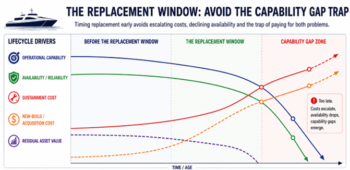
Figure 2: The replacement window closes long before the vessel stops operating.
The Value of Looking Ahead
Perhaps the most important lesson is that replacement planning should begin years before replacement appears necessary and budgeted for accordingly. Owners should understand how maintenance costs are likely to evolve based on age, utilisation, operating environment and maintenance history. They should understand how regulations, technology and customer requirements are changing. They should monitor residual asset values and replacement lead times.
A vessel may pass every engineering inspection and still be approaching the end of its practical life. Likewise, a vessel requiring significant maintenance may still represent excellent value if replacement options are limited or operational demand remains strong.
Most notably, owners should regularly challenge the assumption that todays vessel remains the most effective way of delivering tomorrows capability. This requires long-term thinking and often close collaboration between operators, sustainment providers and shipbuilders. The objective is to maximise the operational and economic value derived from assets over their entire lifecycle, with one flowing into the next.
Conclusion
Vessel replacement decisions are often portrayed as a choice between sustaining an existing platform or acquiring a new one. In reality, the challenge is one of timing.
Replace too early and valuable service life is discarded. Replace too late and the organisation enters the Capability Gap Trap, characterised by escalating maintenance costs, declining availability and concurrent investment in replacement capability.
The most successful transitions occur when replacement vessels enter service before sustainment costs begin accelerating and before operational availability starts to deteriorate significantly. In short, acting whilst within the replacement window.
While there may never be a single correct answer, in the maritime environment, choosing to delay making a decision is still making a choice.
*Thomas Hazel is a former Royal Navy Officer with 15 years of experience as a Warfare Officer and Mine Clearance Diving Officer, with deep technical and operational expertise across complex naval environments. Following his military career, Tom transitioned into industry as General Manager of an Underwater Engineer Company, where he honed his commercial acumen and continued to lead high-performing teams. Joining Austal in 2026 as Business Development Manager for In-Service Support, Thomas brings a practitioner’s understanding of naval operations to the role — and a genuine passion for keeping vessels in service and at sea, delivering on their operational mission.