By Tim Coyle*
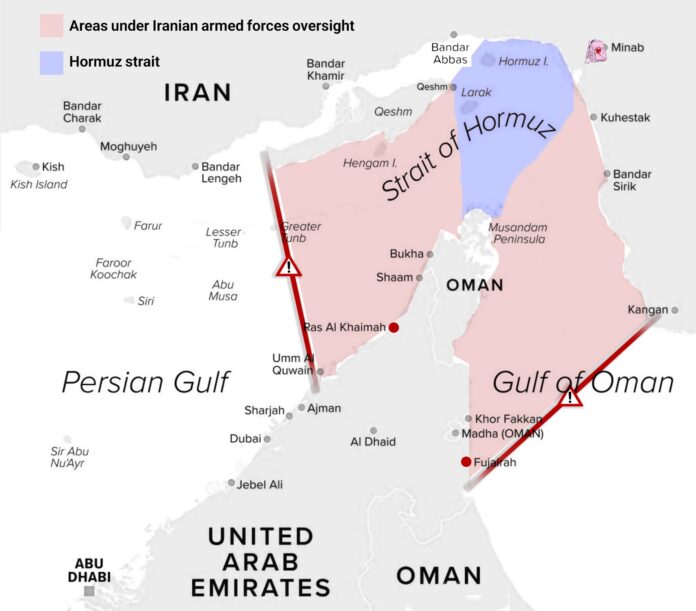
The United Staes/Israel war against Iran is into its fifth month. The Strait of Hormuz remains closed and regime change ‘decapitation’ strikes have seen the clerical dominated Iranian government replaced by the Iranian Revolutionary Guard Corps (IRGC).
The world’s most powerful navy maintains a blockade of Iranian ports while Iran’s resilience against crippling US and Israeli pressures remains defiant.
The Trump Administrations initial calls to NATO, and other allies, to deploy ships to join the US in forcing the reopening of the Strait of Hormuz have returned no response except the statement that ‘it is not our war’.
Allied navies realise the effort to force the Strait and ensure continued access would require an enormous on-going maritime effort for convoy, mine clearance, logistics and likely a major land campaign.
Even in the absence of allied navies’ support, why does the US Navy seemingly resile from a maximum effort to seize and hold the Strait? Does the IRGC-Navy constitute a ‘Fleet-in-Being’ and has it effectively neutered the mighty USN in the Persian Gulf/Strait of Hormuz?
The recent Naval Institute Press publication, Deterrence and Denial; The Power of Fleets in Being, edited by SCM Paine, examines the concept as exercised by various navies from the Age of Sail (beginning with the Anglo-Dutch War in 1690 through the 20th Century – before and after the World Wars – and the Cold War and its aftermath (an excellent review of the book appears on the ANI website).
This article questions whether the IRGCN is the ultimate Fleet-in-Being by using Iran’s geographical constraints as a weapon, combined with its ‘mosquito fleet’ of missile- armed fast attack craft sequestered in inlets, mining threats and other asymmetric means to literally hold the Strait to ransom.
In Chapter 1 of Deterrence and Denial – The Anglo-Dutch Fleet in 1690 – Andrew Lambert, Laughton Professor of Naval History, King’s College, London, posits this definition of a Fleet-in-Being:
‘The essence of a fleet in being is the use of a defensive posture to prevent a superior enemy fleet from exploiting command of the sea; it can be used to delay specific offensive operations – notably an invasion or a commercial blockade – or cover the assembly of additional naval resources to enable the fleet to challenge for command. It is especially important in the wider context of grand strategy, where the power with an inferior fleet may be superior in another aspect of the conflict where it seeks to acquire a decision’.
Stars and Stripes, of 15 April 2026, reported 41% of US Navy deployed ships worldwide were positioning to the Persian Gulf (US amasses major naval force to enforce Iran blockade | Stars and Stripes).
Further reporting on potential war-wining initiatives was the short-lived plan for the seizure of Kharg Island, Iran’s main oil transportation hub. Constraints on US options for such an operation were formidable to the extent the initiative fizzled out as quickly as it was conceived (Kharg Island: How the US could seize Iran’s key oil terminal).
IRGCN developmental interest in fast attack craft was well known from both open sources and classified reporting. Intelligence agencies were following these developments since the 2010s (Iran’s Fast Attack Craft Fleet: Behind the Hyperbole), This 2013 article describes the Iranian purchase of the round-Britain speed and endurance record holding Bladerunner and provides a prescient analysis of IRGCN force development and its potential to directly influence Persian Gulf accessibility. Bladerunner was acquired as part of the IRGCN’s hydrodynamic design program for fast attack craft as was research experimentation in external university experimental tanks
Embedded in the 2013 report is this ironic prognosis:
‘Managing director of Strategic Analysis political risk consultancy, Ruth Lux, said: “The Strait of Hormuz is the most important oil chokepoint in the world and Iran is unlikely to close it as its economy is dependent on exporting upwards of two million barrels of oil a day via the Strait. Furthermore, Iran does not want to alienate those countries which oppose broader sanctions and it knows that a closure of the Strait would result in a US-led military response, which Iran wants to avoid. Continued Iranian threats are already having a negative impact on the energy market as Iran is capable of executing damage to infrastructure and harassment of vessels without full closure of the Strait.”
Ms Lux’s opinion regarding Iran’s unlikely closure of the Strait was preceded in the 2012 RAND analysis (Will Iran Close the Strait of Hormuz (Will Iran Close the Strait of Hormuz? | RAND).
In 2026 Iran has effectively closed the Strait. Although its economy is shattered, the regime, likely now led by the IRGC – a worse prospect than under the previous clerical regime – is unbowed. The Gulf states suffer under Iranian attacks designed to neuter support for the US, and Central Command faces an impasse to the detriment of all.
These operational constraints are exacerbated by extensions to on-station ship deployments, straining morale and personnel wellbeing. The US Navy is stretched to the extent that significant assets have been withdrawn from Pacific Command to buttress Central Command, thereby debilitating US Pacific overwatch capability.
At time of writing the future of this US ‘war of choice’ is parlous and predictions of outcomes are fraught.
From its formidable natural geographic advantages and its asymmetric maritime attack capabilities, the Iranian Revolutionary Guard Corps Navy is indeed the Ultimate Fleet-in-Being.
*Tim Coyle is a former Defence Intelligence Analyst