By Christopher Eylward*
To neutralise this trigger under international law in the case of Taiwan, China is operationalising legal warfare. Instruments including the Coast Guard Law, the revised Maritime Traffic Safety Law, and the 2024 Coast Guard Order No. 3 grant Chinese maritime enforcement agencies domestic authority to board, inspect, and detain foreign vessels in claimed jurisdictional waters. (From The Interpreter. The Lowy Institute.)
Beijing is substituting the traditional concept of a sovereign naval blockade with a civilian-led administrative quarantine.
The China Coast Guard’s routine incursions across Taiwan’s restricted offshore waters represent the operational testing of an asymmetric siege mechanism, one designed to bypass Western defence doctrines entirely. Over the next 12 to 24 months, the People’s Republic of China (PRC) may use domestic statutory mandates, customs safety declarations, and paramilitary assets to achieve the economic isolation of Taiwan without crossing the formal threshold of kinetic warfare.
Rather than deploying the PLA-Navy to seal Taiwan’s coasts, Beijing mandates advance customs manifests for vessels bound for ports such as Kaohsiung, which handles approximately 57% of Taiwan’s maritime trade value. Non-compliant commercial traffic faces interception under the administrative pretext of anti-smuggling, biosecurity, or maritime safety checks.
A law-enforcement quarantine of this type shifts the legal and operational burden of initiating military conflict onto Taipei and its partners, exploiting commercial risk structures to strangle the island’s economy from within.
The operational effectiveness of a quarantine does not rely on sinking merchant vessels; it exploits the mechanics of global maritime finance.
Research from CSIS(Opens in new window) and the Naval War College China Maritime Studies Institute(Opens in new window) demonstrates how the “Kinmen Model” – normalising Coast Guard and Maritime Safety Administration patrols within Taiwan’s contiguous waters – provides the template for wider commercial interdiction.
The operational effectiveness of a quarantine does not rely on sinking merchant vessels; it exploits the mechanics of global maritime finance. When civilian enforcement officers commence boarding operations in the Taiwan Strait, China may reclassify these waters(Opens in new window) as an enhanced risk area. This would lead insurers to levy prohibitive additional war risk premiums, making commercial transits economically unviable. Under standard maritime charter contracts, shipmasters likely invoke safe-port clauses and voluntarily divert inbound cargo.
This dynamic creates an acute vulnerability for Taiwan’s energy security. Taiwan depends entirely on daily deliveries of LNG, maintaining operational storage reserves of only 14 days(Opens in new window). Diverting just a handful of tankers may force immediate power rationing across civilian and semiconductor manufacturing sectors.
This scenario also presents Taipei with an operational dilemma. Interposing civilian Coast Guard Administration cutters concedes Beijing’s premise that the dispute is an internal administrative matter. Conversely, deploying Republic of China Navy warships to escort commercial tankers allows Beijing to claim Taiwan has militarised a peacetime customs operation, providing the pretext for PLA-Navy strike groups to intervene.

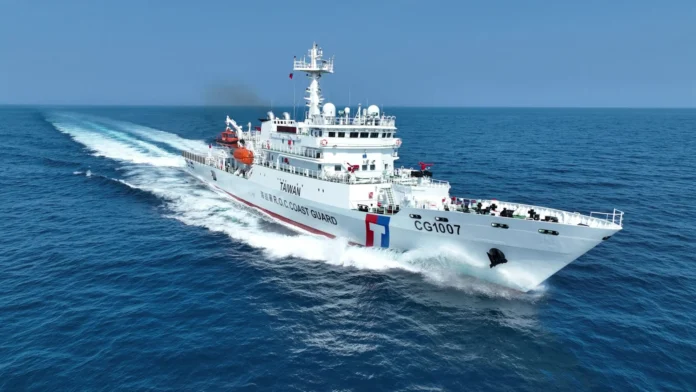
A China Coast Guard vessel patrols on 21 September 2026 near Qingdao, China (VCG via Getty Images)
Deterring an administrative quarantine requires Western defence doctrine to move beyond conventional naval defence planning through three multilateral measures.
First, the United States, Japan, and regional allies should construct a multinational marine reinsurance backstop. By underwriting commercial hull and cargo risk when private underwriters withdraw, partner nations can neutralise Beijing’s ability to use market insurance triggers as an economic weapon.
Second, partner nations should deploy their own Coast Guard assets to conduct joint presence operations in the Taiwan Strait, challenging Beijing’s jurisdictional claims symmetrically without triggering military escalation.
Third, Taiwan may draw on its standing as an autonomous Separate Customs Territory within the World Trade Organisation(Opens in new window) to challenge PRC interdictions under General Agreement on Tariffs and Trade Articles X and XI(Opens in new window), backed by pre-packaged allied sanctions targeting China Coast Guard operational commands.
A coercive quarantine orchestrated by maritime law enforcement represents a form of grey-zone coercion designed to circumvent traditional allied defence treaties. By framing territorial coercion as domestic customs administration, Beijing exploits the sensitivities of global shipping and the fragility of Taiwan’s energy reserves. Deterrence in the Taiwan Strait can no longer focus solely on repelling an amphibious assault. Without integrated commercial insurance guarantees, multilateral law enforcement coordination, and assertive legal counter-measures, the international community risks allowing Beijing to achieve through administrative coercion what it cannot accomplish without war.
*Christopher Eylward is an operations supervisor within the Royal Australian Navy, with over 15 years of leadership experience in maritime operations, tactical data networks, and operational intelligence.