By Tom Sharpe*
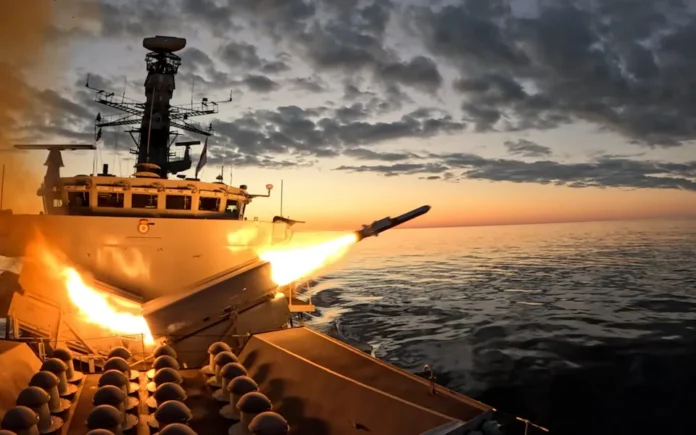
Last week, off the Hebrides, the Royal Navy Type 23 frigate HMS Portland fired a Naval Strike Missile (NSM) into the retired American frigate USS Klakring. Her Wildcat helicopter followed with a Sea Venom launch. Both hit.
HMS Somerset was the first RN warship to fire the NSM, a year ago. That was a first-of-class shoot using a test weapon conducted on a Norwegian firing range with a heavy manufacturer presence. This one was a war-shot missile fired by a real Navy crew against 4,200 tonnes of real ship in a full sinking exercise – a SINKEX.
This gives you what no simulator or test can: the whole kill-chain – detect, track, allocate, engage, destroy – is proved in the real world. You get the assurance that you actually can shoot at a ship out at sea, hit it, and sink it. Live firings against hulks are rare opportunities, so the US fired too. The destroyer USS Paul Ignatius fired an SM-6 and the submarine USS Massachusetts finished the job with a torpedo.
Such live firings at sea are tense. They are the culmination of weeks of planning. The target must be got into place. It must be detected (and, this being peacetime, no uncertainty can be permitted as to its precise identity).
Then, with the ship at Action Stations and hundreds of people focussed on their roles, you have to ensure that the range is clear – one stray yacht, fishing boat or aircraft and the whole show stops. As much data as possible are collected along the kill chain and then fed into the system so that when you take the weapon to war, you can fire with the maximum chance of success.
Live firings of hefty missiles are violent too. It would have helped my composure if the first time I experienced a live firing – it was the now long-gone Sea Dart surface-to-air weapon – I had known in advance that it left the launcher with a bang, not a whoosh.
Sea Venom is shorter range than NSM and is built to defeat corvettes and disable anything larger. For real, and assuming one’s helicopter can get close enough, you’d normally want their weapon to arrive at the exact same time as ship-launched longer-range missiles – in the jargon you want Simultaneous Time on Top (STOT) – to maximise the chances of overwhelming the enemy’s defences. In this case the sequence was staggered, presumably to allow for better impact assessment as each weapon struck.
Now for the less happy part of this story.
NSM was bought from Norway in 2022 to rectify the fact that the Royal Navy’s frigates and destroyers had no missile which they could fire at ships, a pathetic situation which had existed for a long time, ever since the aged Harpoon went out of service. NSM is a better missile: better targeting (as now proven), sea-skimming, with a range in excess of 100 nautical miles and with a land-attack capability.
I was still in the service when Harpoon was timing-out and it was decided we didn’t need an immediate replacement. Part of the justification offered for this was that if we needed to sink an enemy ship we could use Spearfish, the submarine-launched torpedo, instead. This was clearly absurd, even before attack submarine availability plummeted to zero in recent times.
I was never very good at spinning things I fundamentally disagreed with and – while employed as a Navy spin doctor – said to a prominent journalist during one of many discussions that it was “like Nelson doing away with cannons”. The remark proved less off the record than I had hoped and I only just averted a major backlash.
The capability gap proved to be a lengthy one: in 2021 the First Sea Lord was still telling MPs the Navy would “accept that there will be a gap”. When we finally got NSM we reached the right decision and plugged the gap, but in an incoherent way. Only two of our 13 surface warships currently have it. Even when we manage to find a combat warship to escort a Russian one bristling with missiles through the Channel, our ship is usually still without any effective armament.
These systems are about setting the conditions so there will not be a fight, more than they are about actually fighting. In real life, against, say, dark fleet ships and their escorts, if the enemy knows for sure they would win in a fight it is much more likely that there will be a fight.
The 2022 announcement promised NSM for 11 frigates and destroyers. By June last year ministers confirmed three had it fitted: Somerset, Portland and Richmond. Richmond has since been decommissioned, and no destroyer has carried it yet. So, we are now at two from 11. Where are the other nine sets? Here, or still in Norway, or not yet even assembled? When asked this question in July, the Ministry of Defence cited operational security reasons for not answering.
So what is the plan now? June’s defence investment plan (DIP) said the new Type 31 frigates will get NSM and Mk 41 vertical launch tubes. The Type 26 looks likely to carry Stratus – the cruise missile formerly known as FCASW – whilst the DIP also funded NSM for these more expensive full-fat frigates. Statements in 2021 said there would be clarity on much of this “from 2028”.
Nobody offers a date now, and a review of “all options” for the programme was due this month. The Type 45 destroyers are still waiting for their NSMs– they have spent almost all their time to date effectively unarmed against ships or land targets – and they are due to start retiring in 2035.
Having Mk 41 launchers fitted opens other doors, including those leading to the American Standard Missile (SM) family, the Tomahawk cruise weapon – probably the best of its type in the world – and other things that make an old naval surface-warfare officer’s eyes light up, like the ASROC submarine-killer missile. The new SM-6 is the best anti-ship option here, over the older SM-2. SM-2 needs the ship to illuminate its target: SM-6 has its own seeker for over-the-horizon shots and has a range of roughly double that of NSM.
This is what USS Paul Ignatius hit Klakring with. SM-6 is also far faster than NSM and therefore harder to counter, but it is primarily an air-defence missile – probably the best in the world, one of the few that would be effective against hypersonics and ballistics – and it is eye-wateringly expensive. The NSM’s warhead, too, is considerably more powerful. Stratus promises greater range than either, and will be pretty much as good as Tomahawk if all goes well.
You can see why in today’s financial environment our Navy’s leadership looked at a future fleet of destroyers-slash-cruisers, each with 128 or more missile tubes, and concluded it was not realistic. The defence investment plan – the document to which we are supposedly working now – confirmed this, replacing the Type 83 with a “hybrid navy” solution to include uncrewed Type 91 missile platforms.
Whilst there is a road map of sorts to arm the new frigates with a variety of weapons, there is none for these smaller vessels yet, something that will need to be resolved quickly if the “ready by 2029” timeline is to mean “operationally ready” rather than just hulls afloat. A couple of T91s with unallocated NSM sets would be very useful as that programme settles down.
*Tom Sharpe OBE served for 27 years as a Royal Navy officer, commanding four different warships.