By Mohd Yunus*
On 15 August 2026, China published an ecological assessment of the South China Sea(Opens in new window) stating that the coral cover around Sandy Cay has declined by nearly 70% compared to 2016. The cause is said to be a combination of natural factors and extensive human activity. The report comes after months of China and the Philippines accusing each other of damage to coral reefs in the area – and can be seen as a way for China to blame the Philippines for the degradation of Sandy Cay. (From The Interpreter. The Lowy Institute.)
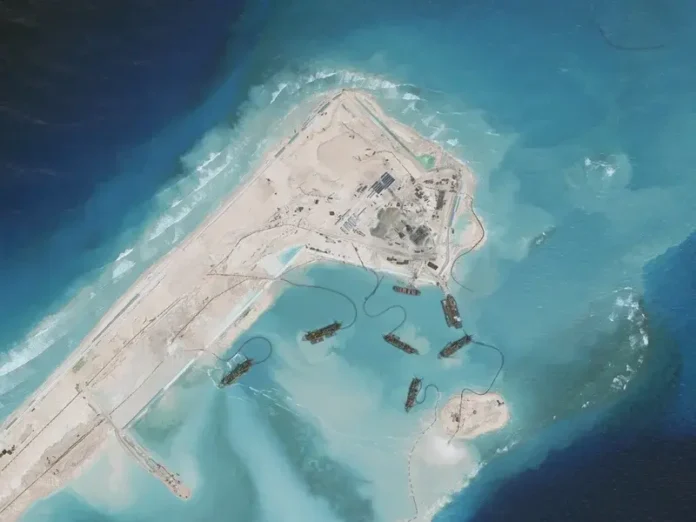
The South China Sea is one of the most biodiverse(Opens in new window) marine areas in the Indo-Pacific, with a rich ecosystem of coral reefs, mangroves, seagrass meadows and fisheries. However, since China’s massive reclamation in 2013-2015, there have been changes in these ecosystems. Satellite imagery tracking by the Asia Maritime Transparency Initiative(Opens in new window) indicates China has taken possession of more than 1,300 hectares of submerged coral reefs to build seven artificial islands in the Spratly Islands, including an air base at Fiery Cross Reef and a military port facility at Mischief Reef.
Sand dredging and landfill damage important habitats for marine life. Current-borne sedimentation pollutes surrounding waters, including unreclaimed areas. A 2016 arbitration(Opens in new window) award found that China breached its obligation to protect marine ecosystems, and it rejected the nine-dash line(Opens in new window), but China rejected(Opens in new window) the arbitration. In addition to China, Vietnam and the Philippines have expanded artificial land in their control areas, adding to the damage.
In Savage Ecology: War and Geopolitics at the End of the World(Opens in new window), Jairus Victor Grove views contemporary geopolitical order as a condition shaped by war and political violence. For Grove, war is not just an instrument of policy, but rather a relationship between humans, technology, materiality, and the environment, with far-reaching ecological consequences. This perspective is illustrated in the South China Sea, where territorial competition, militarisation, resource extraction, and pressure on marine ecosystems go hand in hand.
This is the military logic behind the report. The living, connected sea, where larvae and fish stocks drift across every line on the map, are flattened into points to be dominated, each affixed to flags, ships, warplanes, and legal arguments. The ocean does not adhere to these clear delineations, but political claims require it.
What happens is the translation of ecological science into proof points. Coral reef monitoring data is produced for legal and diplomatic purposes, not to guide the co-management of degraded ecosystems. Distrust makes joint management a concession, so all parties produce one-sided evidence. States debate who is entitled to a reef, while the coral continues to lose its live cover.
An alternative to this is environmental cooperation – an opportunity to rebuild the trust eroded by strategic competition. The first step is to strengthen the joint ecological survey mechanism between ASEAN and China, with the support of independent research institutions and, where necessary, international organisations. Learning from the Joint Marine Seismic Undertaking (JMSU)(Opens in new window)’s failures, this requires a transparent and standardised methodology, periodic monitoring, and a shared database on coral reef conditions, water quality, and fishery resources. Data and methodologies that are not security sensitive need to be made available and auditable by all participants. All activities should be under a without prejudice clause that affirms that participation, site access, data exchange, and use of research results do not diminish, recognise, or alter the legal position or sovereignty claims of any party.
In addition, the region needs marine science institutions with sustainable technical capacity designed to remain functional when political relations heat up, complete with clear technical mandates, stable funding, data verification procedures, and a no-prejudice clause. Their job is not to determine sovereignty, but rather to provide a transparent evidence base. These institutions become a separate technical layer from the dynamics of the dispute.
This is not an easy solution. Environmental protection needs to run parallel to dispute resolution. Claimants will need to agree that unresolved disputes should not be a reason to allow ecosystems to deteriorate.
The South China Sea issue also represents a broader challenge – how do countries deal with ecosystems that know no boundaries? Ecological reports and surveys should not just be used to strengthen positions, but as a warning that the space to delay action is getting narrower. If diplomacy fails to go beyond claims and counterclaims, scientific cooperation and environmental protection can be the starting point for rebuilding trust.
*Mohd Yunus is an independent researcher based in Indonesia. He holds a master’s degree in biological sciences from Khon Kaen University, Thailand.