By Valery Bonakhau*
Financial warfare is conventionally understood as an instrument applied to declared, identifiable assets. Common tactics include freezing accounts, cutting off correspondent banking access, and market delisting of entities. The Hormuz conflict of March 2026 introduced a structurally distinct mechanism operating on none of those principles. What follows is an analysis of that mechanism — how it emerged, how it functions, and why existing maritime security frameworks are not adapted to recognize it. (From: The Center for International Maritime Security.)
Executive Summary
In March 2026, the Hormuz conflict introduced a financial warfare instrument that most strategic analysts have not yet identified. Not the oil price shock. Not the insurance premium surge. This new instrument was the systematic immobilization of cargo in transit as active leverage. At peak, approximately 140 million barrels of oil were rendered undeliverable in the Persian Gulf.
This constitutes a new class of coercive instrument distinct from sanctions and asset seizure which shall be termed the weapon of frozen assets. The weapon of frozen assets is defined as a condition in which a supply chain position becomes illiquid through the convergence of three independent constraint systems. No freezing authority issues an order. No asset is formally declared blocked. The system constructs itself empirically.
The Mechanism: Frozen Assets as Active Leverage
Conventional financial warfare operates on declared assets: accounts frozen by executive order, correspondent banking access removed, entities delisted. The target knows what has been frozen. The freezing authority controls the instrument. What emerged in March 2026 is structurally different.
The blocked assets are not declared. They are positional.
A positional asset is a contractual, logistical, or financial state that becomes unrealizable under specific conditions. A vessel at anchor awaiting Iranian permission is a positional asset. How many such vessels are waiting — UKMTO, Kpler, and Lloyd’s List count them. The fact is recorded. The mechanism is not. Monitoring systems see the symptom: the vessel is stationary. Why every possible exit is simultaneously blocked — without a single official order, without a sanctions list, without a formal prohibition — is a question they do not ask. This is why the weapon of frozen assets went unidentified.
A very large crude carrier (VLCC), a supertanker exceeding 200,000 deadweight tons, carrying two million barrels of Abu Dhabi crude in transit becomes an unrealizable asset the moment it cannot deliver cargo, cannot obtain war-risk coverage for forward transit, or return to port without losses exceeding the cargo value. Returning is not a neutral option as the vessel has already paid freight, fuel, and port fees. A reversal means a new charter back, penalties for breach of the delivery contract, and the loss of sums already paid. The operator had done everything correctly. The cargo was legitimate. The documentation was clean. None of that mattered.
This is the weapon of frozen assets, and countermeasures have not been found.
In any conflict, equipment and personnel losses are counted. Financial warfare produces losses of a different kind: 1,600 vessels at anchor, billions of dollars of cargo going nowhere, and tens of thousands of trapped mariners. Kpler records these losses via satellite.
However, losses are not the weapon but the consequence of its use.
The weapon is the mechanism that created them. Three systems operate simultaneously without a single official order: a permit regime, an insurance barrier, and legislative formalization. None of them formally blocks a vessel, but together they make forward progress impossible.
Jask & the Architecture of Asymmetry
The weapon of frozen assets functions only if Iran can credibly threaten Hormuz while maintaining its own export capability. Without that asymmetry, mutual blockade produces symmetric damage, and the weapon loses its leverage.
Forty years of sanctions were not wasted. Iran spent four decades preparing for this scenario. The scale of Iranian preparation was systematically underestimated by external analysts.
The centerpiece is Jask, Iran’s only oil export terminal located outside the Strait of Hormuz. Crude reaches Jask via the Goreh-Jask pipeline from Bushehr province. Kpler data shows the terminal’s first loading in the current conflict was on March 7, 2026: tanker Dore, 2 million barrels. Design capacity is 1 million barrels per day, and effective capacity is estimated by the EIA and Kpler at approximately 300,000 barrels per day. Inside the Gulf, Iran also operates smaller terminals at Lavan Island, Sirri Island, and Soroosh. These terminals are primarily for cargo top-ups and are typically unable to receive fully loaded VLCCs.
This asymmetry is not incidental. It is the structural condition that makes the weapon of frozen assets viable as a sustained instrument rather than a one-time escalation. Iran can impose transit uncertainty on all other operators while maintaining its own revenue flow. This is not mutual deterrence. It is a directional weapon.
The asymmetry gives Iran a sorting mechanism. States that acquiesce receive access. Adversaries pay an uncertainty premium. Those undecided find their exposure used as an argument for compliance.
There is one further dimension that external analysis has underweighted. Fortune reports that Iran is exploring rail shipments of petroleum products to China via the China-Iran freight corridor, a 5,300-kilometer route through Turkmenistan and Kazakhstan that cuts transit time from 30-40 days by sea to 14-15 days by land. The critical caveat is that railways cannot transport bulk crude oil on an industrial scale. The rail corridor handles petroleum products, petrochemicals, and high-value goods. It is a contingency channel, not a replacement for tanker volumes. Nonetheless, its existence means Iran has built redundancy into its trade architecture that was not present in any previous standoff.
The Insurance Architecture as Operationalization
Within the first week of the conflict, Lloyd’s of London syndicates sharply repriced Hormuz transit coverage. War-risk premiums reached 2.5% to 5% of hull value per transit — $10 to $14 million for a single VLCC voyage. The Lloyd’s Market Association confirmed on March 23, 2026 that insurance was not withdrawn outright and coverage remained technically available. However, at rates approximately sixty times pre-conflict levels, the practical effect was identical to withdrawal. Operators consistently report that the primary constraint is physical danger to crew. The insurance architecture amplified that constraint into a financial impossibility for most commercial transits.
New coverage was available only through the DFC (U.S. International Development Finance Corporation) reinsurance facility and only for U.S.-flagged vessels or vessels with U.S. commercial interests at premium levels that rendered most commercial transits economically unviable. The two-tier structure was partly a design choice and partly a capacity constraint that no one had modeled in advance. On April 3, DFC expanded the program to $40 billion, adding six new underwriters. There is little evidence of actual utilization. The mechanics of this structure and its limits are analyzed in detail in RUSI Commentary on April 2, 2026.
Iranian legislative action on Hormuz transit developed in stages. In late March 2026, the parliamentary National Security and Foreign Policy Commission approved a 12-article billtitled “Consolidation of Iran’s Sovereignty in the Strait of Hormuz” and forwarded it to the Presidium of the Majlis. On March 31, the commission chairman stated: “47 years of hospitality are over forever.” As of May 7, 2026, the bill has not yet passed a full plenary vote — but Tehran has not waited for the law to implement its provisions operationally.
On May 5, 2026, Iran launched the Persian Gulf Strait Authority (PGSA): an official body with a formal email address providing a single window for arranging transit authorization with the IRGC Navy. Vessels must complete a “Vessel Information Declaration” disclosing ownership, insurance, crew manifests, and intended routes before receiving a transit permit. CNN obtained the form from Lloyd’s List. Richard Meade, editor-in-chief of Lloyd’s List, stated that Iran had positioned the PGSA as “the only valid authority to grant permission to ships transiting the straits,” per AGBI. As Splash247 noted, the creation of the authority gives Iran’s toll regime a veneer of bureaucratic legitimacy but resolves none of its legal problems as the IRGC remains a U.S.-designated foreign terrorist organization.
The convergence of three conditions — permit-based transit access, insurance-conditioned financial viability, and legislative formalization — produced the situation described above. A vessel operator simultaneously facing a permit fee demand, a repriced insurance market, and a formally constituted Iranian transit authority has no commercially viable path forward. Remove any one of those three constraints and the trap does not hold at scale. As of this writing, all three remain in force.
In existing analytical literature, this mechanism has not been described as a distinct instrument. It is not a single mechanism. It is what occurs when three independently operating constraint systems act simultaneously.
The $2 Million Question: Sanctions Exposure
The closest historical analogy is the ongoing management of the Suez Canal. Egypt has collected billions for passage through a waterway that geography created and lawyers formalized. What Iran did in March 2026 is structurally near identical with one distinction: the Suez Canal Authority holds a legal mandate. The Iranian corridor does not.
The $2 million is not the central issue. The central issue is that someone paid it. That payment is the precedent.
According to verified Bloomberg data, the Islamic Revolutionary Guard Corps’ (IRGC) base rate is $1 per barrel of crude, which translates to $2 million per transit for a VLCC-class vessel. On April 2, the container vessel CMA CGM Kribi, flagged in Malta and operated by French carrier CMA CGM, became the first Western European-operated vessel to transit Hormuz since the conflict began. The payment mechanism has not been officially disclosed. That same day, France vetoed a UN Security Council resolution that would have authorized military reopening of the strait. The timing is not coincidental.
In a single day, Paris appears to have settled its transit terms and blocked the resolution that would have rendered those terms unnecessary. This is the first documented instance of a NATO member acting openly at variance with allied positions based on national commercial interest alone. The precedent was not set by Tehran. It was set by Paris.
Payments were routed in Chinese yuan or through stablecoins, cryptocurrencies pegged to fiat currency values. Not dollars. This is deliberate architecture. The IRGC has constructed a five-tier system that ranks flag states by degree of political alignment. Yuan-denominated transactions fall entirely outside the dollar clearing system. Stablecoins settle on blockchain rails, circumventing traditional bank intermediaries.
Secretary Bessent’s March 16 statement addressed oil flows, not payment flows. On March 20, OFAC issued General License U (GL U), authorizing transactions necessary for the delivery and sale of Iranian-origin crude loaded prior to March 20 through April 19. GL U addressed oil flows. No authority addressed payment flows at that time. Baker McKenzie analysis confirms GL U was the first OFAC general license broadly authorizing transactions involving Iranian-origin crude oil.
That gap has since been partially closed — but only for U.S. persons. On May 7, 2026, OFAC updated its FAQ, stating: “Payments to the government of Iran or the Islamic Revolutionary Guard Corps (IRGC), directly or indirectly, for safe passage through the Strait of Hormuz would not be authorized for US persons, including US financial institutions, or for US-owned or -controlled foreign entities.” For non-U.S. operators, the legal ambiguity persists. GL U itself expired on April 19, 2026 and was not renewed — Secretary Bessent announced on April 15: “We will not be renewing the general license on Iranian oil.” Financial institutions are left with a compliance question Washington has answered only partially.
Implications for Maritime Security Planning
The situation described above is a structural trap. Documentation was clean. Cargo was legitimate. Every obligation was met. Yet the environment developed a permit system with no legal foundation, an insurance market repriced beyond commercial viability, and a sanctions framework that no authority is applying consistently to non-U.S. operators.
Four implications follow that current maritime security frameworks do not yet account for:
First, the unit of analysis for financial warfare in maritime conflict is the position, not the asset. Existing frameworks are designed around declared, identifiable assets. The weapon of frozen assets operates on positions — contractual, logistical, and financial states that become impossible to exit under specific conditions. A vessel at anchor awaiting an Iranian permit does not trigger any standard financial warfare indicator. This category of exposure is invisible to frameworks built for a different instrument.
Second, the DFC facility has set a precedent. Beijing and Tehran will both model the DFC response as a baseline constraint on U.S. escalation tolerance. The template is now established, and one can only wonder how this precedent will impact future action in the Taiwan Strait, the South China Sea, or the Turkish Straits. The RUSI analysis of the first DFC cycle examines this in detail. France demonstrated the practical consequence: when transit access is available at a price, commercial interest overrides coalition position.
Third, the weapon is self-sustaining once deployed. It does not require active maintenance. The permit regime, the insurance repricing, and the legislative structure each reinforce the others. Dismantling any single layer does not dissolve the trap as the Project Freedom experience confirms.
Finally, the legal architecture is deliberately ambiguous for non-U.S. operators. Tehran has structured the toll regime to create maximum uncertainty for third-country shipping firms: pay and risk U.S. secondary sanctions or refuse and remain stranded. That ambiguity is not a design failure. It is the instrument.
Conclusion
On May 4, the United States launched Operation Project Freedom, deploying guided-missile destroyers, over 100 aircraft, and 15,000 service members to guide neutral vessels out of the Persian Gulf. The operation was paused within 48 hours. Only two vessels transited through the Gulf. Approximately 1,600 remain stranded with the IMO reporting approximately 20,000 mariners aboard nearly 2,000 vessels trapped in the Gulf. Pre-war traffic through Hormuz averaged 120 crossings per day. The same day Project Freedom was paused, Iran launched the Persian Gulf Strait Authority, a formal bureaucratic structure with an official email address, application forms, and a stated mandate to regulate all Hormuz transit. The convergence of three constraints that produced the weapon of frozen assets has not been dismantled. It has received institutional form and will continue to evolve the longer the situation in the Gulf continues.
Valery Bonakhau is an Independent Analyst in Dubai. He spent two decades in capital management across Commonwealth of Independent States (CIS) and United Arab Emirates (UAE) markets before transitioning to independent research. His work applies financial mechanism analysis to geopolitical forecasting, identifying the structural constraints that force political decisions before they occur.
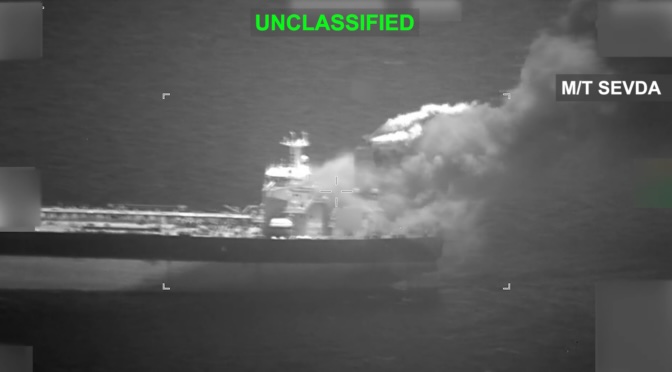
Featured Image: U.S. forces disabled M/T Sevda, an Iranian oil tanker, on May 8 prior to it entering an Iranian port on the Gulf of Oman in violation of the U.S. blockade of Iranian ports and the Strait of Hormuz. (U.S. Central Command photo)