From the ANI Archives: The North Arabian Gulf
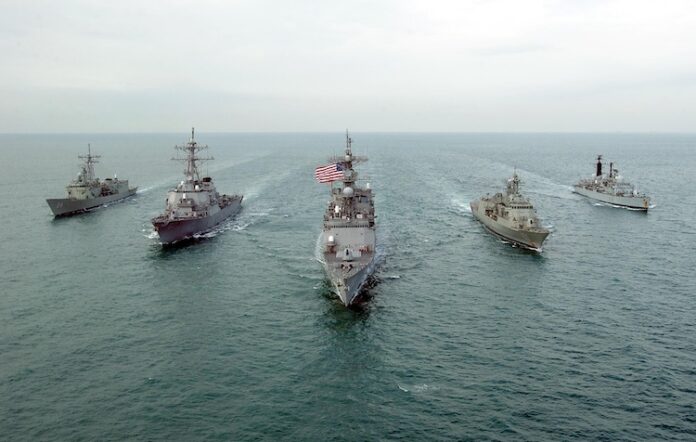
The RAN’s longest operational commitment was its successive deployments to the North Arabian Gulf. The tasking ranged from UN Security Council sanction enforcement, combat operations in two wars and finally maintaining good order at sea. In this article, published in the Summer 2003 edition of the Journal of the Australian Naval Institute, Commander (later Vice Admiral) Ray Griggs describes the manner in which sanction enforcement operations were conducted in 2002 prior to the Iraq War.
Commander Griggs’ ship, HMAS Arunta was part of Operation Slipper Rotation 3 (June-December 2002) with HMAS Melbourne (Captain [later Commodore] Steve McDowell). The rotation task group commander was Captain Peter Sinclair who also commanded the multinational Maritime Interception Force (MIF) generally from a USN destroyer.
Extended Operations in Estuarine Waters – Life in the North Arabian Gulf
In this edition of Shiphandling Corner I thought I might offer a short piece on life in the Northern Arabian Gulf (or the NAG as it affectionately known). I have based this article on my own experiences from HMAS Arunta’s Operation Slipper deployment in the second half of 2002. I have drawn primarily on information that is available in the public domain so as not to compromise security given that we have ships still committed to the task.
While conducting Maritime Interception Operations (MIO) in the NAG is nothing new to the RAN (we have been doing it for over 11 years), the past few months have seen some subtle changes. Our ships have been pushing further north, closer to the Iraqi coast and essentially operating for extended periods in confined estuarine waters. The smugglers have increasingly used motor dhows as well as steel hulled vessels to ply their trade and the phenomenon of coordinated mass dhow breakouts has kept the MIO team extremely busy. The main operating area is no more than 100 square miles with much of this area unsafe for navigation given the plethora of wrecks and shoal water that exists. In these waters the conduct of safe navigation is the cornerstone for successful operations, every cable of shoal water is invaluable and one’s navigational situational awareness simply has to be top notch.
The sanctions enforcement mission in the NAG is fairly straightforward: intercept, and board as required, inbound and outbound traffic from Iraq to ensure that United Nations sanctions are not being violated. This is effected with three types of boardings:
- the Compliant Boarding, where the crew obviously complies with instructions to do so,
- a Resolution 986 boarding, a very structured and detailed search of a vessel, and
- the often more complex Non-Compliant Boarding (NCB).
The RAN provides a unique capability, as it is the only navy whose ship’s companies are trained and permitted to conduct all three types of boardings. Boarding parties can be inserted either by RHIB or helicopter fast rope with boarding teams often operating at extended range from the ship.
The bulk of the compliant and non-compliant boardings are conducted up close to or inside Iraqi territorial sea while the Resolution 986 boardings are normally conducted at the UN inspection point called Comiskey. Boardings are conducted on a range of vessels from 400-500 tonne dhows to 300,000 tonne plus supertankers.
While the mission may be straightforward, these sorts of operations demand an extremely high quality surface picture in what is a very busy patch of water. On any given day our ships are operating in close proximity to 150-200 fishing dhows and trawlers (of varying sizes), 20-30 inbound and outbound legitimate merchant vessels, 40-50 vessels plying the Iran to Kuwait trading route, 20 anchored merchant vessels awaiting an alongside berth and anything up to 40 smugglers a day attempting to run the blockade. Add in operating temperatures of up to 50°C, poor visibility due to heat haze or dust storms, some foreign military vessels and the ever-present threat of an asymmetric terrorist attack and you had all the ingredients for an interesting day at the office.
While the focus was primarily on illegal activity, one of the important aspects of our work was to ensure that our UN operations did not interfere with legitimate local traffic going about its business. As such it was important then for the bridge. Gun Direction Platform (GDP) and Operations Room teams to quickly come to understand what the patterns of normalcy were.
One of the great advantages of the high traffic densities and the tight navigational constraints was that the Officers of the Watch (OOW) gained a wealth of experience in managing multiple activities. In a normal watch the OOW could reasonably expect to have to handle:
- running a patrol line with 3 minute fixing;
- launch, recover and maintain communications with multiple RIIIBS;
- conduct VHF radio queries with vessels to ascertain whether they need to be boarded;
- launch and recover the aircraft;
- make constant course and speed alterations to avoid shipping and large numbers of fishing nets by the distances designated by command;
- routinely work with underkeel clearances of 2-3 metres;
- maintain stationary positions in up to 2.5-3 knots of tidal stream;
- maintain constant tactical awareness particularly for potential surface, air and missile threat; and
- maintain appropriate engineering state dependent on tactical situation.
While traditional in-company time was limited, this was more than compensated for by the requirement to manage at least 5-6 of these tasks simultaneously and often for the vast majority or all of the watch. There is no doubt that the OOW certainly knew that he or she had been ‘working’ by the end of the watch.
In Arunta, with up to 4 RHIBs ‘feet wet’ simultaneously, the tempo on the bridge was often hectic, particularly during the mass breakouts that were a feature of Arunta’s deployment. For the OOW, orchestrating the simultaneous communications flow from four boarding parties to the Operations Room added another layer of complexity.
Because of the sheer size of some of these breakouts (up to 30 vessels at a time) the ship itself often needed to become part of the action and be manoeuvred at close quarters into the path of recalcitrant vessels to ensure compliance. Ship positioning was always a trade off between available safe water, traffic densities (particularly fishing fleets and nets) and being able to best support deployed boarding teams. This often meant very small, constrained areas for the OOW to work in and required constant attention to detail with passing traffic and not insignificant tidal streams to contend with.
The Navigating Officer was kept busy investigating shoals and Position Approximate (PA) wrecks. Whenever he could get a chance he would conduct mini surveys around key areas of interest using hand-held GPS and the relatively new hand-held echo sounders. These torch like echo sounders are a real boon and certainly reduced the setup time compared to the old ‘portable’ boat echo sounders. I found the clarification of the position of PA wrecks of particular value as it significantly increased the amount of useable water. The spot checking of key shoals and banks also increased my confidence in the survey. That said, a deal of prudence still needed to be exercised particularly as we watched the Iraqi harbour authorities raise a large unchartered cement barge that had sunk a number of years ago. Navigational buoys were numerous in number but invariably unlit and posed a constant hazard for boat crews at night. The Endeavour navigator electronic raster chart system (installed on a laptop) was another invaluable piece of kit. It was generally used as a command tool as I was always keen that the OOW maintain terrestrial fixing as the primary method. To have the electronic chart and ship’s position available on the bridge. Operations Room and CO’s day cabin meant I wasn’t tied to one spot and I that I could lead some semblance of a normal life. Again one had to resist the temptation of becoming overly reliant on the tool. I have no doubt that the OOWs prayed regularly for a corrupt hard drive on the laptop to rob me of what I am sure they considered to be ‘far too much information’.
The bridge team’s understanding of merchant shipping increased exponentially. Reports became far more specific than ‘I have a large merchant vessel at Red 30’ as the OOWs improved their merchant vessel recognition skills. This was useful as it is always good for one’s credibility if you don’t ask a 300,000 tonne VLCC tanker inbound for the Mina Al Bakr oil terminal with about eight metres of underwater paint showing what cargo they are carrying! Even knowledge of basic information regarding the key flags and ports of registry proved useful.
Melbourne and Arunta conducted some 1400 VHF or alongside (from the RHIB) queries during their deployment and many a time, not quite truthful information was passed back. As the information collected was often the basis upon which boarding decisions were made, the bridge teams needed to be alert to known flag of convenience states and unusual flag and port of registry combinations. One enterprising young officer taught himself enough Farsi and Arabic to conduct queries in both languages, this made an enormous difference in the ship’s ability to effectively query passing traffic and, of course, to the amount of time he spent on the bridge!
Working International Maritime Mobile VHF in the Gulf is notoriously difficult; with Anomalous Propagation exaggerating what is an already crowded band. It was tough enough getting the right vessel to answer on Channel 16 let alone trying to establish a working channel, particularly when there was more than the odd incidence of anti-western sledging on the circuit. The noise that the cluttered VHF band induced on the bridge also took some getting used to; monitoring VHF was essential so turning down the volume was not an option.
In company activity was limited due to the high operational tempo but every opportunity was seized with fellow RAN or coalition ships to maintain important mariner and warfare skills. Arunta was able to interact with a number of ships including a most valuable two day Passage Exercise with HMS Argyll whilst enroute to a port visit. Replenishment of course provided regular interaction with other units. The particular challenge in the NAG was the depth of water and close attention had to be paid to potential interaction effects. It was however a great opportunity to replenish from USN, RN, Canadian and Spanish tankers and to keep the seamanship skills honed.
The unique combination of an intense tempo set by a relentless and determined group of smugglers, a tense strategic and tactical overlay and difficult navigational and environmental conditions made the task an extremely challenging one. Each rotation to the Gulf has been quite different, as the dynamics of the situation have continued to evolve; we were fortunate to be there during an extraordinary period of activity where the ship’s boarding teams conducted 377 boardings and played a key role in all but shutting down the maritime smuggling into and out of Iraq. Much of our ability to do that however was due to the cumulative effect of the entire MIO operation and in particular the unrelenting pressure that coalition navies have applied in the last 12 months.
About the author
Vice Admiral Ray Griggs AO CSC RAN first contributed to the ANI Journal as a Lieutenant taking umbrage over something a senior officer had written. He specialised in navigation and navigated five ships. At the time of writing this article Ray Griggs was commanding the Anzac class frigate HMAS Arunta. The ship under his command would go on to undertake border protection duties (Operation Relex) and then deploy to the Arabian Gulf (Operation Slipper).
Ray Griggs joined the ANI Council in 2000 becoming Vice President in 2005 only relinquishing that role when he became Chief of Navy in 2011. Over the next few years he covered a wide range of topics from ship handling on operations, manned model simulation and navigational requirements in Defence’s procurement processes. He retired from the Navy in 2018 having served as the Vice Chief of the Defence Force.