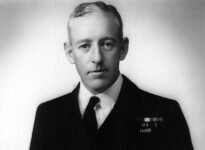
The RAN’s oldest World War II cruiser, HMAS Adelaide was instrumental in installing a Free French governor in New Caledonia and then went on to undertake the vital work of protecting merchant shipping. But perhaps her ‘greatest naval day’ was on 28 November 1942 when she encountered a suspicious vessel in the Indian Ocean while escorting a convoy. One of her officers of the watch, the then 20 year old Sub-Lieutenant Mackenzie ‘Mac’ Gregory recalled the action in the Summer 2005 edition of the Journal of the Australian Naval Institute.

HMAS Adelaide meets the German blockade runner Ramses in the Indian Ocean in November 1942
HMAS Adelaide, a 6-inch gun light cruiser, was laid down on 20 November 1915 at the Naval Dockyard at Cockatoo Island, but was not completed until 31 July 1922. Originally built as a coal burner, she was converted to oil in 1939 with a stowage capacity of 1420 tons.
In April 1924 Adelaide joined the Special Service Squadron of the Royal Navy, and accompanied them for part of their world cruise. This resulted in Adelaide becoming the first RAN ship to traverse the Panama Canal. April 1925 found her back home in Australia as a member of the RAN Squadron. The cruiser spent 10 years in reserve from June 1928 before returning to Cockatoo Island for modernisation and refit.
In March 1939 the ship was recommissioned, only to be placed back into reserve in May. The imminence of war between Britain and Germany gained her a reprieve and 1 September 1939 found Adelaide back on active duty with Captain Harry Showers, RAN in command. Her role was the defence of trade on Australia’s eastern seaboard.
With the French capitulation in Europe in 1940, the pro-German Vichy Government moved to establish control in French overseas territories, including New Caledonia. This initiative gave the Australian Government cause for alarm as they had no wish to allow such a strategic weakness in their sphere of influence. Adelaide was promptly dispatched to Noumea to prop up the Gaullist Free French movement. The move was successful and the pro-Vichy Military Governor handed over to the Free French appointee on 19 September. Adelaide returned to Sydney in early October 1940 with her mission satisfactorily achieved. Over the period May-July 1942 Adelaide undertook a refit at Garden Island, including the fitting of six 20-mm anti-aircraft weapons. She then sailed to Fremantle in Western Australia for convoy and ocean escort duties in the Indian Ocean.
I joined the heavy cruiser HMAS Canberra as a sub-lieutenant RAN in December 1941, and was there awarded my Watchkeeping Certificate. I was the Officer of the Watch at the commencement of the battle of Savo Island on 9 August 1942. We were sunk that night alongside the three US heavy cruisers Quincy, Astoria and Vincennes. I returned to Australia to re-kit and enjoy two weeks survivors leave, and was then appointed to Adelaide. I barely had time to settle in. On 23 November 1942 in company with the Dutch light cruiser HNLMS Jacob van Heemskerck we sailed from Fremantle with three merchant ships loaded with oil drilling equipment bound for Abadan.
German MV Ramses
Built in 1926, the German MV Ramses of 7982 tons with a speed of 12 knots had left Hamburg on 31 July 1939 for Shanghai. She arrived on 25 August, and became stranded on the outbreak of war on 3 September. She remained in Shanghai until she sailed for Kobe on 21 March 1941. In May she sailed to Darien where she loaded soya beans and rubber before sailing for Valpariso on 20 May. En-route, Ramses was turned around and told to steam for Yokohama. She arrived on 30 July and her cargo was unloaded. She then remained in Yokohama, serving as a prison ship, and housing those Allied sailors captured by the several German armed merchant raiders prowling the world’s oceans. During this period the Japanese fitted three scuttling charges in Ramses, each one suppled with a time delay mechanism of eight minutes.
Ramses now loaded into her lower holds 4200 tons of whale oil, 700 tons of fish oil, 700 tons of lard, 50 tons of coconut oil and 300 tons of tea. After languishing in the Far East for over three years, Ramses sailed at last on 10 October 1942. She cleared Yokohama bound for Batavia via Kobe, and Balikpapan in Borneo. Here she offloaded about 1000 tons of general cargo including building supplies and some very important beer.
The Batavia stop was most important – to load 4000 tons of rubber which was a commodity in desperately short supply in Germany. She also loaded 1500 cases of quinine destined for Bordeaux. Ramses sailed for France on 23 November 1942 and planned to run the Allied blockade. A great deal of attention was given to the placing lookouts in the ship and three soldiers and three seamen on each watch were given this duty. One was placed in the crow’s nest, one on each bridge wing, one forward, one aft and one as a spare. Each man was supplied with a powerful set of binoculars, a telephone was connected to the crow’s nest and both the aft lookout and the helmsman wore a telephone headset.
Ramses was fitted with only light armament: two 20-mm guns on each side of the bridge, two machine guns atop the charthouse and two British machine guns mounted aft. On the poop was a large dummy wooden gun fitted with its own wooden platform – this life-like contraption had been supplied and fitted in Japan.
The crew in Ramses were not naval – Captain Falke was a merchant navy officer – and consisted mainly of German merchant sailors and a few Finns. The only service personnel were the 15 gunners, one lieutenant and 2 petty officers.
Ramses was ordered to proceed from raider to raider in the Indian Ocean (she was due to rendezvous with a raider on 29 or 30 November to collect more prisoners taken from allied ships). Having reached the Atlantic Ocean she would be similarly passed from U-boat to U-boat. Finally, when close to Europe, a Focke Wulfe Condor aircraft would provide protective cover. All the crew had been promised the new Blockade Runners’ Badge. The badge was surrounded by a chain, with a central image of the Bremen breaking through.
Running the blockade
At 1416 on 28 November 1942 Adelaide‘s, masthead lookout reported smoke 20o on the starboard bow. This was followed by a report of two masts in view, then the top of a funnel. Within two minutes bridge personnel could see the tops of two masts. We altered course towards the target and increased speed, while at 1422 the quarry turned away and began to broadcast a distress message ‘RRR Taiyang followed by a suspicious vessel‘. No trace of such a named vessel could be found in any shipping publication we carried on board. At 1450 we closed up to Action Stations and all our main armament trained to starboard on this unknown ship.
At 1519 we intercepted a further distress signal sent on a commercial wavelength reading ‘RRR Taiyang still chased’. By 1528 we were well placed on the unknown ship’s beam. Our commanding officer, Captain James Esdaile (a 1913 Naval College entry classmate of Harry Showers) was ably assisted by our navigator, Lieutenant J.W. Penny who had served for many years in the merchant navy, and had experience of the construction details of a host of merchant ships. He quickly produced a photograph of the German ship Ramses from a pool of ‘German Armed Merchant Vessels and Merchant Vessels’.
The ship under observation at this stage flew a Norwegian flag, but in all essential details she appeared to be Ramses. With Adelaide 12000 yards from the target, it was time for decisive action. Captain Esdaile was not going to be caught approaching too close to this ship. He was aware of the fate of (fellow 1913 Entry classmate) Captain Joe Burnett and HMAS Sydney. On 19 November 1941, she was sunk in a fiercely fought battle with the German raider Kormoran, resulting in the loss of Sydney‘s entire crew of 645 officers and sailors.
By 1530 Ramses was almost stopped in the water. Two boats were lowered on her port side. Some eight minutes later we saw an explosion at her stern. The wind quickly blew smoke to cover the whole of her port side. Only her masts and the top of her funnel remained visible. Adelaide opened fire, as did Heemskerck, and Ramses sank at 1552.
The crew had all abandoned the ship, except for her captain, the OIC of the gun crews, and the wireless officer, all of whom were completing the extensive scuttling arrangements. However, hits from Adelaide‘s third salvo quickly hastened their departure. As Ramses slipped beneath the surface, her main 6-inch armament, the wooden gun complete with its wooden platform, gently floated off. We suddenly realised why we had not been subjected to fire from that source.
Heemskerck was ordered to rejoin the convoy and we busied ourselves with picking up the survivors. Seventy-eight crew were now prisoners of war, and ten allied merchant sailors were suddenly no longer prisoners but free men again. How the vagaries of war may suddenly change one’s luck! Then a dog and a pig swam alongside, to be quickly rescued. My most vivid memory of this action was the sight of our sailors stopping the rescue of the German survivors to get the dog and pig safely on board, showing their priority in the rescue operation. I became quite attached to the dog, but after our arrival in Fremantle, where we disembarked the allied sailors and the German POWs, the Australian quarantine authorities insisted on it. I believe the pig was disposed of appropriately en route to Fremantle.
Conclusion
Our sharp lookout located Ramses, a quick identification sealed her fate, with the combination of scuttling charges and accurate allied gunfire preventing her valuable cargo reaching Germany. Ten allied sailors were freed to fight again and for the 78 Germans, the war was over.
Post Script
In 2003 Ward Carr, an American freelance journalist living in Germany, contacted me. By pure chance his father-in-law had been with the Afrika Corps in World War II, and he had a cousin who had served in the German Navy. Willy Schruefer had been a member of the prize crew that took over the British merchant ship Speybank, captured in the Indian Ocean on 31 January 1941 by the armed raider Atlantis. Speybank was sailed back to Germany, converted to an auxiliary mine layer and renamed Doggerbank. Willy sailed to Kobe in this ship, and was transferred to the Ramses. He thus became a POW and was on board Adelaide at the same time as myself in November 1942. Indeed a small world!
In August 2004 an email from Helena Mende in New Zealand informed me that her father-in-law, Gerhardt Emil Herman Mende, like myself now 82, had also served in the Ramses as a merchant seaman. He was a POW in Australia until the war ended, was repatriated to Germany and then migrated to New Zealand where he settled and married. Oh the wonders of the Internet – I never cease to be surprised just how it may link lives together across the world. From 1942-2004, the blockade-runner Ramses is the common link.
About the Author
Lieutenant Commander Mackenzie ‘Mac’ Gregory was born in Geelong in 1922. His father was a steward at Osborne House, Geelong which was the interim Royal Australian Naval College (RANC) (1913-14) and then submarine base (1919-24). The joined the RANC in 1936. During World War II he served in the cruisers HMAS Australia during the Dakar action, HMAS Canberra (Battle of Savo Island), HMAS Adelaide then from 1944 HMAS Shropshire for the Philippines campaign and the Japanese surrender in Tokyo Bay. Post war he served as ADC to the Governor General, Sir William McKell and retired from the RAN in 1954. ‘Mac’ Gregory wrote extensively about the RAN, he also led the efforts to erect the lone sailor ‘Answering the Call’ statue on the foreshore of Port Melbourne. He died in 2014 aged 92.
Mac’s naval history website – Ahoy – Mac’s Web Log is still accessible at https://ahoy.tk-jk.net/index.html