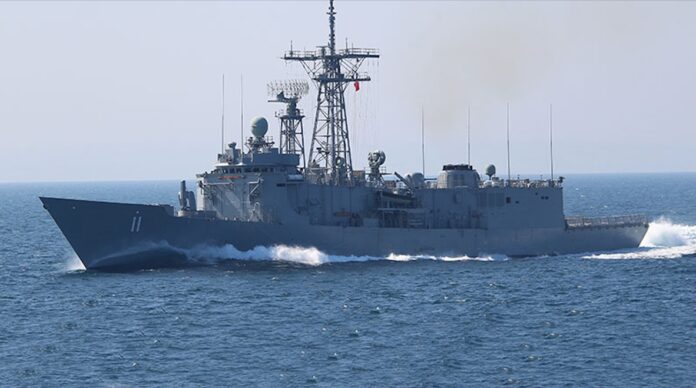
The mid-life modernisation of surface combatants has been a vexed issue over the history of the RAN. When to do it? How comprehensive? Is it worth the expense compared to a new build? The FFG Upgrade was wide-ranging in scope, expensive and delayed, but resulted in some of the most capable frigates afloat. In Headmark 130 published in December 2008 Commodore Lee Cordner wrote a very comprehensive article about the project that will be relevant for the Navy going forward.
The most capable warships in the Navy’s history set to join the Fleet
The most capable warships in the history of the RAN will soon be in service. But how can that be with the first of the Hobart class Air Warfare Destroyers (AWD) more than five years away? Fortunately, the Navy and the Nation will not have to wait that long before four very capable surface combatants are again operational in the Fleet. The upgraded Adelaide Class FFGs are planned to re-enter service as fully operational front-line warships over the next 12–18 months. They will bring what will in some respects be an advanced level of combat capability unprecedented in the RAN. This article analyses the Upgraded FFG, the capabilities that it brings and the challenges and opportunities it presents for the Navy and the ADF.
No analysis of the Upgraded FFG would be complete without first briefly reviewing the policy context that resulted in a decision to proceed with an upgrade, and the FFG Upgrade Project experience. Like most major Defence projects the FFG Upgrade Project (Project SEA 1390) had a long gestation period. Although the project is a capability upgrade to an existing platform rather than a new build, the time taken from concept to the capability being fully operational will be more than 15 years. The FFG Upgrade Project has drawn attention to many Defence policy and project management issues that will briefly be considered here. Whilst project, contractual and audit difficulties have been aired in parliamentary committees and the media, the capability gains and advantages for the total Naval force have not been as well understood. This article seeks to enhance that understanding.
Defence Policy and the FFG Upgrade
The FFG Upgrade Project reflects the outcomes of evolving, indecisive Australian Defence policy making and relatively low levels of national investment in Defence that have marked the Australian experience over several decades. This has impacted negatively on the development of the surface combatant force along with other areas of Defence capability. Procrastination followed by time and cost overruns has largely been the characteristics of Defence procurement; characteristics that are in many respects reflected in the FFG Upgrade Project experience.
In the 1987 Defence white paper the Government announced that the Navy would be expanded “…to a force operating 16 to 17 major surface combatants”. The 1991 Force Structure Review (FSR 91) recognised that the surface combatant force was declining in numbers (it was then down to 10 ships) and indicated a planning intention to replace the DDGs with “an Anzac derivative” to “maintain the continuity of Australian shipbuilding, to achieve commonality … and to build the number up to 16” with the suggestion that “Anzac derivatives could also replace the first four FFGs”.
Prophetically, FSR 91 went on to state: “the ADF has for some time followed a program of mid-life modernisations of the destroyer force… (which) without exception, have been lengthy. Reduced operational availability, together with considerable capital expenditure, have been the consequences of these programs. The concept of mid-life modernisations is not cost effective, and will not continue.” When FSR 91 was presented the DDG Modernisation project was still underway, with prospects of a limited return on investment for those ships.
Notably in this context, the Anzac class frigates were replacements for the River class destroyer escorts; very much at the low-end of the ADF major surface combatant range of capabilities. The chosen Meko 200 base design would be unlikely to provide the space and weight necessary for the significant capability enhancements required to replace the FFGs (and the DDGs). In particular, evolving air warfare (including Aegis phased array radar derivatives and long-range vertical launch air warfare missiles) plus helicopter support capabilities and potentially unmanned aerial vehicles (UAVs) in the future (the Anzac has only one hanger) would be beyond that which a Meko 200 platform could reasonably support.
Not withstanding the FSR 91 pronouncement, due to concerns about platform and system supportability, the FFG Upgrade Project was initiated in 1993. A Surface Combatant Force Study during 1993-96 concluded that given evolving anti-ship missile (ASM) and other threats, the FFGs also required an increase in capability; particularly improved self defence. A request for proposal (RFP) was released to industry in 1994 which led to a request for tender (RFT) in 1997.
By 1997 defence policy statements indicated that 14 major surface combatants were considered an adequate number and the intention to substantially invest in “ASM defences and other upgrades for the FFGs and Anzacs” was declared. By this time the three DDGs were approaching their end of life and were to be retired from service without replacement, significantly reducing the Navy’s air warfare (AW) capability.
The question of surface combatant numbers was left unanswered in the 2000 Defence White Paper other than the (6) FFGs were to be replaced by “at least three air-defence capable ships”. Upgrades to the FFGs plus the Anzacs were also identified to occur. In 2007 Government policy recognised that “Our Navy must be able to establish sea control and operate freely within our region, while denying such freedoms to an opponent.” Given the vast maritime geography and dependence upon the maritime domain for economic, environmental and territorial security for Australia and its region this bold defence policy assertion appears entirely justified. Concomitantly, this policy statement raises reasonable expectations that Australia would seek to acquire a significant surface combatant fleet to operate in collaboration with submarines and land-based air forces. While the acquisition of three AWDs and upgrades to the Anzac and Adelaide class frigates were mentioned, no mention was made of surface combatant numbers or acquisitions beyond the AWDs.
The ADF has 12 major surface combatants (8 Anzacs and 4 FFGs). The Anzacs are shouldering the operational burden which includes ongoing commitments in the Persian Gulf while the FFGs are being upgraded. There is some overlap between when the AWDs are planned to enter service during the period 2014-2017 and when the remaining FFGs are planned to be retired between 2015 and 2021, noting that there will typically be a considerable trials and acceptance period beyond 2014 until the first AWD will be fully operational.
The FFG Upgrade Project
The FFG Upgrade Project began in earnest when the RFT was released which led to ADI Ltd being selected as the prime contractor in 1998. The contract to proceed was signed in 1999. The initial plan was for all 6 FFGs to be upgraded and the Project includes the procurement of 6 ship sets of equipment plus an FFG Warfare Systems Support Centre (WSSC), a Combat Team Trainer and three Operator Trainers.
The FFG Upgrade Project is more an end of life than a mid-life modernisation. The prolonged concept to upgrade timeline with attendant project delays meant that the cost effectiveness of upgrading the older ships could not be justified. In late 2003 the Government determined that Canberra and Adelaide would not be upgraded. They have since been withdrawn from service.
The Project has proven to be challenging and extremely complex. The FFG Upgrade is one of the most sophisticated and extensive enhancements ever undertaken of a modern surface combatant. It involves major weapon, sensor, combat, and command and control systems upgrades along with significant platform supportability work. The system integration work is in some respects unique in the world with the challenge of combining legacy systems from the original FFG configuration (1970s technology) with more advanced technologies drawn from a range of international sources. In addition to the upgrade specific activities many platform deficiencies and deep maintenance issues also had to be rectified to ensure a planned 35 year hull life could be achieved. Effectively this required the ships to undergo major refits concurrent with the upgrade.
The complexity of the Project and its implementation was no doubt underestimated from the outset. Navy, Defence Capability Development (DCD), Defence Material Organisation (DMO) and the prime contractor, ADI Ltd now trading as Thales Australia Ltd have been party to what became an ongoing series of schedule slippages to the extent that the Project is now four and half years late (i.e. the first of the Upgraded FFGs should have been in operational service by 2004). Following an extensive negotiation between DMO and the prime contractor a Deed of Settlement and Release was signed in 2006 that presented a revised master schedule with Contract Final Acceptance due in December 2009.
The extensive delays had resulted in a project climate of frustration and disappointment for all concerned. The situation was exacerbated by a set to work and trials period plagued by systems interface and perceived performance shortcomings, with several major systems initially failing to meet acceptance criteria. The main problem areas have been underwater warfare (UW), electronic surveillance (ES) system, and the central Australian Distributed Architecture Combat System (ADACS), with Link 16 and other significant operational features being progressively incorporated. Of late, more collaborative DMO contractor approaches with a sharper end capability focus have shown dividends, with substantial progress on rectifying problem issues and demonstration of improved performance.
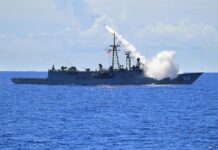
There have also been highly successful and impressive results during the trials and introduction to service period. For example, during ASM defence trials involving HMAS Sydney on the US Navy’s fully instrumented Pacific Missile Range Facility (PMRF) off Hawaii in October 2007 the combination of the upgraded air warfare (AW) package of improved sensors, vertical launched Enhanced Sea Sparrow Missile (ESSM) and ADACS successfully dealt with multiple, simultaneous, multi-directional live ASM attack (using realistic drone missile targets). This event included a successful live ESSM engagement. Incorporation of the 32 cell Mk.41 Vertical Launch System (VLS) into the FFG hull is a considerable naval architectural design feat which helps fulfil one of the key requirements for effective ASM defence in the Upgraded FFG. The ADACS combat system has been developed in Australia and is unique to the Upgraded FFGs.
Given the operational environment of the Navy’s ongoing Middle East commitment a fully functioning, integrated ES capability has been identified as the highest priority outstanding requirement to support acceptance and deployment by the Navy. Navy has understandably taken a firm stand in demanding that the Project demonstrate fully functional operational capabilities. In early 2008 DMO, with strong support from and direct involvement of the Hon. Greg Combet, Parliamentary Secretary for Defence Procurement, established an FFG ES Stakeholders Group. This group includes representatives from all the major players including Navy, DMO, Thales and Rafael (the subcontractor for the C-Pearl system).
A number of significant people and perception casualties have resulted from the extensive Project delays and the failure of some systems to achieve satisfactory results during initial acceptance trials. Within Navy the FFG Upgrade Project and the Upgraded FFG has become known as a “lemon”. Some FFG officers and sailors appear to have lost confidence in the ships and the improved capabilities the upgrade offers. These internal to Navy perceptions will be difficult to rectify as the challenges are progressively addressed and fully operational, high performing systems are accepted in to service. Further, the incoming Labor Government has rightly put Defence on notice about poor project performance. No doubt the FFG Upgrade Project stands out as one of several troubled projects. The media, both nationally and internationally has understandably been critical of the project and this in turn impacts on morale among people in the FFG Fleet.
There are parallels here with the situation that obtained when the Collins Class submarines were encountering problems during introduction to service. The overall result is that Navy (and Defence) is faced with a crisis of confidence both internally and with Government, and this has significant implications for national security. The situation must be resolved satisfactorily and expeditiously.
Considerable progress is now being made due in no small part to a more collaborative approach to solving problems and dealing with challenges generated through initiatives like the FFG ES Stakeholders Group. There is now an atmosphere of cautious optimism that the Upgraded FFG will “get across the line” and highly capable warships will soon be back in operational service.
Key FFG Upgrade Project Milestones
Many important lessons about the management of complex defence projects have been learnt (or relearnt) during this extended and often frustrating project experience. While it is beyond the scope of this paper to identify or analyse the project lessons in any detail, some of the major lessons include:
- Effective, comprehensive and detailed project planning is essential. Early planning shortfalls can have disproportionate downstream consequences.
- Requirements and specifications must be well defined and agreed before contract signature. The lack of clearly defined specifications for many of the FFG Upgrade Project requirements has meant that assessing contract compliance and operational performance against that specified has proven to be extremely difficult.
- Lack of expertise to define requirements and manage and implement the project has proven to be a significant and difficult matter for all parties: Navy, Defence, DMO and the prime contractor.
- Careful consideration must be given from the outset to the systems integration implications of combining legacy systems with more recent technologies.
- Conducting an upgrade of an existing capability concurrent with maintenance availability is a highly complex activity that requires careful planning and close cooperation and collaboration in execution.
- The contract and schedule must be robust and achievable. There must be thorough risk appraisals and risk management processes in place particularly where significant technical, schedule and financial risks exist with a complex project.
- Effective communication and the creation of a cooperative and collaborative environment between all parties, focussed upon solving problems, are essential from the outset. There must be a clear focus by all parties on the requirement to deliver a functional capability to the customer in a cost effective and timely way. The customer must be closely engaged throughout.
The Upgraded FFG – Capability Analysis
As indicated in the introductory remarks, the Upgraded FFG presents a higher level of combat capability than previously available in the RAN. This may sound like a grand claim, but is backed by tangible evidence. The following analysis will draw together and assess the key elements of the FFG systems package that when fully operational and combined with a well prepared, led and motivated ship’s company, comprises an impressive naval combat capability. This analysis will look at the principal naval warfare areas in turn before drawing the total assessment together, recognising that the FFG is an integrated, multi-role weapon system where components of the platform, the weapons systems and the combat system will contribute variously to multiple warfare competencies.
Air Warfare (AW)
A primary aim of the FFG Upgrade Project was to improve the AW capability generally and particularly defences against new generation ASMs, including sea skimming missiles. The Upgraded FFG offers a more comprehensive and complete AW and ASM capability package than hitherto available in the RAN. A classic layered defence approach is adopted, involving hard kill and soft kill capabilities. The key elements of the layers are reviewed below.
The outer layer of hard kill comprises fighter aircraft, whether operated by the ADF or coalition partners, land-based or carrier borne, and combined with Airborne Warning and Control Systems (AWACS) when available, plus the surface to air missile capabilities of other RAN and allied warships that may be operating together. The FFG’s ability to effectively integrate with US and NATO forces for example, and to direct fighters is greatly enhanced with the inclusion for the first time in the RAN of Tactical Digital Information Link (TADIL) J Link 16, added to TADIL B Link 11 and using the Joint Tactical Information Distribution System (JTIDS) for data link communication. This capability effectively enables the FFG to direct the prosecution of hostile aircraft, whether missile carriers, fighter bombers or surveillance aircraft hundreds of kilometres away. An enemy’s surveillance, target selection and identification problem becomes vastly complicated by imposing an extended stand-off range; and hostile aircraft can be engaged before they can launch anti-ship weapons. It also presents a much improved capacity for RAN integration with US-led coalitions.
The subsequent layers of AW capability rely primarily on ship borne sensors and weapons although these can also be cued with information from other sources like AWACS or other ships via Link 16. The air surveillance capability of the FFG has been considerably enhanced by inclusion of an updated air surveillance radar, the AN/SPS 49A(V)1, which provides a much improved ability to detect low altitude and small radar cross section targets, and includes automatic target detection, improved reliability and other features. The operational performance of this radar has proven to be considerably better than the variant it replaced and gives high confidence in the early detection of aircraft and missile targets.
The AW fire control system has been greatly enhanced with inclusion of the Mk.92 Mod.12 system, which is a further enhancement of the Mod.6 system in service with US, Spanish and Taiwanese FFGs. The Mod.12 system includes the same coherent receiver and transmitter (CORT) of the Mod.6 variant plus improved signal processing, solid state electronics and improved reliability over the Mod 6. Mk.92 system performance is enhanced by inclusion of a new Radar Sensor Data Fusion System (SDFS), which provides a Radar Integrated Automatic Detection and Tracking (RAIDT) capability that combines data from all the ships search radars (AN/ SPS 49A(V)1, Mk.92 CAS search, AN/SPS 55 surface search radar) plus the two Mk.92 system fire control radars. The outcome is the automatic detection of targets, automatic correlation of multiple radar detections and accurate prediction of target movement to the Command team and weapons systems.
The range of the Mk.92 CAS fire control channel is more than double that of the earlier variants being now more in line with that offered by the Mk.92 STIR fire control channel. This vastly improved and automated sensor combination means that the reaction time for detect, track, decision, fire control radar acquisition, to firing a weapon at a target is greatly reduced. This enables the engagement of multiple, multi-directional and quickly manoeuvring air and missile targets at a much greater range from the FFG than was previously possible. The capability was practically demonstrated during the PMRF ESSM firings by Sydney mentioned earlier. The performance of the upgraded Mk.92 system is reported to be “excellent”.
The improved radar and weapon system performance is supported by a vastly improved surface to air missile capability. The GMLS 13 missile launcher system has been retained with its potential to carry and launch up to 40 missiles. The system will be upgraded so that SM 2 Medium Range surface to air missiles can be accommodated along with the older SM 1 missiles and the latest variants of the Harpoon surface to surface missile. SM 2 missiles are reported to be entering the ADF inventory in late 2009.
Inclusion of the SM 2 option represents a major enhancement to the Navy’s AW capability with significant force multiplier implications. The SM 2 missile has a maximum range of more than 80 nautical miles (nm) (150 km) compared with the SM 1 missile maximum range of 25 nm (46 km) and the ESSM maximum range of around 10 nm (18 km). SM 2 and ESSM missiles are also reported to have much improved fusing arrangements and therefore effectiveness when engaging very low targets. This means that the surveillance, identification and targeting problem for hostile aircraft seeking to attack or direct an attack on a force at sea protected by an Australian FFG has become a whole lot harder. Previously, when friendly fighter cover was not available, a hostile aircraft could loiter with impunity, conducting surveillance and launching weapons or directing attacks from outside the FFG SM 1 missile engagement zone (MEZ) of 25 nm or the Anzac MEZ of 10 nm.
For the first time the RAN has a genuine ship borne surface to air missile-based area defence AW capability. This means that an FFG can offer effective cover for ships it is escorting as well as for itself; it can provide AW force protection over a significant and moving geographic area. With this capability entering the ADF inventory the circumstance that obtained during the early stages of the Australian-led, UN authorised intervention in East Timor in 1999, where a USN Aegis cruiser had to be relied upon to provide effective air defence cover for the landing force, will not be necessary in the future when an RAN FFG is available.
ESSM missiles deployed from a 32 cell Mk.41 VLS provide a highly effective third layer of hard kill ASM defence. The performance of this system, when combined with the Upgraded FFG radar and fire control package, is reported to be excellent. The ESSM capability offers ASM defence redundancy not previously available in the FFG because the GMLS 13 launcher was potentially a single point of failure.
In addition to the missile capabilities, a fourth layer of hard kill air defence is provided by the 76 mm rapid firing gun. The gun effectiveness has been significantly enhanced by integrating the existing Electro Optical Tracking System (EOTS) 2500 with the Mk.92 system. This capability includes a laser range finder and enables an additional three dimensional gun fire control channel to be integrated with the two radar directed channels of fire. The fifth, last resort defensive layer is the Phalanx 20 mm close in weapon system (CIWS), which is now integrated with the ADACS combat system providing a remote designation capability.
The inner layers of AW capability include the Australian designed and developed Nulka off-board, active ASM decoy. Two additional Mk.137 Mod.1 decoy launchers able to deploy new Seagnat RF decoys and Pirate IR and acoustic decoys along with long range chaff rockets (for confusion) complete the soft kill ASM (and anti-torpedo) suite.
An upgraded ES system is a major component of the enhanced AW capability; critical to sending an FFG in harms way. An effective ES capability is important for cuing hard kill weapons and soft kill measures like Nulka as well as for target identification. The AN/ SLQ 32 ASM warner has been replaced with the current generation Rafael C-Pearl digital combined electronic surveillance and ASM warner system. The system covers the 0.5–18 GHz frequency spectrum and is fully integrated with the combat system. The system has high sensitivity and a high data rate. Significant system integration, perceived performance and human machine interface (HMI) problems have been encountered during trials, which have resulted in low confidence in the ES system among some FFG personnel. As a result of the concerted and collaborative efforts of the FFG ES Stakeholders Group numerous technical issues have been identified and resolved. The Stakeholders are working to present an operational ES system that will meet Navy’s requirements consistent with the Acceptance timetable.
Surface Warfare (SW)
Many of the capabilities enhancements touched upon in the AW analysis are also relevant to SW. The Harpoon system has been upgraded so that the latest variants of the missile can be deployed from the GMLS 13 launcher. The SWG 1(A) Harpoon control panel has been installed in the Operations Room. Harpoon remains a very potent SW weapon with its 80 nm (150 km) range, way points, anti-countermeasures and terminal attack features. A significant aspect of the SW package is the ability to employ the embarked Seahawk helicopter’s surface surveillance, targeting and data link capabilities to provide over the horizon targeting (OTHT) for Harpoon engagements. Other upgraded features, including the fully integrated EOTS with laser range finding for the 76 mm gun, add to a potent SW capability.
A concerning aspect of Navy’s overall SW capability not directly applicable to the FFG Upgrade but relevant to SW capability options that could be available for employment from the FFG and other RAN surface combatants is the failure of the Super Seasprite Helicopter Program. This helicopter was originally procured to be deployed from Anzac Class frigates and Offshore Patrol Vessels (OPVs) (the OPVs never came to fruition). ASM armed helicopters deployed from surface combatants remain a most effective weapon option against missile armed patrol boats and larger surface combatants optimised to operate in the littoral and archipelagic areas in Australia’s region. While there are well founded concerns about the emergence of submarine capabilities in the region the missile armed patrol boat remains a considerable threat and the ADF continues to have a significant capability gap in effectively dealing with this threat.
Underwater Warfare (UW)
The Upgraded FFG offers the most advanced and comprehensive surface combatant based UW capability now available in the RAN. Somewhat similar to AW, effective UW protection of surface vessels and geographic areas like approaches to ports and straits used by international shipping requires a layered defence or defence in depth approach that is asset intensive. The outer layer may include forward deployed submarines like the Collins Class and land-based maritime patrol aircraft (MPA) like the P3C Orion.
The FFG retains the capability to integrate with MPA via data link and voice communications and to coordinate, control and direct wide area UW surveillance activities. The FFGs capacity to embark and operate two S70B Seahawk helicopters presents a significant force protection.
The Seahawk employs a range of UW surveillance and localisation sensors including for example passive and active sonobuoys and high definition search radar, and can deploy anti-submarine torpedoes. The Upgraded FFG integrates information via a discrete Seahawk data link into the FFG combat system, which enables effective coordination and control of force UW efforts. The ability to embark two helicopters remains a significant asset provided by the FFG. The Anzac class frigates and the new Hobart class AWD can embark only one helicopter which impacts on the numbers of helicopters available in an RAN surface force to support operational rotation and redundancy. This shortcoming will be felt in the future as the FFGs retire from service.
The onboard UW package in the Upgraded FFG comprises several significant capability enhancements. The AN/SQS 56 and Mulloka hull mounted sonar’s (HMS) have been replaced with the second generation Spherion medium frequency HMS that provides active and passive submarine detection capabilities. The Albatross Torpedo Detection System (TDS) towed passive array has been added. When combined with the Lescut acoustic decoys, this system offers a greatly enhanced self defence capability against torpedo attack. Information from the HMS and the towed array is fused and integrated automatically into the combat system.
Like the ES system experience, initial results from the onboard UW sensor package were disappointing. Trials conducted at the Canadian Nanoose Bay fully instrumented underwater range facility have confirmed that the sensors are performing satisfactorily and system interface problems have been identified that are being resolved. Anecdotal reports from recent UW trials indicate that the combination of the HMS and towed array passive and active capabilities are giving impressive submarine detection results. Also like the ES system, significant HMI issues have been identified. The passive and active data from the HMS and towed array are presented in a single Sonar Operator Console (SOC) which is highly operator intensive. This entails a complex and high workload for the single operator; consideration is being given to addressing HMI and specifically the workload associated with concurrency tasking.
Another UW feature is the addition of the Petrel Mine and Obstacle Avoidance Sonar (MOAS). The MOAS provides three dimensional imaging and automatic detection and tracking out to around 700 metres. The MOAS is controlled and monitored from the bridge. It performs extremely well in its designed role and provides a very useful aid to navigation in confined waters. The FFG Petrel MOAS is the same as that fitted in the Anzac frigates, thus offering training and supportability benefits.
The Combat System
The FFG Operations Room (Combat Information Centre – CIC) layout remains virtually unchanged from the original configuration. However, changes soon become apparent with new flat screen colour displays, although functionality is very similar to the former arrays with the NCDS functions retained. ADACS Baseline Build 3 software package is currently undergoing trials in HMAS Darwin. This brings Link 16 capability plus a number of fixes to address software integration problems identified during trials. The incorporation of advanced command and control (C2) and decision support features like automatic detection and tracking of many hundreds of targets, dissimilar sensor data fusion, improved tracking in clutter, automatic threat grading, interfaces with weapons and sensor systems and the multi-tier weapons scheduler in the Mk.92 system significantly improve the C2 performance of the FFG and reduce operator workloads. A new Combat Data Link Management System (CDLMS) has been incorporated to enable Link 11 and Link 16 to be managed.
The upgraded C2 package includes an On Board Training System (OBTS) that provides sensor stimulation (the facility to inject false targets through the sensors) and effector (weapons) simulation to avoid safety issues. The OBTS is reported to be an excellent training aid that provides realistic presentations for operator training.
Supportability
A major feature of the Upgraded FFG and one of the main reasons for initiating the upgrade is greatly improved supportability. In addition to the weapons and sensor upgrades already outlined several obsolete and obsolescent equipments have been replaced. The combat and weapons systems are now supported by AN/ UYK 43 computers, which have replaced the AN/UYK 7 computers. Former FFG sailors will be pleased to learn that the often problematic ship’s service diesel generators (SSDGs) and 400 Hz static frequency converters (SFCs), essential to the provision of power for the ship’s systems, have been replaced. The former SSDGs have been replaced with Caterpillar diesel generators that are painted in stylish white and the SFCs are now solid state. Chilled water systems have been upgraded however the original signal data converters (SDC) have been retained.
Platform upgrades have included increasing the limiting displacement from 4100 tons to 4200 tons. Modifications have included reduced electromagnetic and acoustic signatures. Improved resilient mountings for machinery have been incorporated to reduce self noise which contributes to enhanced sonar performance.
The Upgraded FFGs are in many respects now Australian “orphans” which means that Defence must take responsibility for configuration management and through life support. This offers challenges and advantages, like full control over software management and maintenance. Inclusion of the WSSC is an important feature. A windfall logistics outcome from project delays and the decision not to proceed with upgrades to Adelaide and Canberra is that six ship sets of new equipments were procured. This means that further options for spare parts are available to support the upgraded equipments and the retired FFGs have been comprehensively cannibalised for spares to support legacy equipments.
Human Capability
Human capability is an essential component of combat capability; indeed it is the most important capability factor. Clearly the FFG Upgrade Project has been a long and frustrating experience for many of the FFG personnel involved. For example, as the lead ship to be upgraded, the Sydney team have borne the brunt of much of the initial trials programs enduring the vague and dynamic nature of contractor driven schedules.
HMI has been identified as an issue with both the ES and UW systems and there may be shortcomings in other areas. Lack of familiarity with the new systems has been exacerbated by reduced access while the systems have been in contractors’ hands. Also, given schedule slippages, initial equipment application courses soon fell out of step with posting cycles. This has meant that some personnel have experienced the frustration of not being adequately trained for the systems they are to operate. Combined with systems performance teething problems it is not surprising that there has been a “crisis of confidence” among some FFG personnel. Now that systems integration and performance problems are being resolved perception and attitude issues may soon ease. Certainly the Upgraded FFGs are fine ships with excellent capabilities and hopefully all FFG personnel will soon become justly proud of being involved.
There may however be a more complex and demanding people issue that needs to be addressed. The Upgraded FFG in many respects represents a quantum leap in capability. For example, the new ES system is far more sensitive and capable than its predecessor and indeed any ES system in the RAN inventory. Similarly, the UW package with the active/passive HMS integrated with a TDS towed array that also offers a passive detection capability, provides a far greater level of capability and accompanying complexity than the RAN surface community has previously encountered.
Configuring smart systems for optimum performance and understanding the results generated requires equally smart and experienced operators who know much more than simply how to operate the equipment. They need to have a deep understanding of the operating environment, whether, for example it is the electromagnetic spectrum for electronic warfare or the acoustic environment for undersea warfare. The generic combat system operator concept supported by application courses may no longer be sufficient.
The advent of relatively advanced, very capable and complex systems in the Upgraded FFG may serve as a useful precursor to the introduction of the even more capable and complex AWDs. There may be a requirement for the Navy to revisit the issue of deep specialisation for systems operators in the surface community.
Tactical Development
During the preparation of this article the extent to which tactical employment of the Upgraded FFG has been the subject of thoughtful and experienced consideration was not able to be ascertained. Clearly the FFG presents a significant capability enhancement and its effective employment requires considerable tactical development effort, including experimentation and fleet trials to ensure that it is employed to the optimum effect in a range of diverse and demanding scenarios. The simple fact that the RAN has for the first time a genuine area AW defence capability at its disposal means that new thinking about tactical employment of the FFG should be a priority. When combined with the enhanced FFG UW capability, in a regional security context that includes rapid qualitative and quantitative improvements to maritime capabilities, including the proliferation of submarines, the need for concerted tactical development efforts is compelling.
Conclusions
The FFG Upgrade Project grew from an evolving Australian defence policy context of indecisiveness, procrastination and lack of commitment to defence expenditure. The Project commenced in 1993 following a policy statement in 1991 that mid-life modernisations for surface combatants were considered not to be cost effective and would not continue. Concerns with supportability and survivability of the FFGs in a contemporary threat environment were the key drivers that led to the decision to proceed with an upgrade.
The contract for upgrading the FFGs was signed with ADI Ltd, now trading as Thales Australia Ltd, in 1999. The upgrade is one of the most sophisticated and extensive capability enhancements of a surface combatant ever undertaken. The parties to the Project underestimated the challenge and the Project has suffered schedule slippages to the extent that it is now some four and a half years late. Delays and relationship difficulties have contributed to frustration and disappointment for all concerned. This has impacted on confidence in the Upgraded FFG within the Navy and between the Navy, Defence and Government. Significant project management related lessons have been learnt and re-learnt in what has been a difficult project for all parties. After an extensive contract renegotiation and the adoption of a more collaborative approach, the Upgraded FFG Project now appears to be on track to achieve delivery of ships to the Navy during late 2008 and during 2009 to meet the revised schedule.
The Upgraded FFG presents a higher level of surface combatant capability than previously available in the history of the RAN. For the first time the RAN has a genuine ship borne area air defence capability. Air defence comprises several layers utilising enhanced systems and sensors combined with comprehensive hard and soft kill capabilities. The AW and anti-ship missile defence capabilities are impressive. The FFG SW capabilities have also been enhanced. The UW package is the most capable for a surface combatant in the RAN with the capacity to embark two Seahawk helicopters and improved onboard active and passive detection capabilities. These enhanced naval warfare capabilities are fully integrated with a unique Australian combat system. The combination of systems and weapons improvements provides a considerable naval warfighting capability in a compact package.
One of the key objectives of the Upgraded FFG was to improve supportability and this appears to have been achieved. Concerns remain with performance, integration and therefore acceptance of the ES and UW systems. Technical and other issues have been identified and are being progressively resolved. There is now confidence that the FFGs will soon be back in operational service.
Issues like HMI, human capability development and tactical development may require further priority attention. The Upgraded FFG provides a valuable growth path toward introduction of the AWDs and the lessons learned should be helpful when introducing that advanced warship in to service. The FFGs and AWDs will be in service together for several years, and along with the Anzac FFH, will provide the Navy and Australia with a small but potent surface combatant capability.
The Upgraded FFG is a highly capable warship that is well constituted to make a major contribution to Australia’s maritime security over the next decade. FFG personnel will continue to serve with pride and distinction in these fine ships as they again become fully operational, now with much improved capability as fighting ships.
A fully referenced version with additional tables is at https://navalinstitute.com.au/wp-content/uploads/2014/04/headmark-130.pdf
Postscript
In 2020 HMAS Melbourne commissioned into the Chilean Navy at the Almirante Latorre while HMAS Newcastle also entered Chilean service as the Capitán Prat.
About the Author
Commodore Lee Cordner AM RAN (retired) joined the RAN as a Junior Recruit in 1968 and retired as a Commodore after 49 years’ service: full-time and reserve. He served as XO of the frigate Darwin and later commanded the frigates Sydney and Adelaide. He holds a doctorate from the University of Adelaide and masters’ degrees from the US Naval War College and the University of Canberra. He is widely published as a strategic analyst with his research primarily on Indian and Pacific Ocean maritime security.