By Mark Bailey*
The Strait of Hormuz oil and LNG tanker traffic was not closed by Iranian or US action. Tankers cannot sail because their War Risk Insurance (WRI) has been withdrawn. As usual, this has all happened before.
WRI was not withdrawn exactly per 1914, because assessors could not assess risks in global war. WRI was withdrawn because of an interaction with EU financial regulations.
1914 – The Forgotten Lessons of War Risk Insurance (WRI) in a Globalised World
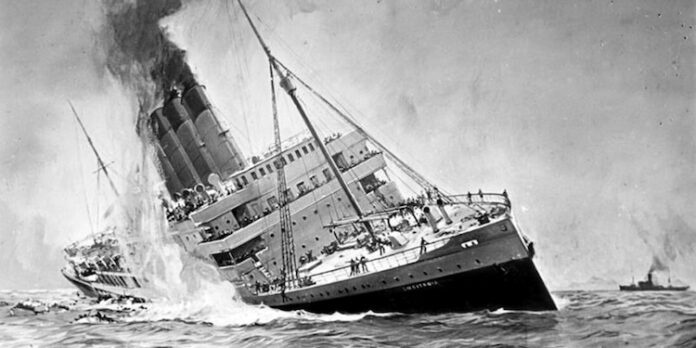
Archduke Franz Ferdinand was shot on Sunday 28 June 1914. On 23 July Austria issued an ultimatum to Serbia. On Monday 27 July finance and credit markets began destabilising as marine insurance rates rose for Mediterranean trades. Shipping charters for the Black Sea trade failed and from the 28th war risk premiums rose, spreading rapidly to all ships trading with Adriatic, Black Sea and Baltic ports. On 28 July Austria declared war on Serbia, making Austrian and Russian ships uninsurable. On 30 July war risk insurance rates on British ships started rising, starting with Baltic trades. On 31 July the first trades were suspended; German firms ordered loading of Spanish iron ore on their account suspended; German trans-Atlantic passenger-liner sailings began to be suspended that night.
When the financial industry re-opened after the UK bank holiday on Tuesday 4 August the maritime industry was shutting down. Chartering had nearly ceased and WRI rates reached 10-15%, meaning low-profit bulk goods like coal, grain and timber could not be lifted. The freight market was paralysed and financial dislocation was global, in twenty countries banks and exchanges were closed. The British government moved quickly, having guaranteed to underwrite war risks for grain and flour from North American ports.
This task fell to a sub-committee of the Committee of Imperial Defence (CID) composed of senior shipping and insurance industry figures: the Rt. Hon F. Huth Jackson (Director of the Bank of England), Lord Inchcape (Chairman of P&O), Sir A. Norman Hill (Secretary of the Liverpool Steamship Owner’s Association and manager of the Liverpool and London War Risks Insurance Association), Sir. R. Beck (Deputy Chairman of Lloyds), Mr A Lindley (a respected Average Adjuster) and CID Secretary Captain M.P.A. Hankey. They understood the central problem: no-one could assess the risks of general war. Underwriters could not estimate their exposure so insurance could not be issued until assessors were able to estimate war risks. Trade could not be permitted to stop. The machinery of how British ships could be secured against war risk was explained to Parliament by Lloyd George on 4 August right after Prime Minister Asquith reported the lack of German response to the ultimatum expiring at 2300 that night. Parliament passed the WRI scheme right after the war declaration.
WRI covered all overseas trade and prevented credit market collapse. Risks could be managed in a graduated way by adjusting insurance coverage, something no state department could do. Preparatory work meant that the State Insurance office opened on the first day of the war and was issuing provisional cover slips by 1400 on that day (5 August 1914). The WRI scheme took some days to stabilise the situation: within 48 hours of war all the major liner companies and many tramp companies joined it.
On 6 August WRI was extended to Dominion and Colonial registers. By 10 August, the cargo insurance rate had dropped from 5% to 4%, the commercial rate had dropped from a peak of 20% to 6% and the crisis was under control.
This mirrors what the US President did on 3 March 2026.
2026
WRI is over a century old and has never been withdrawn in exactly this manner. The difference is the 2016 EU Solvency II insurance regulations requiring insurance companies to have financial reserves sufficient to withstand a 1-in-200 year event. It has three pillars (Quantitative requirements including capital requirements and asset valuation; Governance and risk management standards including the Own Risk and Solvency Assessment (ORSA); and Supervisory reporting and public disclosure requirements) and was based on the Basel II banking regulations. Yet the structure was based on conventional risks, not spikes where multiple losses of tankers carrying hundreds of millions each were possible. No insurer has such reserves and raising rates cannot provide them.
Twelve P&I clubs insure 90% of global deep-sea tonnage. By 2 March seven issued 72-hour cancellation warnings for Gulf WRI. Transits declined by 80%, 43 crude carriers anchored and 13 LNG tankers diverted. The strait was closed by a logical response to EU regulation. On 3 March US President Trump ‘… ordered the United States Development Finance Corporation (DFC) to provide, at a very reasonable price, political risk insurance and guarantees for the Financial Security of ALL Maritime Trade, especially Energy, traveling through the Gulf. … available to all Shipping Lines. If necessary, the United States Navy will begin escorting tankers through the Strait …’
This is commercial WRI, the US stands to make a financial profit (doubtless worsening the invective of US anti-Trump media), demonstrating lack of popular understanding of the issues.
The mechanism is the same as in August 1914 and September 2008, where banks ceased lending because verification of counterparty solvency cost more than sort-term loans were worth. When the reinsurers cannot model the risk they cannot understand their exposure and cannot price risk. They had no option but to withdraw coverage, stopping trade. They cannot act until reinsurance risks are understood and they cannot violate EU Solvency II regulations.
This is not a strategic policy timeline.
Trump’s action will generate immense goodwill in the Gulf States but will not impact fuel disruptions for the reasons above, which hint at 6-18 months until full insurance reinstatement. Current Brent crude prices reflect estimates of a three-month disruption after which supply chains will take 3-12 months to return to normal. On 2359 GMT on 5 March the cancellation notices bit – which is exactly why the US President offered British-WWI-style state WRI. Not one tanker will transit the strait without it. This may well cut the 9–30-month disruption down to 4-6 months. Success looks like Hormuz transits at the normal 60 per day. If that happens then it may take only 4-6 months to regain full stability. As of 5 April, seven ships were in transit (not 60), just .8% of normal and the WRI premium was 5%, 60 times the normal 0.15%.
The Houthi Red Sea issue did not trigger P&I withdrawal yet premiums remain elevated after years. The 2008 bank crash took nearly two years to normalise with massive taxpayer injections: the maritime insurance market will get no such support.
*Dr Mark Bailey, BA, MDefStud, PhD, Lieutenant Commander RANR, Naval Studies Group Fellow, Australian Defence Force Academy, Adjunct Lecturer UNSW ADFA, Research Associate King’s College London. Coordinator. The Corbett Forum