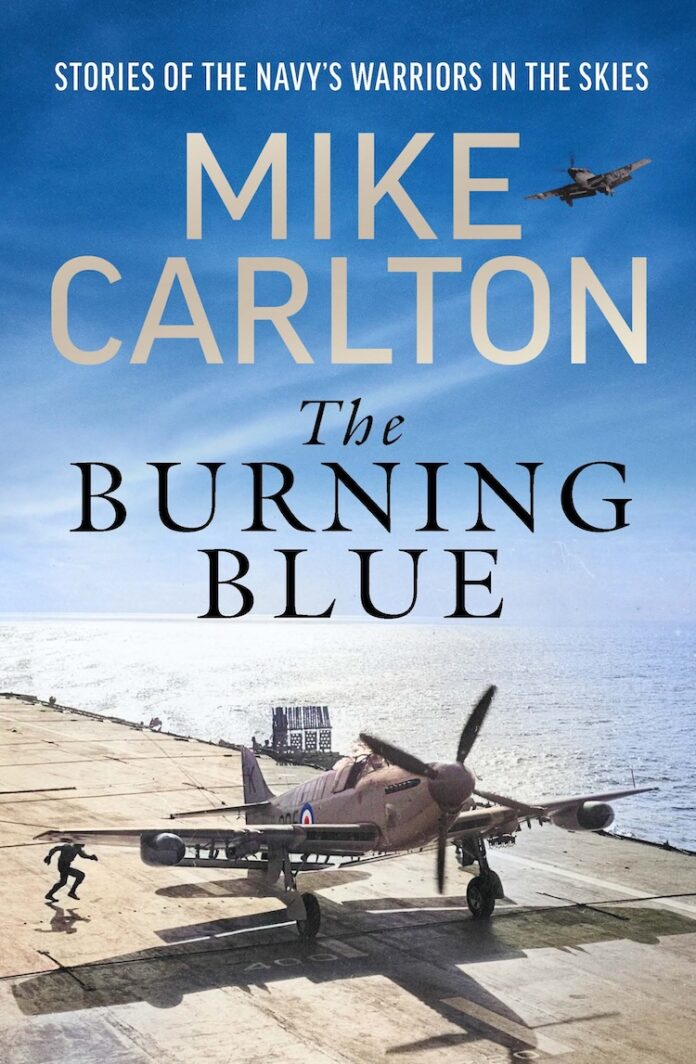
The Burning Blue: Stories of the Navy’s Warriors in the Skies. By Mike Carlton. Penguin Random House, Australia, 2026 . 420 pages with 53 photographs. https://www.amazon.com.ai/Burning-Blue-Stories-Navys-warriors-ebook/dp/B0gyt94H9
Reviewed by Desmond Woods
Mike Carlton has now written six books which document the history of Royal Australian Navy. He started writing in 2016, that is a decade of recording history often from last living sources. He does deep research into multiple archives and books and online resources making use of the Seapower Centre- Australia’s collections.
He started doing this epic study of the Navy’s history because Admiral James Goldrick asked him to do so. James recognised that for Australians to start reading the story of their Navy at war in the twentieth century the narrative needed to be presented to them by a storyteller and journalist, who had the gift of being able to put human faces on to the vast canvas of war at sea.
Burning Blue is the sixth in this series and it as every bit as engaging as the previous five volumes. James Goldrick’s faith in the author is once again vindicated. He would have highly approved of the Chief of Navy’s Gold Commendation which Mike Carlton received after his last book Dive which tells the stories of Australian submariners.
The events of the post 1945 RAN Fleet Air Arm, and its people, have been covered in two volumes of Flying Stations. Burning Blue goes half a century further back in time and deeper into the social history and context in which the story of Australian naval aviation is embedded.
The Great War
The starts with origins of flight in Australia and then narrates the extraordinary stories of Australian naval aviators who found themselves flying, and fighting for their lives in combat, less than a decade later. The exploits of young Australians serving in the Royal Naval Air Service (RNAS) fighting and dying over the trenches of the First World War are hardly known. Mike Carlton vividly describes them and the Australians who pioneered the use of aviation for warfare.
On Churchill’s instructions Australian RNAS pilot Arthur Longmore was the first aviator to drop a torpedo into the sea and have it run to its target. Harry Hawker, from Victoria, was the Chief Test Pilot for Thomas Sopwith’s aircraft with which the British contested the skies over the battlefields of northern France. Though Harry was killed in a flying accident in peacetime his surname lived on in the fighters of the Second World War.
From Melbourne came Sub Lieutenant Alec Little, who was a gifted marksman, who never entirely mastered landing safely and who transformed in the skies into the highest scoring Australian fighter pilot of either world war, with a tally of forty-seven enemy aircraft shot down. He was killed just before his 23rd birthday. By then he had been awarded the DSO and Bar, the DSC and Bar and the Croix de Guerre.
At sea the RAN’s two light cruisers Sydney and Melbourne were the first to embark aircraft on platforms over their forward gun turrets. This was the inspiration of the CO of Sydney, Australian born Captain John Dumaresq.
The Sopwith Camels were launched to attack Zepplin airships over the North Sea. On ditching the pilot was expected to release his harness and as the aircraft wheels pitched the aircraft forward on striking the sea, be thrown out of his cockpit and over the wing above him into the sea. Theoretically he could survive and be rescued. Sometimes this dangerous manoeuvre worked.
Between the Wars
Burning Blue continues with the social history of Australian aviation starting with the political victory of the RAAF over the Navy when it came to flying at sea. The Chief of Air Staff demanded that Government policy should dictate that only the RAAF would provide pilots on Navy ships.
The RAN was restricted to providing observers and mechanics. There was to be no Fleet Air Arm and all maritime aircraft were to be owned by the RAAF. The result of this single service folly was, as in UK, mismanagement, poor resourcing and a waste of potential. Not till after the next war would the RAAF Chief of Staff be told by Prime Minister Ben Chifley that the Navy would have a Fleet Air Arm and would crew and fly its own aircraft at sea and ashore.
The first flight around Australia’s entire coast was made in 1924 by former RNAS observer Jimmy Goble and pilot Ivor McIntyre, AFC. They carried small arms and a rifle in their seaplane in case they encountered hostile natives in the outback, where not all tribes had encountered Europeans. None were hostile.
They set a record for this aviation circumnavigation as no one else had ever attempted what they achieved – a mapping from above of the most useful looking bays and harbours and potential ports for the Navy.
Admiral VAT Smith
Burning Blue deals well with the long and full career of Admiral Sir Victor Alfred Trumper (VAT) Smith. He would be impossible to ignore, as his career and that of the FAA are so intertwined that he was and is known as the Father of the Fleet Air Arm. His wartime exploits in Swordfish were, to use his personal motto, “Second to None”. He survived being shot down and having his ship sunk twice. This undoubtedly due to his courage and physical stamina but also to luck.
Had he not just been posted back to Australia in December 1941 he would have been killed in action in February 1942, along with his Commanding Officer and friend Lieutenant Commander Eugene Esmonde VC. VAT would have been his observer, as the Royal Navy’s 825 Squadron was destroyed by German fighters as it attacked with torpedos the three German battleships making their Channel Dash.
Without enough vital RAF fighter cover, courage was never going to ensure survival of these heroic but doomed RN FAA aircrew. Without that earlier posting home VAT Smith would be remembered as one of many brave young RN and RAN FAA pilots and observers killed in action or died of wounds.
Operation Strangle – Korea
The story of the Korean War ,1950-53, is rarely taught in Australia. It has been largely forgotten despite the fact that the peninsular is still technically at war and the DPRK remains in the hands of the same deranged and homicidal family dynasty that started the war in 1950.
When commemorations for Australia’s 340 Korean war dead occur it is, understandably, the losses in battle of Australian Army that are remembered.
The feats of skill and endurance of the then newly created RAN FAA, are little known and so it is very good to see that the author does those operations justice. The reader is taken through the daily effort, hardship, danger and successes of the maintainers and the aircrew who took their piston engined aircraft off HMAS Sydney’s deck, often in the most marginal flying conditions.
The extreme limits of what was possible in the pre jet age were reached and exceeded duringOperation Strangle, the name given to the interdiction and destruction of North Korean men, munitions and supplies from the sea. One of those pilots who was seriously wounded, was the young Lieutenant Peter Goldrick, the future father of James.
There is a description of the response of Sydney’s command team, Captain Harries and his Executive Officer Commander VAT Smith, battling to keep the carrier seaworthy during Typhoon Ruth. It is a reminder of what the ‘ raging of the sea’ can do to even the best prepared ship.
The author interviewed and recorded the recollections of the families who were living in married quarters at HMAS Albatross waiting for husbands and fathers to return from operations during the last fifty years. These firsthand recollections make this book much more than an historical ‘report of proceeding’ military history. The journalist’s instinct for finding a new story in a familiar place is very evident and enjoyable.
The EMU that Flew over Vietnam
The story is well told elsewhere of those dangerous RAN Helicopter Flights Vietnam contingent deployments and Mike Carlton has sought out the writers of those earlier first accounts of life in the Experimental Military Unit.
These now elderly naval aviators have added to their recollections, with contemporary and candid quotes, from their unpublished contemporary diaries. Mike Carlton was a young ABC reporter in Vietnam and sets down his own recollections which add depth to his writing about this tragic conflict which absorbed so much blood and treasure for a more than a decade.
There is a touching chapter devoted to the role of the carrier Melbourne the frigate Torrens rescuing Vietnamese refugees fleeing danger in boats after the fall of Saigon to an unforgiving new regime. It was an example of professionalism, decency and humanity, in lawful compliance with the 1974 Convention on the Safety of Life at Sea.
Those ninety Vietnamese who were rescued and lived their lives in Australia were indeed the fortunate few. They were vastly outnumbered by those thousands of Vietnamese who drowned when their small boats foundered unseen. It was the Fleet Air Arm, the eyes of the Fleet, that made the difference.
The End of the Era of Fixed Wing Flying
The book covers very well the fight that the Navy put up to try to get a UK replacement for the elderly Melbourne, complete with Sea Harriers, and why the RAAF fought back and won.
The scale of the challenge facing aircrew saving lives during the Sydney Hobart Yacht race in Bass Strait is vividly described.
The book does not deal with the FAA’s people flying in operations in Bosnia, the Middle East and Afghanistan. That is well covered in other books. It concentrates on particular people, places and events and does not attempt to reproduce those other narrative works. No one book can cover everything that is noteworthy and admirable in the RAN’s aviation history
The Sharks of 817 Squadron
Burning Blue concludes with the story of 817 Squadron and the magnificent relief effort that two Sea Kings led, flying from HMAS Kanimbla when the Boxing Day Tsunami devastated Aceh. Tragically one of the aircraft, Shark 02, was then lost in a crash on Nias Island delivering supplies and a medical team to earthquake victims.
That most recent Fleet Air Arm tragedy is sensitively dealt with and closes the book. It is a reminder of the dangerous nature of naval aviation in both war and peace.
Burning Blue has a very extensive and useful bibliography which shows that, as is his practice, no source has been left untapped in the author’s research for the most accurate of references and the most interesting accounts, written, recorded or recalled by those who were there.
This book is a ‘must read’ not just for those whose lives have intersected with naval aviation, but also for any Australian who wants to learn, possibly for the first time, that ‘the Navy flies’, and has been doing so since the very earliest period of aviation. Magnificent men, and women, in their flying machines came in Navy uniforms.
This new book tells their stories and pays tribute to generations of courage and humanity. It is a volume that takes its place next to its five companion books by Mike Carlton as the foundation of any useful RAN history library.
I am confident that it will be read and enjoyed by the serving members of the RAN, by the ‘ old and bold’ veterans, by the Australian public and I recommend it unreservedly to ANI readers.