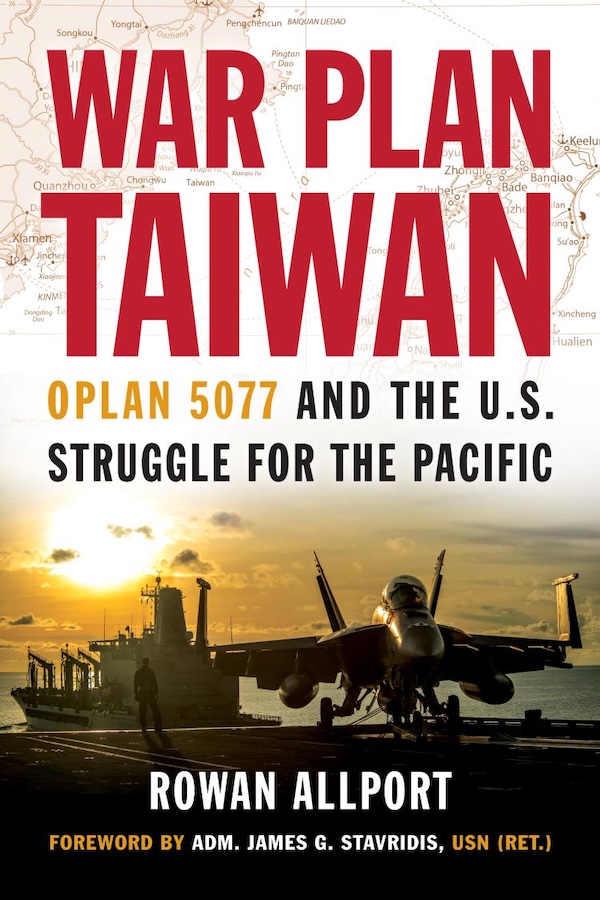
War Plan Taiwan; OPLAN 5077 and the US struggle for the Pacific. By Rowan Allport. Naval Institute Press, Annapolis, Maryland, 2026.
Reviewed by Tim Coyle
‘Predictions of the timeline, circumstances, and nature of a PRC move against Taiwan have become somewhat of an industry’. (War Plan Taiwan p.123)
In his Foreword to War Plan Taiwan Admiral James Stavridis USN (Ret.) former NATO Supreme Allied Commander, states his concern over ‘the potential for war between the United States and the People’s Republic of China (PRC) over the fate of the Republic of China (ROC), or Taiwan’. Few would dispute his views.
Stavridis then acknowledges author Rowan Allport’s narrative of century of military planning and conflict in the Indo-Pacific region and the potential for escalation into open warfare over Taiwan in 2029.
Political leaders, military planners, diplomats and informed citizenry across the Indo-Pacific region share, to a greater or lesser extent, the realisation of the catastrophic effects such a conflict would inflict on the region and beyond.
Allport sets the scene for War Plan Taiwan with a USINDOPACOM OPLAN dated 23 September 2029. The rubric Areas of Concern nominates the Joint Operations Area as ‘the entire USINDOPACOM AOR which extends from the US West Coast to the Pakistan border’, encompassing 36 nations.
The Area of Interest ‘is world-wide owing to the global reach of the state and substate actors resident in the AOR’. The deft and disciplined military terminology bespeaks the severity of the scenario.
Fully half of War Plan Taiwan comprises the historical background to US miliary plans for conflict in the Pacific initially through the pre-war War Plan Orange against Japan. This narrative is essential to the understanding of the US strategic position against an emergent Imperial Japan whose Navy trounced Russia in the Russo-Japanese War.
Following the 1945 defeat of Imperial Japan, the victory of the Chinese Communist Party under Mao Zedong, saw Chiang Kia-shek’s Kuomintang (nationalist) party defeated on the mainland in 1949 resulting in their decampment to the island of Formosa (later Taiwan).
Allport continues his historical analysis of US interaction with both the PRC and Chiang’s dictatorship in the ensuing decades. The vicissitudes of US-PRC-ROC relations are forensically covered, which included planned nuclear intervention in some circumstances. The relationships blew hot and cold; the most spectacular event being President Nixon’s visit to the PRC in February 1972
Until the 2013 ascendency of Xi Jinping to the PRC presidency the People’s Liberation Army (PLA), although steadily increasing in size and capability, was still regionally inferior to the US and allies. Xi rapidly bult the PRC to become the ‘pacing challenge’ and a ‘peer competitor’ to the US and allies in the region.
Allport starkly delineates the contemporary strategic and operational stand-off in the Indo-Pacific as envisioned in 2029. For this analysis War Plan Taiwan is a valuable resource.
The subtitle ‘OPLAN 5077 and the US Struggle for the Pacific’ has, for the non-US reader, some omissions.
While recognising the book concentrates on the ‘US Struggle’. There are many other regional countries – allies and non-aligned nations – who would be severely affected by such a conflict. Therefore, the book overlooks this reality and ideally should have an additional chapter addressing the political and geo-strategic implication of a war over Taiwan.
Most Indo-Pacific countries are non-aligned. These include powerful counties such as India, followed by Indonesia. Others include important counties such as Vietnam, Thailand and the strategically located Malaysia and Singapore. The South Pacific nations, though small, require a measure of consideration which might incline them to China. The US may well have a plan for the struggle for the Pacific but to ignore the neighbours might ruin the party.
Reference to the regional US allies – Australia, Canada, Japan and the Philippines is inadequate; they appear sparsely on pages 189 to 193.
As an Ausralian reviewer I will confine my comments to what Allport says about Australia.
Most of the commentary is accurate. Australia is ‘torn over Taiwan’ for the reasons expressed. Allport mentions the (November 2021) ‘hawkish’ statements of former Defence Minister Peter Dutton who opined that ‘it would be inconceivable that Australia would not support the Unites States in the event of war over Taiwan’.
Dutton was roundly criticised by this statement. Indeed, as Leader of he Opposition, his Liberal (conservative) Party suffered a landslide federal election loss in 2025 which saw Dutton lose his parliamentary seat (albeit not just for that statement). Apart from a few conservative hawks, Australians are leery of overcommitment of the Ausralian Defence Force (ADF) to any Taiwan operation.
The Ausralian Government published a definitive Defence Strategic Review in 2023 (supported by later documents) warning of regional threats with little or no warning time. While acknowledging the US as the primary ally, the Review defined the Australian Area of Direct Miliary Interest (ADMI) as extending from the north-east Indian Ocean to Southeast Asia and the South Pacific; it does not include North Asia or Taiwan.
Allport correctly identifies Australia’s limited force projection capabilities (noting the post-2029 deliveries of the controversial AUKUS Virginia-class SSNs) and the ADF’s wartime tasking primarily ‘focussed on territorial and Sea Lines of Communication’ (SLOC). However, his conclusion that this tasking would be ‘to provide a secure base of operation of US-led forces’ is presumptuous. It would be primarily for Australian national SLOC protection. It is a rather large island and is not to be regarded as a US base.
The author indulges in excursions from the main theme of PRC/ROC interactions with the US since 1949 by examining The South Atlantic and Southwest Asia. One wonders whether this detailed discussion of the 1982 Falklands War and Desert Storm and Desert Shield might have been summarised and reasons given for their inclusion in a study of Indo-Pacific. As outlined above, a contemporary analysis of non-aligned Indo-Pacific nations’ reactions to a US/PRC confrontation might have been more apposite to the main theme.
These points aside, War Plan Taiwan – despite its complexity – is a valuable source for understanding the contemporary strategic and operational challenges the US faces in a 2029 confrontation over Taiwan. Its readership should include regional Indo-Pacific allies and non-aligned planning staffs to inform their respective national leaders from which they can determine national strategies.