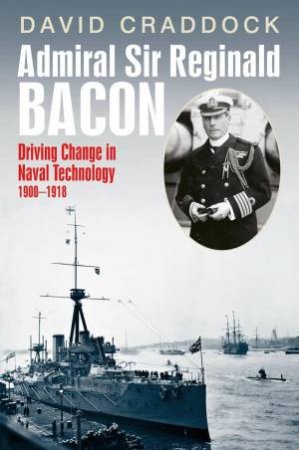
Admiral Sir Reginald Bacon. Driving Change in Naval technology 1900-1918. By David Craddock. Seaforth Publishing, Barnsley, 2026 ISBN 978-1-0361-4589-7 (Hardback) ISBN 978-1-0361-4591-0 (Epub)
Reviewed by David Hobbs
David Craddock began his working life as a Merchant Navy Cadet in P&O before deciding not to follow a career at sea. Instead he chose to study graphic design as well as gaining a BA in History through the UK Open University.
For five decades he has successfully followed a career in historic interpretation and is now a Trustee of the Britannia Museum at BRNC Dartmouth besides devoting time to writing books on naval history. I recommended his first book, What Ship Where Bound?, a history of visual communications at sea, to ANI members in 2021 and found this new book to be even more absorbing. Professor Andrew Lambert, the Laughton Professor of Naval History at King’s College London, wrote a short introduction for this book which he ended by describing it as an excellent study, an endorsement with which I completely agree after reading it myself.
Admiral Bacon was one of the key players in the technological revolution that transformed the RN during the early years of the twentieth century. It did not evolve without opposition and the ensuing controversy led Bacon to leave the Service early. He had joined the hulk Britannia at Dartmouth in 1877 and his career initially followed a conventional path, including time spent on the sail training ship HMS Cruiser in 1884/85. After that he specialised as a torpedo officer in 1885; this was a technical specialisation within a branch which was responsible for all ships’ electrical installations at the time. His first command was Torpedo Boat 33 during the annual manoeuvres in 1887, an experience that stimulated his interest in new technologies and the tactics they made possible. His 1899 Paper on the use of torpedo boat flotillas, written while he was serving in the Mediterranean Fleet attracted the attention of its C-in-C, Admiral Jacky Fisher and he was promoted to Captain in 1900 on Fisher’s recommendation. From then onwards Bacon was identified by those who opposed change, especially Admiral Beresford, as being a member of the ‘Fishpond’ and suffered antagonism and controversy as a consequence.
His ability to appreciate the value of new technologies and make carefully-considered recommendations on how they could be employed to the best advantage at sea led Bacon into a series of challenging and, for the time, unusual appointments. He became the first Inspecting Captain of Submarine Boats and oversaw the introduction of the first Holland-designed boats into service in 1901. His shrewd technical mind had immediately seen shortcomings in their design, not least in the lack of life-support systems, and he worked with the shipbuilding firm of Vickers to design the improved ‘A’ class boats and prove to sceptical senior officers that submarines had a very definite role to play in future naval warfare. When Fisher became First Sea Lord in 1904 he chose Bacon to be his Naval Secretary and he thus played an important role in the Committee on Designs which led to Dreadnought which brought several new technologies together; subsequently becoming her first captain when she was completed in 1906. After taking the ship on her first, experimental, cruise in 1907 he replaced Admiral Jellicoe as Director of Naval Ordnance, the division of the naval staff responsible for new weapons especially, at that time, guns and the emerging fire-control systems to support fire at increasing ranges. In 1908 Bacon wrote a letter recommending that the Admiralty should fund the construction of a rigid airship and create a naval air department within the naval staff, recommendations that marked the beginning of Admiralty interest in naval aviation. Bacon was promoted to flag rank in 1909 but elected to take early retirement after becoming involved in the rift that had followed the Fisher/Beresford feud. He became the managing director of Coventry Ordnance Works, COW, a big gun manufacturer set up by several shipbuilding concerns to try to break the duopoly of Vickers and Armstrong. It had not come close to doing so, however, by 1914 when war broke out.
Remarkably, his desire to return to active duty led to him being appointed as a colonel in the Royal Marines Artillery in 1915 to command a battery of COW-built 15-inch howitzers which he took to France. At the end of the year, however, he returned to the RN to become the Vice Admiral commanding what was known as the Dover Patrol in charge of operations in the eastern part of the English Channel. In this post he master-minded a number of ingenious plans for bombardments, raids and an amphibious assault on the Belgian coast. Once again, however, his appointment was marred by controversy and he was relieved of command at Dover by Admiral Keyes on the last day of 1917. The April 1918 attack on Zeebrugge, now usually credited to Keyes, was in fact originated and planned by Bacon who ended the war as Controller of Munition Inventions at Winston Churchill’s Ministry of Munitions. After the war he became the author of books that included both fact and fiction genres and became Justice of the Peace for Hampshire in 1921. His books included a biography of Jellicoe, an analysis of the Battle of Jutland and the novel The Stolen Submarine; The Story of a Woman’s Pluck. Few contemporary authors had such wide-ranging talent. He died in 1947.
If this brief listing of his many achievements has whetted your appetite to find out more about this remarkable man you will not be disappointed in David Craddock’s book. In the present era when the introduction of unmanned systems and command and control techniques based on AI-technology are fundamentally changing the way in which contemporary navies operate, it is fascinating to learn how one man was at the forefront of equivalent technological changes over a century ago. Craddock devotes chapters to each phase of Bacon’s career and he sets the scene in every case by giving sufficient background information to enable the modern reader to understand what the changes involved and why they were so important. This really is an excellent study of a man who not only saw the need for change but who was not afraid to strive as hard as he could to achieve it, despite opposition from those who failed to grasp its importance. I thoroughly recommend it.