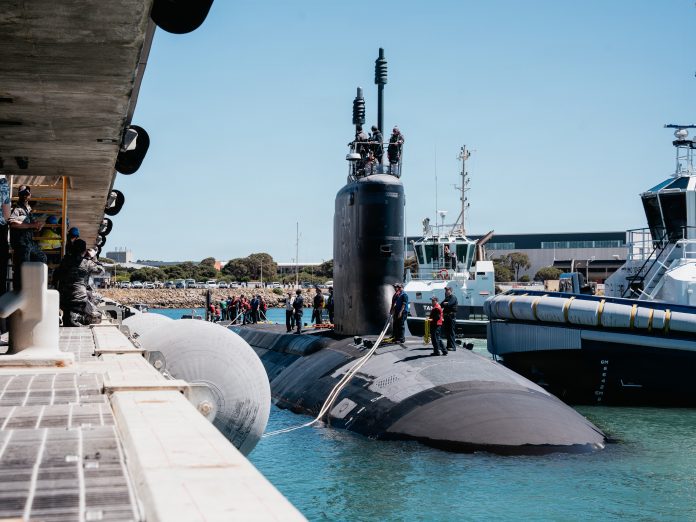
Australia, the United States and the United Kingdom have taken further steps regarding Australia’s preparations for the establishment of Submarine Rotational Force‑West (SRF‑West), Australian Defence Magazine reports.
The Virginia-class nuclear-powered submarine, USS Colorado (SSN 788), has arrived at HMAS Stirling for the next US Submarine Maintenance Period (SMP), which will be a month long.
SRF-West has been scheduled to commence in 2027, which will see Australia build the workforce, infrastructure and operational experience required to support AUKUS, strengthen cooperation with Australia’s AUKUS partners, and contribute to regional security, stability and deterrence in the Indo-Pacific.
During SRF‑West next year, HMAS Stirling will see up to four US Virginia-class, including Colorado, and one UK Astute-class, nuclear-powered submarines begin a rotational presence.
“This maintenance period brings us closer to establishing SRF-West,” director of AUKUS, International & Systems, US Navy Rear Adm. Doug Adams, said.
“Our Lead Maintenance Activity, Pearl Harbor Naval Shipyard and Intermediate Maintenance Facility, is doing a great job ensuring the Australian personnel trained in Hawaii are ready and able to support our submarines.”
Colorado’s visit marks the fourth SMP in Western Australia since the establishment of the AUKUS security partnership, and the third in the last 12 months, highlighting the ongoing progress under AUKUS Pillar I.
The boat is also the sixth nuclear-powered attack submarine to visit HMAS Stirling following the announcement of the Optimal Pathway.
“The presence of US and UK nuclear-powered submarines at HMAS Stirling for maintenance and shore support activities provides our Royal Australian Navy personnel with invaluable hands-on experience and the skills and expertise needed to support and sustain Australia’s future conventionally armed, nuclear-powered submarine capability,” Chief of Navy, Vice Admiral Matt Buckley, said.
The visit will showcase Australia’s growing ability to sustain US and UK nuclear-powered submarines.
“As we approach the establishment of SRF-West, we must remember that our trilateral efforts are being driven by the challenging strategic environment in the Pacific and our collective desire to deter aggression and ensure peace through strength,” US Pacific Fleet, Submarine Force, commander, US Navy Rear Adm. Chris Cavanaugh, said.
On 26 October 2026, Secretary of War Pete Hegseth and his Australian and UK counterparts issued a joint statement naming USS Colorado as the first US Navy Virginia-class fast-attack submarine assigned to Submarine Squadron 3.
As part of this maintenance period, fully trained and qualified Australian personnel are conducting work on an operational US Virginia-class submarine, using Australian-designed maintenance infrastructure and equipment, and upgraded port facilities.
Over the coming weeks, trained and certified Australian civilian maintenance technicians from ASC will perform routine maintenance on a Virginia-class submarine for the first time, working alongside specialists from Pearl Harbor Naval Shipyard and Intermediate Maintenance Facility (PHNSY&IMF).
Alongside ASC, 15 Western Australian businesses are supporting the maintenance of the submarine.
“Australia’s nuclear-powered submarine capability will be built through practical experience, and that is exactly what is happening at HMAS Stirling,” ASC, Chief Executive Officer, Alex Walsh, said.
The businesses include WA-owned and operated Australian Safety Engineers (ASE), who will provide everything from scaffolding, crane and rigging support to specialist welding equipment, testing and certification, and environmental protection solutions for the SMP.
“As the rotational presence of US and UK submarines at HMAS Stirling increases, ASE expects to see growing demand for specialist maintenance and support services, creating opportunities for investment, workforce development, and long-term business growth. ASE is well positioned to support long-term sustainment activities while continuing to invest in our workforce and strengthen our capabilities in Western Australia,” ASE Managing Director Brian Snashall said.
Whilst the maintenance is underway, Australian businesses continue to progress through a rigorous national qualification program that supports the construction of Virginia-class submarines in the US.
Established by the Australian Submarine Agency (ASA) in partnership with the US Government and delivered by ASC, the Defence Industry Vendor Qualification (DIVQ) Program helps Australian businesses strengthen their systems, processes and technical capability to meet US submarine requirements.
The maintenance period will demonstrate several new pieces of Australian-built infrastructure. Technicians will use an Australian, custom-made metal safety walkway, also known as a sail “racetrack.”
It will sit around the submarine during its time at HMAS Stirling – giving workers safe and rapid access to carry out submarine maintenance work.
The team will also leverage recent nuclear-powered submarine-specific upgrades made to HMAS Stirling’s Diamantina Pier and other local solutions, such as a pure water plant, high-pressure air compressor and dehumidifier.
“Through these historic port visits Australia has continued to progress our ability to not just host SSNs for longer periods but also deliver maintenance to schedule and get the boats back to sea,” the Australian Submarine Agency’s head of Virginia Division, Royal Australian Navy Rear Adm. David Mann, said.
The United Kingdom’s Royal Navy will be an active participant in the SMP.
“The more the three nations work together to maintain submarines – whether American or British – the faster we’ll be able to uplift our Australian partner’s knowledge and skills and increase commonality across our submarine forces,” the UK Prime Minister’s Special Representative for AUKUS, Sir Stephen Lovegrove, said.
Other than the racetrack installation, key activities to be undertaken during the SMP include personnel from Australia, the UK and the US working side-by-side to conduct off-hull capability demonstrations using specialised training equipment and locally produced submarine components.
Australian personnel will conduct in-hull maintenance work, including replacing the thin line towed array and ship repairs.
Australian personnel (supported by US personnel) will conduct simulated radiological scenarios that exercise radiation safety practices and procedures, with no radioactive waste being transferred ashore.
These scenarios have been designed to simulate elements of the capability that will be in place at HMAS Stirling to support the initial scope of maintenance activities from 2027.
All activities under the SMP continue to be undertaken in full accordance with the non-proliferation and safeguards obligations of Australia, the US and the UK.
Under the AUKUS pathway, UK and US nuclear-powered submarines have conducted increasingly regular and extended visits to HMAS Stirling, with each visit and maintenance period building upon the previous.
In 2024, the first-ever joint maintenance period conducted on a US nuclear submarine in Australia was delivered on the USS Hawaii (SSN-776) and supported by the USS Emory S. Land(AS-39).
In 2025, the USS Vermont (SSN‑792) was successfully serviced without a support ship, relying on shoreside facilities and a blended US and Australian workforce for the first time.
In early 2026, the first ever maintenance activity was conducted in Australia on a UK Royal Navy Astute-class submarine, HMS Anson (S123), which successfully integrated local Australian-made components and systems.