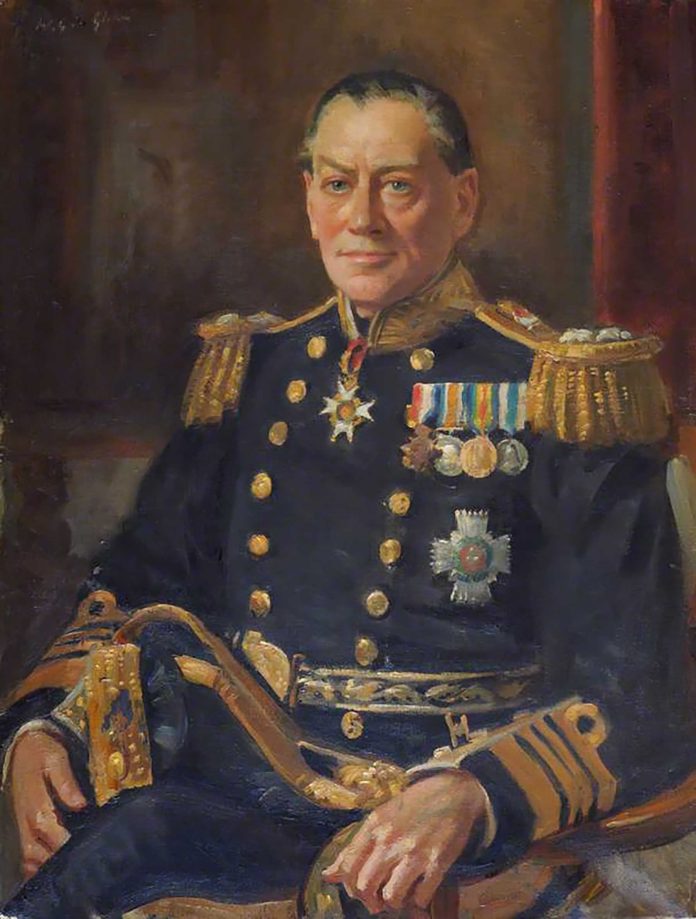
Palpable excitement rippled through the halls of the British Admiralty on 5 August 1914. Winston Churchill, the First Lord of the Admiralty, was especially animated. Britian had declared war on Germany the previous day, joining World War I. “Now we have our war,” Churchill exclaimed to his assistant director of operations, Captain Herbert Richmond. “The next thing is to decide how we are going to carry it on.”1 (From: the US Naval Institute.)
In his diary, Richmond called Churchill’s boast a “damning confession of inadequate preparation for war.” He claimed, “All this should have been thought of before.” As assistant director, Richmond had done just that. A year earlier, he had submitted a memorandum detailing the courses of action the Royal Navy could follow in the event of hostilities. The single word response, “Interesting,” gave Richmond little reassurance.2
Before joining the Admiralty staff, Richmond had amassed significant operational and leadership experience, including command of the battleship HMS Dreadnought. But these more typical naval assignments were often overshadowed by Richmond’s intellectual pursuits.3
The wartime environment spurred Richmond’s cerebral bent. In the years before World War I, he had watched key British naval advantages erode as rising naval powers and new technologies emerged. Such developments promised to change the character and conduct of naval war. It was this rapidly evolving world in which Richmond sought to improve the education of British naval leaders.
Intelligent Methods
A short time before the outbreak of World War I, Richmond joined several like-minded officers to found what became the Naval Review: a private-circulation, professional journal for the Royal Navy.4 Richmond was concerned that there was no forum for naval officers to express their ideas independent of Admiralty oversight.5 “What I hope to develop is the mental habit of reasoning things out,” he said.6 Another founding member explained Richmond sought “to foster clear thought in the rising generation of naval officers, rather than the blind acquiescence in authority.”7 Naval leaders routinely confront complex problems, but Richmond saw officers founder time and time again because they were not prepared to make difficult decisions, especially in situations where there were only least bad answers. Complex strategic thinking, Richmond realized, required officers to regularly take the time to study and reflect.
Richmond’s experiences during World War I led him to focus even more on officer education. Soon after the war, he received orders to revive and oversee the War Course at Greenwich. In 1927—nearly at the end of his career—he became the founding commandant of the Imperial Defence College.8
These were not easy assignments. After several months heading up the War Course, Richmond vented in his diary, “It is curious, though it is not really surprising, to see how unable most officers are to express themselves at all.” He found naval officers repeatedly failed to identify their necessary objectives. This, in turn, meant they were unable to effectively assess situations or analyze their salient points. He bemoaned,
They think nothing of contradicting themselves two or three times within as many sentences and are astonished to find they have done so. Yet, these are our future guides in all high matters. No wonder the average statesman can make them say anything, & make a hash of their proposals.9
In these last sentences the crux of Richmond’s argument emerged. Senior naval leaders needed to be more than technically proficient; they needed to confidently engage with political leaders, be capable of discussing strategy, and explain in cogent ways what the Royal Navy could and—perhaps more important—could not accomplish.
Developing methodologies to improve critical thought would become one of Richmond’s greatest legacies after the war.10 He argued that officers must prepare intellectually prior to the outbreak of hostilities, because once a war had begun, it was too late: action became paramount. He asserted, “The process of developing the power of thought must be begun at the beginning of the naval officer’s career and carried through all its stages.” Instead of rote memorization of facts, he asked officers to study history using what he called “intelligent methods” that involved reasoning and critical thinking.11 Such studies took officers beyond learning what happened and forced them to consider how and why past events occurred as they did.
While most naval officers became tactically proficient with their ships and weapon systems, many lacked the ability to apply these instruments to their greatest strategic effect. In the face of this deficiency, Richmond claimed, “The better a man is educated, the more he understands the big things, the better judged will be his actions.”12 Becoming effective in such methods of critical thinking is not a quick process and does not result from “any other path than hard and sustained reading and thinking.”13
Profiting by the Experience of Others
Before World War I, Richmond made friends with Julian S. Corbett. Today, Corbett is best remembered as a strategic thinker who wrote Some Principles of Maritime Strategy, but at the time, he was seen as a leading British naval historian who emphasized careful scholarly research.14 Richmond was so taken with Corbett’s method he began to write what turned into a three-volume history of the British navy in the War of 1739–1748 (also known as the War of Jenkins’ Ear).15 Though Richmond had a deep love for history, he, like Corbett, saw history ultimately as an instrument to aid in real-world decision-making.

History, Richmond claimed, “is the raw material out of which the knowledge of the principles of strategy and tactics is built up.”16 The study of history enhances critical thinking, and is therefore an essential tool for educating the mind. Describing a candidate for a future leadership position, Richmond explained, “If he has no opinion of his own, he will find that the making of a decision, and the stating of his reasons for it, are very hard, possibly impossible.” When an officer must make such a decision, there will be neither time to consult books for an answer, nor someone there to provide a solution. By studying history, Richmond claimed, a leader “is far more likely to be able clearly to see the object to be attained, and to appreciate the course of action best calculated to attain it.”17 In short, as Richmond put it: “History gives you a reason for your beliefs.”18
But Richmond was no dull pedant, encouraging the study of history for the sake of historical knowledge, or the memorization of how many ships Nelson had at Trafalgar or when a specific battleship fired its first salvo at Jutland. “I have no desire to make Historians of Naval Officers,” Richmond said, “But I have every desire that Naval Officers should be capable of using history in an intelligent manner, understanding how to analyze it, what is applicable & what is not.”19
No stranger to conflict, Richmond anticipated future wars would, despite technological advancement, “infallibly present problems of the same nature as all of those of the past, including that of 1914, have presented.” He sought to have officers analyze events from history that had no right or clear answer. He wanted leaders to grapple with historical decisions that could include opening new operational theaters, balancing efforts between competing operations, and identifying the decisive point in a campaign.20 By studying historical examples, officers could learn what normally occurred, then apply that knowledge to see through the fog of a contemporary environment.
Moreover, Richmond recounted, “A study of history impresses upon one’s mind how easy it is to make a mistake and how far-reaching such a mistake may be.” As a result, it was essential for officers to continually read, learn, and think, for he claimed, “Study is a real preparation of the mind for war.” Such mental preparation could never be perfect, however. “All we can do is to try and foresee as much as we can . . . by profiting by the experience of those who have gone through the mill.”21
In the process, Richmond urged leaders to avoid facile maxims or what he called “catchwords” that would only sometimes be true. Instead, leaders must be prepared to think and reason. He claimed:
Study helps one to do this: and the study that is the most directly connected with our profession, the training that is most valuable to develop our minds, our imagination, to fortify our beliefs, to help us to solve the great problems of war, is that of the experience of those who have gone through it.22
For the same reason a veteran is better prepared for conflict than a new soldier, Richmond believed that a solid grounding in history is an essential tool for any naval officer preparing for the supreme test of war.
But the proper study of history does not mean the cursory perusal of a few books or attending an odd lecture. Rather, Richmond advocated for the deep study of the past. Some might balk at this argument, considering it a waste of precious time. But Richmond believed lives and the security of the state depended on extensive preparation. After what he witnessed in World War I, he linked British failures in part to senior leaders failing to systematically study and apply history. Following the war, Richmond made it his mission to ensure the next generation would not repeat those mistakes. In the process, he made a compelling argument that historical study should serve as a foundation for reasoned analysis. Studying history, he maintained, makes one “capable of formulating views on, and forecasting events in, war and strategy.”23
A Means to Learn Something About Strategy
Following World War I, British naval leaders pondered whether to restart the War Course to provide its up-and-coming officers with a war college education. Richmond’s name was floated to lead the organization, but some objected that he would “teach nothing but History.” When Richmond learned of this critique, he thought, “This is very funny. They think of me as a historian only, and don’t know my views, nor why I study History. They can’t see that I use it as a means of learning something about strategy, and not as an end in itself.”24 Years later, he reiterated, “My naval history is merely my outside hobby, to amuse myself and to develop my instinct in strategy and tactics . . . It is merely a form a mental training which I believe to be useful.”25

Some might consider Richmond’s views on history irrelevant in a world in which the promises of AI, machine learning, and a host of other advanced technologies are reshaping how decisions are made. But if leaders hope to effectively interact with these decision-making technologies, they must first develop the critical thinking skills Richmond emphasized.
It is important to remember Richmond witnessed the technological transformations of his own era. He commanded the revolutionary battleship Dreadnought, after all. Navies of his lifetime also witnessed the emergence of wireless communications, submarine development, and the advent of air power. Richmond knew technology would change the character of war.
Still, counterintuitively, Richmond looked back in time for answers. He understood the fundamentals of naval warfare endure from age to age. The struggle to control the sea lines of communication dominated naval operations during the Age of Sail and World Wars alike, and it remains critical today. Weapons and platforms change, but strategic objectives remain much more constant.
Richmond believed that an education steeped in history gives naval leaders a point of departure for understanding the contemporary strategic environment. An amateur approaches each situation for the first time. Richmond and his fellow students of history approached the same situations armed with a rich historical context and deep strategic understanding. That is what it means to prepare the mind for war.
The positions expressed in this article are the author’s alone and do not represent the Naval War College, the U.S. Navy, the Department of War, or the U.S. Government, and these views are not necessarily shared by them.
1. Diary entry for 5 August 1914 in Arthur J. Marder, Portrait of an Admiral: The Life and Papers of Sir Herbert Richmond (London: Jonathan Cape, 1952), 92.
2. Diary entry for 5 August 1914 in Marder, Portrait of an Admiral, 92.
3. For a biography of Richmond, see Barry D. Hunt, Sailor-Scholar: Admiral Sir Herbert Richmond 1871-1946 (Canada: Wilfred Laurier University Press, 1982).
4. Peter Hore, ed. Dreadnought to Daring: 100 Years of Comment, Controversy and Debate in The Navy Review (Great Britain: Seaforth, 2012), xi–xiii; Andrew Lambert, The British Way of War: Julian Corbett and the Battle for A National Strategy (New Haven: Yale University Press, 2021), 283.
5. Richmond to Dewar, 13 June 1911, Dewar Papers, DEW/34, National Maritime Museum, Greenwich, United Kingdom.
6. Diary entry for 27 October 1912 in Marder, Portrait of an Admiral, 89.
7. H.G. Thursfield, “Admiral Sir Herbert W. Richmond,” The Naval Review 35 (February 1947), 6.
8. Alfred Dewar, “Admiral Sir Herbert William Richmond,” The Naval Review 35 (February 1947), 3.
9. Diary entry for 10 November 1920 in Marder, Portrait of an Admiral, 365.
10. Bruce McLennan, “The Historical Lessons and Intellectual Rigour of Admiral Sir Herbert William Richmond,” Australian Defence Force Journal 168 (2005), 23.
12. Herbert Richmond, “Thought and Discussion,” in National Policy and Naval Strength and Other Essays (London: Longmans, Green, 1928), 230.
13. Herbert Richmond, “The Late Julian Corbett,” The Naval Review 11 (1923), 16.
14. Kevin D. McCranie, Mahan, Corbett, and the Foundations of Naval Strategic Thought(Annapolis: Naval Institute, 2021), 47–48.
15. Herbert Richmond, The Navy in the War of 1739–48, 3 vols. (Cambridge: University Press, 1920), 1:v; D.M. Schurman, The Education of a Navy: The Development of British Naval Strategic Thought, 1867–1914 (Reprint, Malabar, FL: Krieger, 1984), 122.
16. Richmond, “The Late Julian Corbett,” 14, 15.
17. Richmond, “The Use of History,” 282.
18. Richmond, “The Use of History,” 292.
19. Richmond to Dewar, 6 January 1911, DEW/34, National Maritime Museum.
20. Herbert Richmond, “Combined Strategy,” in National Policy and Naval Strength and Other Essays (London: Longmans, Green, 1928), 54.
21. Richmond, “The Use of History,” 289.
22. Richmond, “The Use of History,” 292–93.
23. Richmond, “The Late Julian Corbett,” 19.
24. Diary entry for 18 November 1919 in Marder, Portrait of an Admiral, 359.
25. Richmond to Dewar, no date [1927], DEW/34, National Maritime Museum.