Report on US Navy Shipbuilding Program
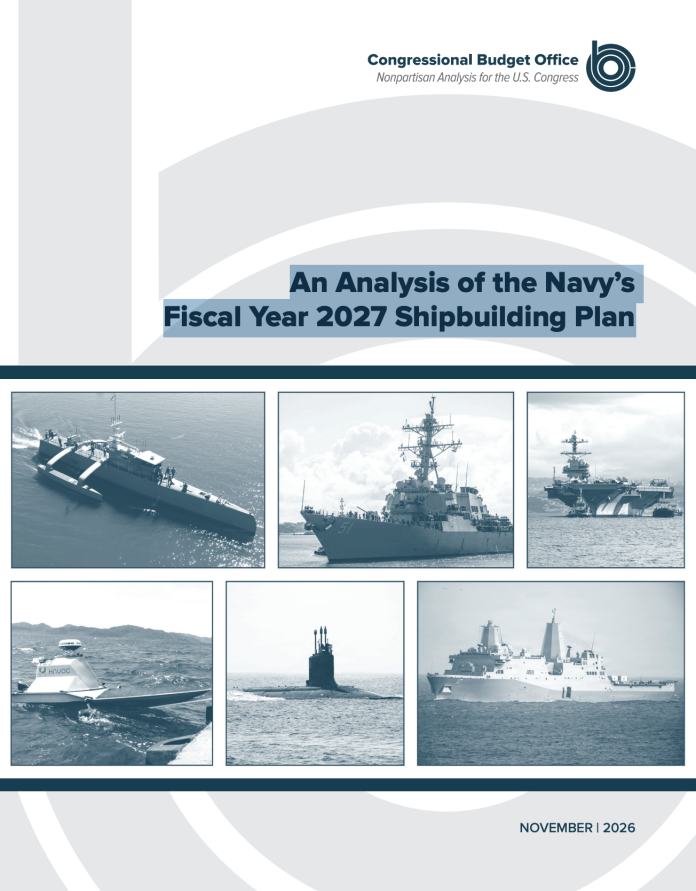
On 19 November the US Congressional Budget Office (CBO) released its analysis of the US Navy’s shipbuilding Program. It shows significant cost increases.
Each year, as directed by the US Congress, the US Department of Defence submits a report with the President’s budget describing the US Navy’s plan for its future fleet for the next 30 years. In this report, the Congressional Budget Office analyses the Navy’s 2027 plan and estimates its costs. Overall, the US Navy wants to build a larger fleet whose firepower is distributed among more ships and unmanned vessels than it is today.
- CBO estimates that the Navy’s 2027 plan would cost 41% more annually in real terms (that is, with costs adjusted to remove the effects of inflation) than the average amount appropriated over the past 5 years. Total shipbuilding costs would average $54 billion (in 2026 dollars) over the next 30 years, which is about 18% more than the Navy estimates. A notable addition to the 2027 plan is a new proposal to purchase 15 nuclear-powered guided missile battleships, which would significantly increase the cost of the Navy’s large surface combatant program. To implement the 2027 plan, the Navy’s total budget, including the costs of operating and maintaining its ships, buying new aircraft and weapons, and funding the Marine Corps, would increase from about $310 billion today to $415 billion (in 2026 dollars) in 2056.
- Fleet Size. The number of battle force ships would increase from 286 today to 398 in 2056.
- Purchasing Plan. The Navy would purchase a total of 371 new combat ships and combat logistics and support ships. It would also purchase 58 new and 29 used auxiliary ships that would not be part of the battle force.
- Fleet Capabilities. The fleet’s firepower would increase slightly over the next five years but would then decline until 2035 as the Navy retired more missile-capable ships than it commissioned. After that, the fleet’s firepower would increase again and become distributed among more ships and unmanned vessels.
- Industrial Base. Over the next 30 years, building the future fleet envisioned in the 2027 plan would involve producing substantially more tonnage than the nation’s naval shipyards have produced over the past 10 years. Production of nuclear-powered submarines, in particular, would increase significantly.
Of interest to Australian readers is the analysis of the nuclear powered attack submarine program. The report states:
“Attack Submarines and Guided Missile Submarines. The Navy currently has 47 nuclear-powered attack submarines (SSNs): 18 Los Angeles class, 3 Seawolf class, and 26 Virginia class ships. The fleet also includes 3 guided missile submarines (SSGNs), which are converted Ohio class ballistic missile submarines that can carry large numbers of conventional missiles and special-operations forces. On 3 August 2026, the Navy announced that the 19 Virginia class submarines with Virginia payload modules (VPMs) currently under or slated for construction over the next three years would also be designated as SSGNs
According to the 2027 shipbuilding plan, after an initial decline to 45 SSNs and SSGNs in 2030 and 2031, the force would grow larger and become more capable than it is today. Under the 2027 plan, the Navy would buy 60 SSNs and SSGNs and would have 68 SSNs and SSGNs in the fleet by 2056
The Navy would finish purchasing Virginia class SSGNs in 2029 and would resume production of a redesigned variant without the VPM. It would purchase the redesigned ships at a rate of 2 per year from 2030 to 2039 and then 1 per year for most years from 2040 to 2056. In addition, the first next-generation attack submarine, SSN(X), would be bought in 2040, then 1 SSN(X) per year would be purchased from 2042 to 2056.”
The report can be accessed at:
https://www.cbo.gov/publication/62917