From its inception, the ANI sought to be an institution to improve the naval proficiency at sea through the sharing of the experiences of its members in its journal. In Headmark 146 (December 2012) Vice Admiral David Shackleton wrote of his accumulated experience as a warfare officer.
Beyond the Principal Warfare Officer – Some Personal Experiences
How the navy trains to fight has great relevance to how it will fight when push comes to shove. As it is for the Navy at large, getting the very best from all of a ship’s crew and its total capability is critical for success. And in this mix now, is the network (both internal and external), which could be amongst the most powerful of force multipliers, or its Achilles heel. I can remember when CSOC3I at Maritime Headquarters and sea riding USS Blue Ridge as the first Australian to have full exposure to Exercise Tandem Thrust, the cry in Flag Plot was ‘it’s on the network’. A serious problem for Commander 7th Fleet back then was: ‘who authorised the engagement to start because it wasn’t me’?
I am of that generation of PWO’s that learned and practiced the warfare game in what could be called the dusk of the analog era, and experienced the digital dawn in the RAN when the Naval Combat Data System (NCDS) was introduced. I doubt there are many fond memories amongst my peers of plotting tables and their idiosyncrasies of cogs, wheels, and chinagraph pencils. As the on-watch operations room officer in the Flag Plot of the carrier Melbourne, I remember well the Admiral asking in a loud clear voice “where is the bloody submarine”. And the nonplussed Leading Seaman RP with a cheesy grin on his face saying “here it is sir”, as he picked up the plastic token from the deck where it had been knocked by the energetic duty Staff Officer who was attempting to get a brownie point. Fortunately the Admiral had a sense of humour.
How anybody made sense of what was going on when dealing with the shouting that was necessary to be heard over the din of multiple speakers from various quarters of the ships armament is beyond comprehension. But, strangely, and against all odds, it did seem to work. I worked in that environment and it was exciting in a quirky way. As an adjunct to this, I did enjoy my time as an air controller for a variety of reasons, amongst which was that the folks on the other end of the radio were, by and large, rational people while in the sky.
My PWO course was number 10 and undertaken at HMS Dryad in UK. I was one of four RAN officers in a group of about 32. HMAS Perth was being fitted with NCDS in Long Beach USA in 1975 when I started the course. Two of us did two years exchange with the RN on graduation followed by the Advanced Warfare Officers (AWO) course prior to returning to Australia.
The RN PWO course was conducted in a highly professional manner. The officer and sailor instructors were impressive and they really knew their stuff. However, there was an Australian PWO on the staff who tried very hard, and with varying degrees of success, to restore the balance with some rather serious RN officers. The engineering theory and practical content of the course was relatively high. We were particularly expected to be able to hold intelligent conversations with Weapons Engineering officers and sailors about the sensors and weapons we would become responsible for as warfare officers in our future ships. We learned, in some detail for example, how the gunnery system worked and so on. The RN had the view that the skills needed to be an effective watch-keeping warfare officer did not remove the need for seaman officers to become knowledgeable specialists in a domain such as the previous long course officers had been. Their solution was the AWO course, but at that time it didn’t fully make the grade (in my view) so far as delivering on the promise of deep specialist knowledge. The Electronic Warfare, communications and other elements, especially Task Group command and control, were excellent. But the RN was still working out what the digital age meant, and on my AWO course was much underdone.
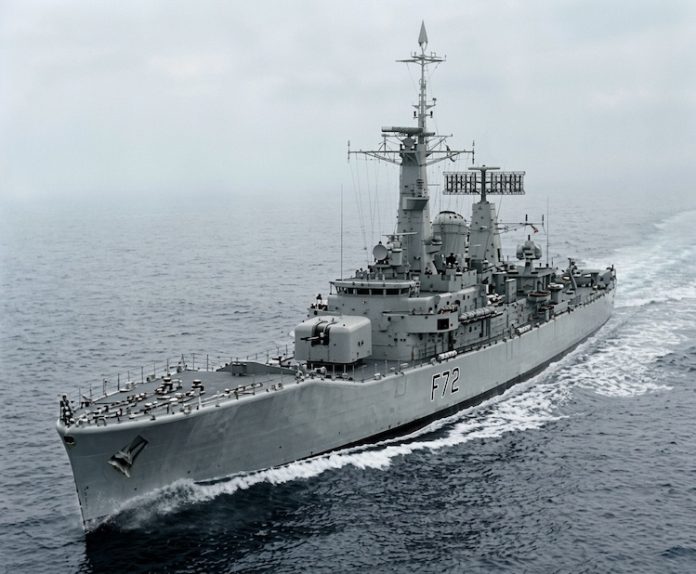
On graduation as a PWO I was posted to the last of the Batch 3 Leander frigates, HMS Ariadne, where I took over from another Australian on exchange. The ship was less than five years old, but it had all-analog sensors and weapons. I was one of the two PWO’s. My counterpart was the ASW officer, ship’s training officer and nuclear depth charge officer; I was the Operations officer and all the rest – which I really enjoyed and learned much from being so fully occupied. When a PWO was not closed up we kept bridge watches, as did the navigator. A 25 knot passage through the English Channel in lumpy weather and lousy visibility was guaranteed to keep you totally awake for the entire middle watch, especially as there were no assistants on the bridge other than the signalman; and the Captain sitting his chair providing encouragement whenever necessary.
First stop after graduation from Dryad was Command Team Training, followed by a family removal to Plymouth in parallel with Harbour and Sea Acceptance Trials (HATs & SATs), and then a full Basic Operational Sea Training (BOST) work up at Portland of about seven weeks.
SATs Gunnery in the Plymouth exercise areas was exhilarating. I had to re-learn a few gunnery things the hard way. One was to ensure that firing was completed before the towed target became too close and the crossing rate became extreme. My strong recollection is of the WEEO trying to hide from the Captain who climbed up to the GDP to deliver one of the best blasts of my career. The only thing that had gone wrong was the 4.5” gun had trained from the starboard beam to right ahead while still firing, and that a merchant ship called up on VHF asking if there was a war on in the approaches to Plymouth. On a positive note, the check fire alarms had worked very well.
It was a character building posting. A later episode occurred, also concerning gunnery, which the Captain as a TAS officer (Torpedo and Anti-Submarine Warfare) didn’t seem to like. The live firing bombardment exercise at Roosevelt Roads (Puerto Rico) was going so well that I declined the opportunity to switch ammunition from Variable Time (VT) to Time Mechanical (TM) fuses. This was an analogue gunnery system and I didn’t want to run the risk of the ballistics being set incorrectly, so the firing went on for most of the afternoon with Ariadne eventually clocking across the range at 22 knots. The Captain was ecstatic and gave BZ’s all-round. The Executive Officer, who was of the Long G variety, could not believe that it was possible to fire three years of practice ammunition in one afternoon; until I showed him the graph that extended vertically over several pages and he nearly choked. I found the RN still used the old letter style of: Sir, I have the honour to report that I have been stupid…….
The RN Task Group included about nine ships and an SSN and we initially deployed into the Mediterranean, then to South America and home via the west coast of Africa; a round trip of about four months. We literally had an encyclopaedia of trial tactics to undertake, keep records of results, and send back to CINCFLEET on our return. In my experience, navy people like trying new ideas and especially get satisfaction out of helping improve the professionalism of their occupation. Later, when I was back with the RAN and on deployment, we had to invent trials such as these ourselves. I wonder if such a circumstance came about by removal of a Flag Staff at sea after the demise of Melbourne. The Fleet Staff had an important role in tactical development and warfare policy, and being part of the Sea Training Group was not their only function.
The workup at Portland conducted by Flag Officer Sea Training (FOST) was hard work and very professionally rewarding. When I joined Hobart on return to Australia and did another work up, I couldn’t believe how much less intense it was in comparison. On the other hand, in that ship we had five warfare officers on their second or third warfare posting. I found the so-called RAN PWO familiarisation at Watsonfor returning officers such as me was amateur to say the least. In stark contrast, the NCDS pre-joining courses I undertook at the Combat Data Systems Centre (CDSC) in Canberra were simply outstanding. In company with a group of other officers and sailors of both seaman and technical persuasions, I completed three operator courses of increasing complexity, an NCDS Systems course that was outstanding in terms of helping me learn just what the system could, and could not do, and an introduction to computer programing as applicable to the AN/UYK-7 computer which controlled the combat system – and I worked out that computer programing was not for me, but knowing about how it was structured was of great help operationally. This training was about three and a half months all up as I remember. When I eventually joined Hobart as the PWO D, I therefore had a very good understanding of ‘what went on behind the VAB’ (variable action button) and – just as importantly – why. When I later commanded Brisbane, this knowledge sometimes made me a difficult person as I recall.
In Hobart, the NCDS WEEO and I shared a cabin, which was an accident of postings, but it also contributed to the cross-pollination of knowledge essential to getting the best out of what we had. The first versions of NCDS had a fairly ordinary Beacon Video Processor (BVP) in that automatic identification from IFF/SIF codes was rudimentary; the NCDS WE Leading Seaman and I wrote a minor computer patch that enabled us to enter the Mode 2 codes of aircraft coming on task and help improve the identification process. We hadn’t learned how to get the best out of Link 11, so we all worked at it; operations room folks, communicators and maintainers.
On passage to anywhere in Hobart we tried all the casualty modes and encouraged sailors and officers to ‘try stuff’. In defence watches we had a watchkeeping WE Leading Seaman or Petty Officer whose job it was to make sure the system worked how it should on a continuous basis. If there was a problem, they gave the operators options as to how to get the best out of the system while it was being fixed. There was also a watchkeeping senior sailor who made sure the Supply Department did its part. It was a total team effort. I imagine today that the requirement has become even more intense to be a total team.
The PWO philosophy as designed by the RN incorporated a structured organisational methodology that was intended to enable the PWO to direct and oversee the complete team’s performance. Missile/Gun Directors for instance oversaw missile and gun controllers who fired weapons etc. Training was designed so that the competencies of officers and sailors were complementary and wholly focussed on the achievement of tactical success as a team. The Operations Room design and layout, internal and external communications arrangements, picture compilation and decision making procedures were part of the total systems approach adopted by the RN. The USN does it differently, and I found the design of the NCDS system, while excellent in many respects, did not support adoption of the so-called ‘PWO System’ to the same extent that the RN had implemented. The CIC layout of the DDG reflected USN practices, and even after its NCDS update, was not configured to meet the organisational components of the ‘PWO System’ and internal work-a-rounds were needed. One hopes we have learned that to maximise the potential of a tactical war fighting philosophy that involves people at its core, means that there must be a strong and clear complementarity in the way it is implemented procedurally and technically.
In my own view, to understand how best to fight the ship, it is essential that there be a deep technical literacy by both the operators and maintainers – of what is needed to fight the ship (and the Navy). For both groups it is about understanding the operational demands and limitations imposed by technical capabilities and performance. No single group/branch is likely to fully know as much about all domains as it is possible to know. But they should always know they are working together collaboratively. By technical, I mean the full range of technical and associated support capabilities of the ship, and not only the combat system. When it works, this is a very powerful team.
To close this recount of experiences, my formative years and the collective technical and operational knowledge I gained were highly valuable in my later career. I was subsequently involved in a variety of interesting technology and capability matters which ranged from working on the combat system for the ill-fated replacement aircraft carrier project, the DDG NCDS update, the Anzac War-fighting Improvement Program, advocating that cooperative engagement and Aegis become part of navy’s future capabilities and having a role in selecting the present Collins combat system.
While one can expect that improvements are happening on a continuous basis, I hope these short anecdotes have recounted some of the origins of current practice, which may or may not be entirely relevant to today’s circumstances. But I do hope they will contribute to the conversation about what will emerge: ‘Beyond the PWO.’
About the Author
Vice Admiral David Shackleton AO RAN (retired) had a 36-year naval career that culminated in being Chief of Navy from 1999-2002. His sea commands were the destroyer escort HMAS Derwent and the destroyer HMAS Brisbane and he had earlier seen war service in the Vietnam War. David Shackleton earned a PhD in History from UNSW Canberra and his thesis explored the 40-year transformation of the RAN through its operation of the three American-built Charles F. Adams-class DDGs. An adjunct professor with the Naval Studies Group at that university, he recently co-authored Building a Strong and Sustainable Fleet: A Vision for the successful implementation of the Australian Naval Shipbuilding and Sustainment Plan available at: