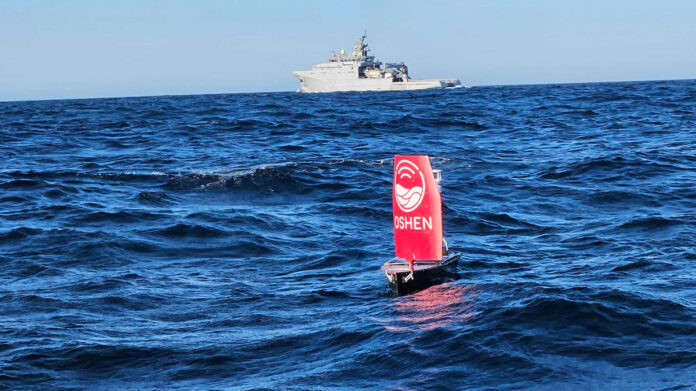
A British maritime technology company is testing a distributed anti-submarine surveillance network made up of six small robotic sailboats at the multinational REPMUS26 exercise in Portugal, with each vessel carrying a hydrophone and operating as part of what Oshen describes as an “acoustic picket line”, according to the company.
The 1.2-metre C-Star uncrewed surface vessels are being used together against live targets for the first time, with the boats spread across an area of water to create a passive listening network rather than concentrating sensors on a single ship or towed array. Oshen says the arrangement could allow operators to change the shape and density of the network as conditions change, while observations from several positions could help determine the location of a contact rather than simply its bearing.
Traditional passive anti-submarine warfare systems can use long towed arrays carrying large numbers of hydrophones behind surface ships. These provide sensitive local detection and bearing information but can be affected by noise from the towing vessel and are tied to the movement and position of a comparatively small number of platforms. Oshen’s approach is instead based on deploying a larger number of inexpensive autonomous sensors across a wider area, with the company suggesting a future network could be used to monitor areas such as the GIUK Gap and cue other anti-submarine assets once a contact is detected.
Each C-Star taking part at REPMUS is fitted with a hydrophone supplied by Systems Engineering and Assessment. Oshen says the vessels can hold station under sail for extended periods and have been designed for operations in difficult weather. The company has previously demonstrated C-Star operations in a Category 5 hurricane and argues that the small size and low profile of the boats could make a distributed network harder to identify and disrupt than a smaller number of larger sensor platforms.