By Tom Sharpe*
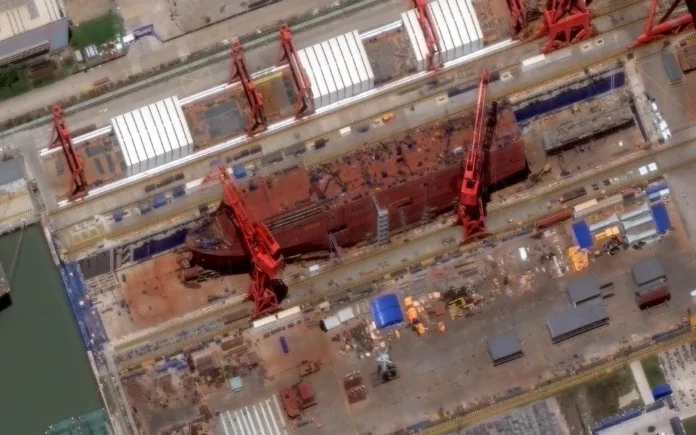
Satellite imagery published this week showed a large vessel taking shape at the Hudong-Zhonghua shipyard in Shanghai. It looks like an amphibious assault ship – well-deck aft beneath a large flat deck, hangar tucked into the forward superstructure – but the cargo is not landing craft. It is built to carry, launch and recover uncrewed submarines, and big ones: extra-extra large uncrewed underwater vehicles (XXLUUVs).
The two XLUUV types China has been testing at Hainan Island are 115ft and 148ft long: six to eight times the displacement of America’s Orca and the bigger ones are only 36ft short of, say, a German 212A fully crewed diesel-electric submarine.
The mothership could carry perhaps four XXLUUVs, tend them at sea and deploy them a long way from home – the west coast of the United States is the obvious place.
Much of the reportage calls this a first, but it isn’t really. Japan’s Chiyoda was built to carry a dozen midget submarines in her hangar and launch them down a stern ramp, and deliver them to the Aleutians and Guadalcanal in 1942. HMS Bonaventure carried Britain’s X-craft mini subs to the Far East. The Americans built ships in the 1970s to carry their rescue submersibles and have used chartered oil-industry vessels as submersible motherships ever since.
Russia’s Yantar, so often found loitering over our cables, carries two deep-diving mini-subs, and China has been launching its own crewed submersibles from motherships for more than a decade. Launching small submarines from a big surface ship is not new.
What is new is scale and intent. This is China declaring that it wants to do this at scale and from a ship that can be easily tracked. It’s pretty brazen really.
The good news is that a mothership has vulnerabilities its cargo does not. You can see it loading from space and know that a deployment is coming. Having been alerted, once at sea, she will be relatively easy to follow, and if your tracking device happens to be an allied nuclear-powered submarine (SSN) then the launched drones will be similarly easy to spot, analyse and track.
With an estimated range of 7,000-10,000 nautical miles, the XXLUUVs could transit to the US western seaboard on their own, but it would take ages. Assuming they are diesel-electric powered, which is almost certain, they would have air-intake “snort” masts above the surface for most of the journey and therefore easy to track.
There are a few assumptions stacking up here, but clearly China has done the actual maths and determined that something that can help close the distance first, and then deploy them, is worth investing in despite the vulnerabilities. This might be because they have determined it will also be easier and quicker to conduct trials and maintenance from at sea than constantly having to dry-dock on land. Trials and logistics aside, I am absolutely sure I wouldn’t want to be in that mothership if things were seriously heating up.
Then there is the age-old problem of underwater communications, which I doubt China has cracked. Radio waves barely penetrate seawater at any useful data rate, no matter how hard you try. If you want your drone to act as a sensor, or map Critical Undersea Infrastructure, it could do so for days or weeks at a time then come to periscope depth to uplink all the data – that’s a practical proposition.
If you want it to hunt and, if necessary, destroy another ship or submarine then that is very different. By the time the XXLUUV has come to periscope depth, transmitted its findings, received its orders and dived again, that data will be time-expired. There is a reason a normal submarine has its sensors, weapons and decision-makers all in the same tin can. Or you make it fully autonomous but that requires its AI brain to contain a hell of a lot of very highly classified data before deploying.
Last week the Iranian Revolutionary Guard fished a US-made Anduril Dive-LD out of the approaches to the Strait of Hormuz. The Pentagon says it was an older model carrying nothing classified; of course they did. But the bigger and cleverer these vehicles get, the more will be on board, and the more it will matter when one is picked up. You could rig it to self-destruct, but like all military kit, everything is a compromise and the more complex and heavy you make it, the more you eat away at the advantages of autonomy.
Everyone is at this. The US has three Orcas and money earmarked for about 13 more. Australia’s Ghost Shark is in production. Russia has its Gugi mini-subs, especially dangerous because they are manned and nuclear powered. We have XV Excalibur, 40ft and 19 tons, handed over in December for two years of trials. BAE’s Herne XLAUV demonstrator, together with XLUUVs and smaller UUVs form a key part of the Royal Navy’s ambitious hybrid plans.
They will help shore up the Greenland-Iceland-UK gap against Russian submarines and spy ships increasingly present in the North Atlantic. China may have less interest in the North Atlantic for now, but it will clearly be able to reach it soon.
This development mirrors current global major warship production – China first, the US second, everyone else third and by some distance. We can’t match it, nor should we try, but in a time like today when we Brits are unable to deploy a single working SSN, we need to ensure we are keeping up with other means of defending against this kind of threat.
Because if we don’t, the likelihood of having to do so goes up.
*Tom Sharpe OBE served for 27 years as a Royal Navy officer, commanding four different warships.
This article was first published in The Telegraph and is republished with permission of the author.