By Tom Sharpe
Last week, Sky aired its new series The Wargame, a TV adaptation of last year’s award-winning podcast of the same name. In outline, Russian “grey zone” activities in our waters, of the sort we see every day for real, suddenly turn fully black. Actions deliberately designed to test our responses and consume our defence resources while remaining below the level that requires a conventional military response spiral out of control. Ships sank, missiles exchanged, population centres hit and, by the final episode, the horrific spectre of a nuclear strike appears.
More importantly, though, it exposes in gory technicolour the glaring gap between our existing conventional forces and our nuclear deterrent. To use a golf analogy, we have a few wedges and then nothing until our driver. This needs money to resolve.
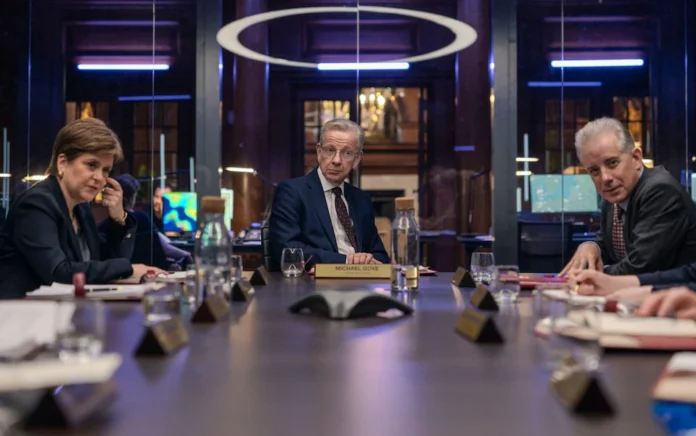
Two other retired military officers and I were in an operations room acting effectively as service advisers to the Chief of Defence staff, played by Gen Sir Richard Barrons. He was a key member of the Cabinet Office Briefing Room (COBR) team who rightly captured most of the airtime.
Our single working Type 45 destroyer (realistic) is stationed off Faslane to protect our nuclear deterrent submarine base because it is the only thing we have that might be able to intercept a ballistic missile (it formally doesn’t have this capability, but in the real world a T45 has intercepted a low-end Houthi ballistic missile above the Red Sea). There is a conversation in the show about the merits of putting her there versus protecting population centres, the kind of awful problem that only having one operational destroyer bestows upon you – see whether or not HMS Dragon should protect RAF Akrotiri or head to the Strait of Hormuz as a real example from earlier this year.
This sort of thing confronts our naval planners every day and exasperates them as much as it surprises and annoys the cast members in the programme. The First Sea Lord’s plan to pull us out of this hole is both ambitious and sound, but – and you know where this is heading – that plan needs more money.
Dependence on allies
The Wargame also shows our dependence on allies and, in particular, the US. In the show, we turn to them almost immediately, and they say no. This, of course, is a historical reality and not just what we could expect today. Europe joins us when the missiles start flying, but even then, much of that combined effort in terms of logistics, communications and intelligence is underpinned by the US. Without the Americans, we are in big trouble.
But The Wargame makes it very clear that we must not over-rely on them in future. This needs a high degree of cooperation with our allies on this side of the Atlantic, much of which is taking shape nicely, and an uplift in spending – sorry to repeat myself, but this is very important – which isn’t.
The show makes all too clear our lack of national resilience and ability to communicate quickly in a contested and confusing environment. Press briefings and the daily news cycle are an embedded part of our media landscape but will always lag behind digital commentary. Establishing a trusted network that can cut through this immediately is key and, unlike bombs and bullets, not expensive to do.
Nicola Sturgeon, playing the deputy PM, is caught on a hot mic after a press conference saying, “we’re only in this mess because that big f—–g baby is taking orders from Russia”. The scenario is that she/the deputy PM doesn’t actually say this; it’s a deepfake by Russia, but it gets an immediate negative response from the in-show POTUS. That’s funny on the show, not funny at all in real life and entirely realistic. Communications is a weapon just like any other and a central pillar of the Russian playbook. This week’s announcement by the real PM of a National Centre for Information Defence to tackle this is a step in the right direction.
Power at sea
The Wargame shows how much of the action in a plausible confrontation takes place at sea, particularly in the earlier stages. The RAF and Army both have key roles to play too, but in the current resource environment where brutal prioritisation is needed, if we can’t plug the GIUK gap then the Russian submarine threat renders much of our other defence activity moot. We were historically strong here and our allies will look to us to return to this strength. The Navy is moving as fast as it can in this direction as part of the Hybrid Navy plan.
Again, less than a fortnight ago in the real world, we test-fired a US Mk48 heavyweight torpedo from an Extra Large Uncrewed Undersea Vehicle (XLUUV), XV Excalibur, built by MSubs in Plymouth – a world first. This capability was developed fast, for relatively little cash and there was not a defence Prime in sight – a positive sign that we are getting the hang of procuring and testing complex weapons quickly.
I will never stop saying we must do better and we still need our shields up ready for the first minister who suggests that XLUUVs can now replace SSNs, because they absolutely cannot. But it’s another positive step and – back to the wargame – a handful of these things would have been mighty useful in the scenario. And of course this is the sort of capability that helps to stop the whole thing escalating in the first place.
In risk terms, The Wargame is a low-probability, high-impact scenario. By episode four, the COBR group has moved to a secure bunker as nuclear escalation looms. The horrific implications of this are briefed. The importance of both our own deterrent remaining the ultimate guarantor in this scenario and of having sufficient conventional forces to minimise the chance of ever getting there is made evident.
As a side note, watching the actors portraying the COBR members, all of whom have done jobs similar to the ones they were playing here, cordially – if animatedly – discussing and debating issues on which they had markedly different ideologies was a reminder that in an era of polarised online rage, measured collaboration remains a core part of sensible decision-making. All of this was deftly steered by Michael Gove as the fictional PM.
Early reviews focused too heavily on the make-up of the cast who, by virtue of many being ex-politicians, will by definition divide opinion. By the end of the week, though, this had swung as most people realised the message was far more important than who did what in a previous life. It was also the reason that when Deborah Haynes – the Sky News security and defence editor – asked whether we would like to be involved, we all jumped at it.
Briefly stepping out of the game, one could say leadership is often a “glass half full” business, particularly in dark times. Doom-mongering rarely helps. Likewise, pretending the glass is three quarters full doesn’t help either, especially when everyone can see the glass.
Our defence apparatus has to break this habit. Be positive, yes, but also be honest. The current Defence Secretary should be commended for becoming involved with this programme, but his answer in the interview with Cathy Newman verged on false optimism when he discussed “other capabilities” we have to deal with threats such as those seen in The Wargame and in real life.
This was in stark contrast to Sir Richard – the pretend head of the Armed Forces – who, when asked at a (very well) simulated press conference whether we had enough capability to deal with this threat, stepped back and said “I have the resources I have”, and later described how we had enough to sustain a fight for two weeks and no more.
Who you believe here will determine whether you think our static defence resourcing is sufficient to meet the rapidly increasing threat. And this isn’t just about the more hardcore scenario depicted in the show. Earlier this week I wrote about the current threat to our undersea infrastructure, which, if enacted, could be as damaging as many of the non-nuclear scenarios depicted here without a shot fired.
Penny Mordaunt, who played the Defence Secretary in The Wargame, summed it up nicely in the live show Q&A: we have a choice: spend 5 per cent of GDP on defence now or spend 50 per cent later when we go to war. And that’s not even to mention the other terrible costs of a hot war.
*Tom Sharpe OBE served for 27 years as a Royal Navy officer, commanding four different warships.
This article first appeared in The Telegraph and is repubished with the author’s permission.