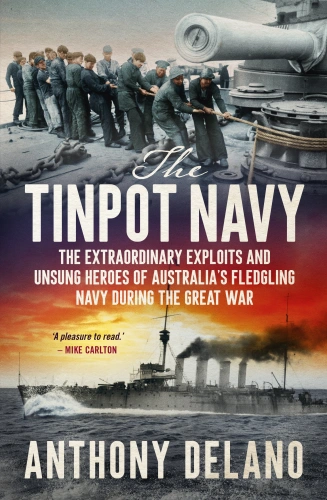
The Tinpot Navy – The Extraordinary Exploits and Unsung Heroes of Australia’s Fledgling Navy During the Great War. By Anthony Delano. Allen and Unwin 2025.
Reviewed by Desmond Woods
I enjoyed reading this history of the RAN’s genesis before and during the Great War. It is written by veteran journalist Athony Delano, who is an RAN World War II veteran. This book is a revised and improved version of his earlier 2016 book “They Sang like Kangaroos: Australia’s Tinpot Navy in the Great War.” That book attracted mixed reviews and lacked a bibliography. It was regarded by some naval historians, who reviewed it, as being a ‘series of good yarns’ rather than naval history.
This version of the book has successfully addressed those criticisms and the author has provided a bibliography and evidence for sources. It is still intended for the general reader who has not read the history of the RAN at the beginning of the 20th century in other official or scholarly sources. That is a large category of Australians whose knowledge is limited to Diggers in the Dardanelles and their role on the Western Front. So this book is meeting a need for a concise and readable account of what Australian sailors and their ships were doing in the Great War.
The book title ‘‘Tinpot Navy’ has been retained from the earlier edition. It might have been a fair description of the Commonwealth Naval Force between Federation and 1913. But when the First Fleet Unit arrived in Sydney, led by the battlecruiser HMAS Australia, the RAN was a modern, versatile and powerful force of warships including, cruisers, destroyers and two E class submarines. Unlike the Commonwealth Military Force in August 1914 the RAN was “In All Respects Ready.” The pejorative name ‘Tinpot Navy’ was no longer being applied after the victory of HMAS Sydney over Emden, when it became clear to previously doubtful Australians that their RAN ships, were a match for their opponents and able to be of real service in defence of imperial sea lanes.
Delano’s revised book provides generally accurate, and certainly readable accounts, of how these new ships, and the men who served in them, were used, and misused, between 1914 -1919.
The RAN losses and the tragedies are explored and responsibility attributed. The long and dangerous passage in 1914 of the two Australian submarines to Australia through blazing heat while dealing with mechanical failure and near collisions is recounted. The subsequent loss of Lieutenant Commander Thomas Besant and all 34 of the crew of AE1 off Rabaul and the probable cause of the disaster based on recent evidence seen on the boat is discussed. The fate of Dacre Stoker’s AE2 in April 2015 after penetrating the Dardanelles and then being shelled and sunk in the Sea of Marmora is equally well written about.
Delano deals with the folly of not properly employing HMAS Australia to bring the German Far East Squadron to battle in the Pacific in late 1914. But he does not go on to make explicitly the obvious fact that the Admiralty’s mistake in leaving Australia idle in Suva cost the Royal Navy two cruisers sunk and 1400 men and boys killed at the Battle of Coronel. The eight 12-inch guns of HMAS Australia could, and should, have been with doomed Admiral Christopher Cradock and his sailors off Valparaiso where they were overmatched by Scharnhorst and Gneisenau in a one-sided duel at dusk. For weeks prior to the disaster Admiral George Patey in HMAS Australia was very sure he wanted to be released to pursue Von Spee’s ships to Chile, which was the only place they could go, and repeatedly asked the Admiralty, through the Naval Board in Melbourne, and directly, for permission to do so. He was never released until the battle was lost and Fisher took charge in Whitehall.
Instead, of making the obvious decision to accede to Patey’s pleadings, the inexperienced First Lord of the Admiralty, Winston Churchill sent to Cradock stationed at the Falkland Islands, an elderly (1899) reserve manned, pre-Dreadnought battleship, This was HMS Canopus, which was obsolete and only saved from being scrapped because the war broke out. It mounted just four12 inch guns with a very slow rate of fire. This outclassed old ship was too slow, and mechanically unreliable, to be of any use to Cradock in the battle he knew he was about to engage in. Fortunately for her 750 RNR crew Canopus was not present at Coronel or she would have been quickly sunk with heavy loss of life.
Because she was rated as a battleship Churchill had romantically called Canopus a ‘citadel ship’ around which Cradock’s cruisers would be safe. He left the real ‘citadel ship’, the powerful battlecruiser HMAS Australia, ‘off the plot’ far from where she was needed. Churchill was very much a ‘hands on’ engaged First Lord of the Admiralty. He was constantly involved, some would say interfering, in daily decisions on global ship movements. He, not the First Sea Lord Prince Louis of Battenberg, was making final decisions in late 1914. Churchill overruled his professional advisers who told him that battlecruisers should be sent to Cradock. Churchill cannot consequently escape responsibility for this costly blunder and the RN’s first defeat at sea in a century.
The pointlessness of seizing the no longer useful German wireless transmitter at Bita Paka in New Guinea by a frontal assault up an enfiladed jungle track is well dealt with. It is familiar territory for those who have read the contemporary accounts of this unnecessary tragedy. It involved the loss of the first Australian lives in battle in the Great War and is well described. None of these German radio stations in the Pacific were worth the bones of a single Australian matelot or digger. With the departure of Von Spee and his ships they had been overtaken by events and would have surrendered without the need for loss of life. Jingoism overcame common sense.
Delano then deals with the long campaign by the elderly, underpowered, coal hungry, light cruiser HMAS Pioneer to destroy the modern German light cruiser Konigsberg which for months evaded its RN pursuers by mooring well up the Rufiji river in East Africa. Pioneer was commanded by Thomas Biddlecombe who took his totally unsuitable little cruiser upstream and fired salvos for 6 hours at the target, which was invisible in the tangled foliage, without registering a hit. It was, nevertheless, a good effort and a prelude to Konigsberg’s final destruction by two RN monitors the following day.
Acting Commander Biddlecombe then became the first RAN officer to be sunk with his ship. Bored with life in a battleship, he volunteered to command a small well-armed Q ship. HMS Warner was intended to decoy U Boats to the surface and sink them with gunfire. Unfortunately for Biddlecombe and his crew, U-61’s captain was not deceived by this ruse of war and used his last torpedo to sink Warner instead. This very dedicated officer never left his little ship and died with it as it sank.
The Battle of Cocos Island is well covered and particularly the part that chance played in the outcome. The author makes the valid point that if all SMS Emden’s time expired shells that hit Sydney, in her opening salvoes had exploded, Captain Glossop and his bridge team would have been killed in action, and the ship would have been in serious trouble. Glossop was fortunate to survive in action long enough to learn that German gunnery was deadly accurate and Emden had guns which had longer range than the Admiralty experts had anticipated. Glossop withdrew Sydney to a safe range where he could hit Emden but not be hit by return fire. The RAN’s first victory could very easily have been its first disaster.
Delano does not deal with the RAN Bridge Train at Gallipoli where sailors and their officers worked tirelessly, exposed to Turkish fire, to provide pontoon structures which enabled the British landings at Suvla Bay to be supported. Because these men were not at ANZAC Cove they were little noted in 1915, and losses were not remembered. Some mention of them in this book on the RAN in the Great War should have been made for the sake of completeness.
I was unaware until reading this book of the significant part that Ballarat born, and HMVS Cerberus trained, Captain Reginald (Guy) Gaunt played in New York when he successfully intrigued, though his spy ring, to get Woodrow Wilson to declare war on Germany in 1917. Delano has devoted an entire book to this extraordinary and flamboyant Australian trained RN intelligence officer who, according to the British Prime Minister David Lloyd George, by bringing America into the Alliance, won the war single handed!
The little remembered, long and costly campaign to bottle up the Austrian surface fleet in the Adriatic, behind the Otranto Barrage, made of wire and chain, was an example of an Australian destroyer flotilla doing a tough job and doing it well. They had little support either from the Australian Naval Board or from the Admiralty. The probable suicide by drowning of the Australian flotilla’s popular and successful Commanding Officer, acting Commander William ‘Cocky’ Warren, may have been the result of his depression brought on by this perceived neglect following months of unremitting toil and unrelieved responsibility at sea.
The author handles HMAS Australia’s volunteer sailors’ outstanding part in the Zeebrugge Raid comprehensively and fairly. It is undoubtedly true that at least one RAN sailor, Dalmorton Rudd, could have justifiably been awarded a VC for his outstanding courage fighting machine guns positions on the Zeebrugge mole. But that can be said of many other RN ratings and officers who, like Rudd, were also given lesser awards for their gallantry during that night’s desperate hand to hand fight.
The author paints a stirring verbal picture of the day that the German High Seas Fleet sailed into captivity at Rosyth ion 21st November 1918 with HMAS Australia prominent in the long lines of RN and USN ships waiting to receive these disarmed ships.
He also deals with the determination of Admiral Dumaresq to treat the reasonable demands of the lower deck of HMAS Australia, asking for another day in Perth, to return hospitality, as being a full-scale mutiny. It was certainly insubordination, but Dumaresq’s decision to make examples of good sailors, including the stoker Dalmorton Rudd DSM, by court martialling and jailing them, was surely an historical low point in leadership and management of RAN sailors. Dumaresq deserves the opprobrium liberally bestowed on him in 1919 by the Australian public and by posterity for his insensitivity to the nature of the Australian character and the difference between RN and RAN ratings when it came to matters of discipline.
This is a very enjoyable book with good footnotes, photographs and an extensive bibliography. Oddly, this extensive list of sources does not include David Stevens’ Centenary of ANZAC 2014 book on the RAN in the First World War entitled “In All Respects Ready.”
It is a great credit to Anthony Delano that, having joined the Navy in 1944 as a 15-year-old, and seen war service at sea, he has, in 2025, produced this admirable history of the early RAN. It has been published more than eighty years since he joined the Navy. That is a remarkable achievement with which to continue his fine career in investigative journalism and the writing of history.
Mike Carlton, the naval historian, has written of this book: “This will delight Australian naval history buffs. It is a feast of fact, well researched, with a light touch that is a pleasure to read.”
Congratulations and thanks are due to this veteran author for this late flowering work. He has produced a well written and very readable account of the RAN at war in peace and war in the first two decades of the twentieth century.