By Clive Williams*
On 27 July 1916, British merchant seaman Captain Charles Algernon Fryatt faced a German naval firing squad near Bruges in German-occupied Belgium. He was 43, a civilian with seven children and the master of the Great Eastern Railway steamer SS Brussels. His alleged crime was attempting to ram a German U-boat more than a year earlier.
The Germans branded him a franc-tireur—an unlawful civilian combatant[1]. A hastily convened German Imperial Naval Court (Marine-Kriegsgericht) convicted him, and he was executed the same day. International outrage followed.
British Prime Minister H. H. Asquith described the execution as murder, while newspapers from New York to Geneva denounced it as an atrocity. The case also raised enduring questions about the rights of merchant seamen under the laws of war that continue to resonate today.
Fryatt was born in Southampton on 2 December 1872 and was raised partly in Harwich, Essex. He entered the merchant service at an early age, serving on several vessels before joining the maritime arm of the Great Eastern Railway in 1892.
The Great Eastern Railway operated ships so that it could offer seamless passenger and cargo services between London and the Continent. Passengers travelled by boat train from London’s Liverpool Street Station to Harwich before boarding Great Eastern Railway steamers for Rotterdam, Antwerp and, later, the Hook of Holland.
In March 1915, while master of SS Wrexham on the Harwich–Rotterdam run, Fryatt was chased by a German U-boat off the Dutch coast. He ordered full speed, reportedly reaching about 16 knots, above the ship’s normal maximum of around 14 knots, with deckhands assisting with stoking in the engine room.
The pursuit lasted more than 40 nautical miles through shallows and minefields. The U-boat could also make 16 knots on the surface but abandoned the chase once SS Wrexham neared the Maas light-vessel and entered Dutch territorial waters. The ship arrived in Rotterdam intact but with burnt and blistered funnels. Fryatt’s grateful employers rewarded him with a gold watch.
Later that month, while commanding SS Brussels near the Maas light-vessel, Fryatt was ordered to stop by German submarine U-33. Rather than surrender, Fryatt ordered “full speed ahead” and attempted to ram the submarine. The U-boat crash-dived and escaped damage.
First Lord of the Admiralty Winston Churchill had earlier instructed merchant captains to evade and, where possible, resist submarine attack, warning that surrendering a ship without making every effort to escape could attract official sanction. The Admiralty awarded Fryatt a second gold watch and a certificate praising the fine example he set.
On 23 June 1916, SS Brussels was intercepted by German destroyers off the Belgian coast and Fryatt and his crew were taken prisoner. The inscription on his Admiralty watch was later cited by the German prosecution as evidence that he had sunk a submarine – even though U-33 had survived the encounter[2].
Fryatt was tried at Bruges Town Hall on 27 July 1916 and convicted of being an unlawful combatant. He was shot that same evening. A German proclamation declared the execution a just, if belated, act of vengeance.
After the war, a German legal commission concluded that the sentence could be justified under Germany’s interpretation of international law, although two members dissented, condemning the proceedings as judicial murder[3]and criticising the haste with which the trial and execution had been carried out.
Fryatt’s body was returned to Britain in 1919, where he received a state funeral at St Paul’s Cathedral before being reburied at All Saints’ Churchyard, Upper Dovercourt. His funeral was one of only three post-war ceremonies accorded exceptional national honours; the others being British nurse Edith Cavell[4] and the Unknown Warrior.
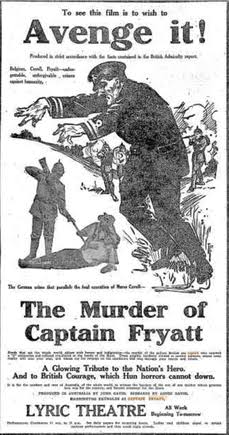
The Fryatt story quickly reached Australia and inspired the 1917 silent propaganda film The Murder of Captain Fryatt, directed by John Gavin and written by his wife, Agnes. It dramatised Fryatt’s attempted ramming of the German submarine and his capture and execution, while adding a fictional Belgian romance subplot. English actor Harrington Reynolds portrayed Fryatt.
The film is now considered lost, with no known surviving copies.
The Murder of Captain Fryatt reflected the strong imperial sentiment of the period, hailing Fryatt’s courage to boost military recruitment and reinforce public resolve against Germany. Australian audiences recognised in Fryatt the same qualities celebrated in ANZAC narratives – resourcefulness, defiance, and duty performed under hazardous circumstances.
Issues raised by Fryatt’s case remain strikingly relevant today.
Modern defence of merchant shipping includes armed civilian security teams protecting merchant vessels from Somali pirates, and merchant vessels responding to Houthi drone and missile attacks in the Red Sea and Ukrainian drone attacks in the Black Sea and Sea of Azov.
Relevant issues are: when do civilian vessels acting in self-defence or providing cargoes that support an enemy become participants in hostilities[5]?
The classification of irregular fighters, hybrid threats and the treatment of captured non-state actors also continue to test legal principles similar to those at the heart of Fryatt’s case.
Although maritime warfare and the law of armed conflict have evolved considerably since 1916, the vulnerability of global maritime trade – particularly for island nations like Australia – has not.
For Australia, the relevance is practical as well as historical. As a trading nation dependent on Indo-Pacific sea lanes, Australia has a direct interest in freedom of navigation and the security of commercial shipping. The RAN and merchant fleets serving Australia increasingly operate amid great-power competition, grey-zone tactics, and threats to vital energy and trade routes.
Fryatt’s story illustrates how the actions of an ordinary merchant navy captain can become woven into national wartime memory.
Fryatt was posthumously awarded Belgium’s Order of Leopold and Maritime War Cross. Memorials to him exist in Britain and Belgium, while in Canada there are mountains named after both Fryatt and his ship. King George V personally expressed his abhorrence at Fryatt’s execution, and Fryatt’s widow received generous financial support.
Fryatt’s enduring legacy lies in the question his death posed but never resolved: when civilians under military attack choose resistance over surrender, who has the authority to decide whether that act is heroic or criminal? In an era of contested seas, hybrid warfare and increasingly vulnerable global trade routes, that question remains as relevant today as it was in 1916.
*Professor Clive Williams MG is a visiting professor at ADFA and was formerly an honorary professor at the ANU’s Centre for Military Security and Law.
[1] The term franc-tireur originated during the Franco-Prussian War (1870) to describe non-uniformed civilian irregulars fighting on land. Germany controversially extended this land-based doctrine to the sea, alleging that a non-commissioned merchant vessel attempting to ram a warship was an unprivileged civilian combatant committing an act of illegal warfare. However customary naval law – including the Hague Conventions (1907) and Prize Rules – has long maintained a clear separation from land warfare. Under established naval customary law, merchant mariners possess a recognised right of self-defence against capture or attack by enemy warships. Exercising this right does not turn mariners into war criminals nor unprivileged combatants. If captured, they are legally entitled to Prisoner of War status, not criminal trial and execution.
[2] U-33 survived the war. It conducted 16 patrols, mainly in the Mediterranean and Black Sea, sinking around 84 vessels. It was surrendered to Britain at Harwich on 16 January 1919 and broken up at Blyth in 1919–20.
[3] “Judicial murder” (Justizmord) is a specific legal and rhetorical term used by international jurists (such as Walther Schücking, a dissenting member of the post-war German commission). It denotes an execution carried out under the pretence or colour of law by a court that lacked lawful jurisdiction or violated fundamental principles of natural justice and due process.
[4] Edith Cavell was a British nurse executed by Germany in 1915 for helping Allied soldiers escape occupied Belgium.
[5] Note that a merchant ship’s cargo may make it a military objective, but the crew remain non-combatants unless they directly participate in military operations.