
Michael Hickey and James Fitzgerald*
Australia must exploit ambiguity in its sovereignty[1] narrative to enable AUKUS. The Garrett Enquiry is energising the Australian public to consider AUKUS realities.
Australia has not been truly sovereign in its own right since 1788. The head of state remains a foreign monarch. Generations of Australians have been lulled into forgetting this reality by the cultural familiarity of the Anglosphere and overall economic prosperity afforded by Pax Americana. But Australia’s national identity is now opaque and strategic assumptions are changed. Let’s be clear, concerns about loss of sovereignty arising from AUKUS are illusionary. We’ve never really had it.
AUKUS requires clear eyed assessment of Australia’s sovereignty ambitions. Functioning sovereign states require the resources to defend their interests. The Defence and Security ‘Commentariat’ tend to express these security capabilities mechanically, typically in terms of military force structures comprising ships, submarines, planes, tanks, infantry battalions, etc. Capability gaps are identified in the acquisition, transitioning, or sustainment of platforms. The prevailing focus in the AUKUS debate on the military-industrial complex’s ability to build SSN-AUKUS is illustrative. However, arguments for future force structure cannot be made in a vacuum. They should be cost conscious and restrained by the available human resource. In Australia’s case the foremost future capability gaps will be in humans, not machines. Recent ANI critique of the AUKUS dependency of workforce is germane and overdue.
The ANZUS Treaty singularly illustrates Australia’s strategic security team. Despite the Trump presidency where many Australians were forced to confront for the first time a shocking cultural and values misfit with the leadership of the major partner, the AUKUS agreement continues to emerge as the security guarantee to renew common interests of natural partners. Australia’s commitment cannot be understated. We have everything to play for in preserving enough of Pax Americana to maintain our concept of Australia within the rules-based order upon which our economy and way of living depend.
A real risk to our strategic objectives is Australian demographics. Australia cannot expect a sovereign workforce enabling its strategic partnership commitments to emerge from within. The demographic trends demand an alternative. Australians are aging and not attracted to Defence careers. A declining percentage of Australia’s population will pass fitness and security vetting for Defence and other security agencies even if inclined to join. The 2023 Review of Australian Migration reports it is not fit for Defence purposes and is enabling an expanding underclass of temporary workers. Divided loyalties are an increasingly vocal trend in Australia’s pluralist society. Put simply Australian demographics do not support future Australian Defence workforce objectives.
The RAN is a highly regarded training provider, and the Navy Training Organisation is complex. The RAN’s Mission relies on operating a dynamic ‘training pipeline’ to produce trained Sailors and Officers. Security vetting, conducted by AGSVA, has been a traditional problem to Navy Training Schools in delivering newly qualified personnel to the Fleet in a timely fashion. Trainees often struggle to provide the evidence required of the security vetting agency and training outcomes and graduations are delayed. Australia’s demographic trends are likely to increasingly frustrate vetting outcomes. Yet security assessments must be assured for the AUKUS work streams. The inescapable consequence is future efficiency of the training pipeline will be compromised for reasons Navy has no ability to control. This is a profound reputational issue for the RAN.
The eminent and sorely missed James Goldrick noted poignantly that if Australia is to embark on the SSN program the bill in people must be understood and met from the outset. The commitment to AUKUS is not diminishing, and time is pressing to be innovative in finding the human resources to achieve AUKUS. The AUKUS Pathway statements remain ambitious job creation targets but lack detail on innovative ways to find the resources.
So, if sufficient Australians cannot be found to enable Australia as a sovereign AUKUS partner what are the alternatives? A default option could be Australian Basing for US Submarines. This option may win out by stealth over time but is an unlikely preferred option unless strategic circumstances overtly shift.
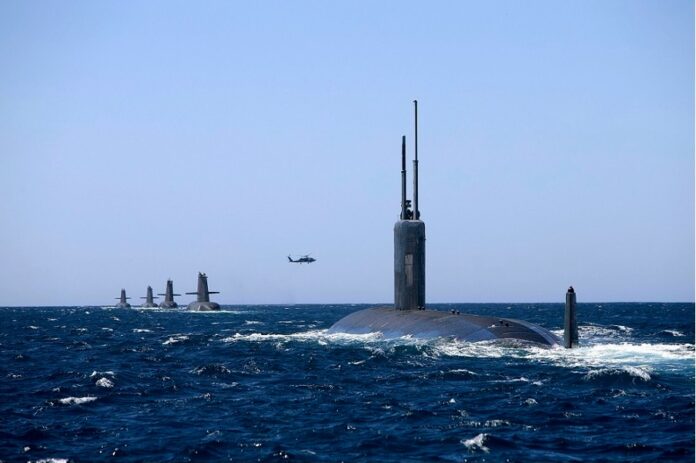
A new Naval entity to achieve the new maritime security guarantee under AUKUS is a concept worth testing. AUKUS provides opportunity for a fresh approach to collective security among nations with an interest in sustaining an open global trading system governed by markets and the rule of law. Partner nations would contribute resources, but the AUKUS Fleet could be controlled as a federated entity. The strategic advantage offered by submarines is ambiguity. This advantage is multiplied by the size of the networked submarine fleet, the compelling opportunity of AUKUS. So, if the strategic guarantee offered by an AUKUS Fleet is greater than the sum of the parts of the participant nations, would the partners be better served by a fleet of submarines flying AUKUS flags?
An AUKUS Fleet would potentially, and by necessity, illustrate efficiency and effectiveness outcomes over existing National Navies. Operationalised by a franchise model with central Command and Control an AUKUS Fleet could be characterised by the collective objective of unrestricted oceans and the interoperability of its fleet operations and sustainment. Its genesis should include specific consideration of the workforce and crewing requirements of each submarine. The conceptual goal would be crews combined of a mix of partner nations. Home basing of the submarines and their crews will require nuance and new ideas, but with the right incentives both can be inherently mobile.
The raise, train, and sustain aspects of an AUKUS Fleet workforce demand careful attention but provide opportunities over existing national stovepipes. Flexibility is key to enabling AUKUS workforce requirements and AUKUS partners will need to find ways to expand the partnership from a crewing perspective. Specifically, pathways for like-minded nations (Canada, New Zealand, and others) to join the partnership must be envisaged. The model for training must be driven by efficiency and duplication managed. Centres of excellence will be required to master the standards and develop curriculum for an AUKUS Fleet. Training delivery will be franchised and centrally controlled in a similar but separate arrangement to Operational Command and Control. The sustainment aspects of an AUKUS Fleet workforce can only be speculated but there should be no doubt it could test the resolve of the partners.
AUKUS may provide Australia’s future security guarantee as part of a reinterpreted international communion of interests, but resources to enable it could require re-balancing of sovereignty ambitions to prioritise the common interests of the AUKUS partners. Fulfilling the AUKUS promise requires delivery of both machines and humans. The inconvenient truth is sovereignty ambitions are constrained by resources. The human side of the Australian AUKUS conundrum will likely need some radical solutions.
Michael Hickey is retired from permanent service in the Royal Australian Navy. He held appointments as the Director of Studies for the Defence Strategic Studies Course and Director Navy Training.
James Fitzgerald is a lawyer, legal strategist, and adjunct associate professor at UNSW Faculty of Law.
[1] Challenges associated with the term sovereignty for Aboriginal Australians is respectfully acknowledged.

A most thoughtful and innovative proposal of mixed SSN crews from like-minded navies. But precisely which countries would provide personnel? The writers give Canada and New Zealand as possibilities. These and other traditional allies have their own manning problems.
RAN submariners are integrated into US SSNs largely for training. Could this serve as a future model? But command authority and national sovereignty would be major stumbling blocks.
Manning and training are aspects of AUKUS, and the wider navy, which are overlooked in the current fractious debate. The writers have drawn these essential aspects into questioning the traditional personnel management establishment.