
By Nathaniel England*
In light of recent developments, Australia needs an alternative approach for transitioning to SSN-AUKUS. Under current industrial, workforce, and alliance constraints – the existing “Optimal Pathway” is too tightly coupled, externally dependent, and misaligned with the conditions required for success. To preserve AUKUS as the long-term strategic objective, Canberra must develop a new transition sequence that better mitigates the risk of a potential capability gap in the 2030s and 2040s.
The question is not whether Australia should pursue advanced nuclear-powered submarines (SSNs) via AUKUS Pillar I, but whether the current project strategy is too structurally fragile, exposed, and based on assumptions that are no longer holding. Australia’s Collins-class submarine fleet is ageing, the decision to pursue nuclear propulsion came late (in retrospect), and the resulting plan now relies on a tightly sequenced chain of events that leaves little room for deviation.
The AUKUS “Potential Capability Gap” Risk:
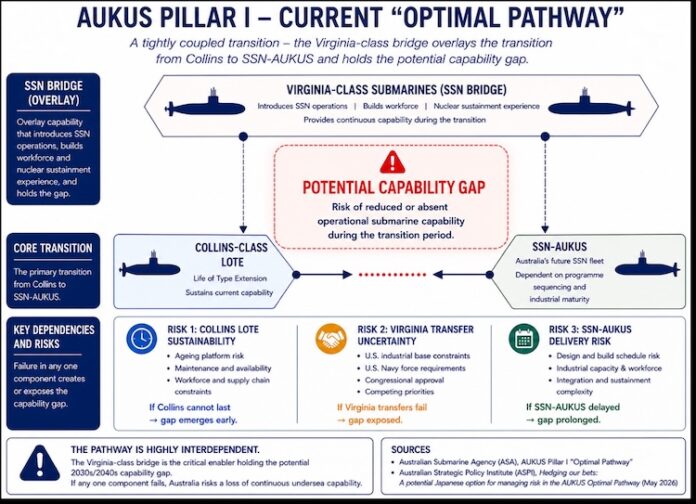
The current AUKUS “Optimal Pathway” is better understood as a tightly coupled transition of three core parts: Collins-class Life of Type Extension (LOTE) into the 2040s, the acquisition of at least three Virginia-class submarines in the 2030s as an “SSN bridge,” and the arrival of SSN-AUKUS in the early 2040s.
Yet a failure to increase United States (US) submarine production, a shift in congressional/US-Navy priorities, pressure on the allied industrial base, or Collins LOTE difficulties does not simply delay delivery; it directly affects Australia’s ability to sustain and transition its own submarine capability. Coherence exists only if everything goes according to plan. Yet in a world increasingly characterised by uncertainty and disruption (which AUKUS is intended to help mitigate) – that ambitious planning looks more like poor risk management.
Recent developments suggest that several of the pathway’s key assumptions are now under strain simultaneously – from Virginia-class transfer uncertainty and industrial setbacks to growing pressure surrounding Collins fleet LOTE itself. The “potential capability gap” that has been frequently referenced throughout the AUKUS debate is now more salient than ever.
Virginias are no longer guaranteed:
Nowhere is AUKUS fragility more apparent than with the future transfer of US Virginia-class submarines. This nuclear-powered submarine (SSN) capability “bridge” is central to the transition and carries disproportionate dependency across the overall pathway. Yet it remains conditional, externally controlled, and subject to both US industrial base ramp-up and the availability of US Navy assets.
A recent US Congressional Research Service report has now openly questioned the feasibility of transferring Virginia-class submarines to Australia under current production and force posture constraints. While not definitive, it reflects a growing acknowledgement that this “SSN bridge” is not guaranteed – despite previous political assurances.
This concern is already visible in recent AUKUS debate with proposals to address this increasingly likely scenario. Opposition Liberal Senator James Paterson has suggested the government consider long-range strike platforms such as the B-21 Raider stealth bomber. Likewise, a recent ASPI report has made a similar diagnosis of the problems and risks laid out here, and recommends a “Plan B” to lease Japanese submarines (like the Taigei class) as an interim “stop-gap” measure. Both reflect legitimate concerns about the uncertainty of Virginia-class transfers and the overall pathway.
Although the leasing or rapid-acquisition logic behind a Japanese Taigei proposal may appear attractive as a “less disruptive” intervention, it ultimately reproduces the same external dependency problem already present within the current pathway. Submarines are among the most strategically sensitive and operationally constrained assets in any navy. If reversible transfer or leasing arrangements were viable within this context, they should already form part of the AUKUS pathway itself. There is little reason to expect Japan would risk sovereign-operational flexibility that even AUKUS partners have not offered. More fundamentally, replacing dependence on Virginia-class transfers with dependence on leased Japanese submarines does not resolve the underlying sequencing problem – it splits the dependency risk between partners.
The B-21 proposal, like other long-range strike options, reflects a different issue of the debate. AUKUS is intended to provide both strategic deterrence and a sovereign sub-surface capability, yet the two are often conflated within broader public discussion. Long-range strike platforms such as the B-21 may contribute to the former, but they do not resolve the latter – which is the central transition problem currently facing Australia. Submarines are not just strategic strike platforms; they provide persistent undersea stealth presence; Intelligence, surveillance and reconnaissance (ISR); tracking and shadowing; long-cycle patrols; survivability; and strategic uncertainty in ways that long-range bombers cannot replicate.
Australia’s challenge is therefore not merely maintaining the ability to strike targets at distance, but preserving continuous submarine capability while transitioning into sovereign SSN operations. The B-21 may nevertheless warrant renewed consideration by Canberra as a complement to a future sub-surface force, but as an addition, not a substitution.
SSN-AUKUS delay and Collins LOTE concerns:
Collins-LOTE is being asked to sustain the existing submarine force well beyond what recent operational experience suggests is comfortable, whilst SSN-AUKUS depends on a major industrial and workforce expansion delivering broadly on schedule by the early 2040s. The result is a tightly coupled transition with limited visible margin for schedule recovery if delays or sustainment pressures emerge across multiple components simultaneously. The pathway is therefore exposed from both ends – dependent on Collins lasting long enough, and on SSN-AUKUS arriving soon enough, within a relatively narrow transition window with minimal overlap.
A recent United Kingdom (UK) Parliamentary Committee report has confirmed that SSN-AUKUS delivery is already slipping under industrial strain, workforce shortages, and delayed investment. It warned that failure to sustain the required pace “could lead to delay in delivering SSN-AUKUS with serious consequences” for both national capability and partner credibility. Given the UK is critical to development and execution of SSN-AUKUS design and implementation, these constraints are not abstract, and they impact Australia’s own acquisition timeline. Canberra is aware of this, and has made substantial investments in the UK industrial base, but that unfortunately may not be enough to keep the British/Australian development on track.
More broadly, large government and defence-industrial projects of this scale rarely proceed exactly as originally envisioned. Despite strong political backing and sustained investment, schedule slippage, supply-chain bottlenecks, changing strategic conditions, workforce constraints, and cost escalation are common features of long-term national programmes. Assuming that SSN-AUKUS will arrive precisely when required under the current transition window appears counterfactual to historical experience.
At the same time, Collins LOTE itself is becoming a strategic dependency rather than simply a sustainment programme. The Royal Australian Navy currently operates a six-submarine fleet that has already experienced significant maintenance and availability pressures in the 2020s. Extending these Collins-class submarines reliably throughout the 2030s and into the 2040s represents an ambitious assumption underpinning the broader AUKUS strategy.
As ageing platforms are pushed further beyond their original service horizons, sustainment complexity, maintenance burden, and reduced availability are far more likely to increase rather than stabilise. In 2024 there was serious corrosion and saltwater damage discovered across the fleet, and later in the same year it was listed as a Product of Concern. Both developments validate the growing skepticism surrounding whether the small fleet can reliably sustain itself for the period required.
Therefore, if either SSN-AUKUS is delayed and/or Collins cannot be extended long enough, the result is a potential capability gap in the decades ahead. A risk that (under the current pathway) can only be mitigated by the transfers of Virginia-class submarines – which are now becoming more unlikely.
Intervention considerations:
Accepting the risk of a potential submarine capability gap is antithetical to the strategic rationale underpinning AUKUS Pillar I. The partnership was pursued in response to a deteriorating strategic environment in the Indo-Pacific. At the same time, Canberra also recognised the long-term importance of undersea capability for deterrence, strategic reach, strike, and the need to acquire submarines that would otherwise quickly become obsolete. Therefore, a transition pathway that accepts the risk of a capability gap during this same period ultimately undermines the very logic used to justify the programme in the first place.
AUKUS (and the “Optimal Pathway” to achieving it) has become politically symbolic. There are strong institutional and political pressures to preserve the current approach on the basis that this major defence programme requires consistency, alliance cohesion, and long-term commitment. There is no doubt that AUKUS is a once-in-a-generation transition in military capability, workforce structure, industrial capacity, and strategic posture. However, adjusting the sequencing of such a transition should not be considered abandonment of the objective or AUKUS more generally.
Recent geopolitical developments, industrial delays across allied defence sectors, and growing uncertainty and disruption in the international environment all reduce the margin for error. Yet continuing to defer structural adjustment risks concentrating disruption later, when the consequences may be significantly more severe and far less manageable. A failure to deliver on Pillar I will bring significant geopolitical harm to Australia, UK, and US, particularly from capability loss and allied reputational damage.
Arguments against intervention and change also often assume that altering the pathway introduces additional complexity or disruption. In practice, the opposite may now be true. The current model already relies on multiple tightly coupled assumptions holding simultaneously over several decades, while depending heavily on external industrial and political conditions. As these pressures intensify, keeping the existing sequence unchanged may itself become the more complex and burdensome option.
Conclusion: A new transition sequence is needed.
The fragility now emerging within the AUKUS pathway cannot be resolved through partial interventions that address only one component of the transition. Most proposals so far have focused on a single point of failure (typically the uncertainty surrounding Virginia-class transfers), while leaving the broader sequencing problem unchallenged. Others implicitly assume that failure in one component requires abandoning AUKUS altogether and pursuing either a fleet of French-SSNs or modern conventionally-powered submarines.
None of these solutions so far have fully addressed the heart of the problem. If SSN-AUKUS is to remain Australia’s long-term strategic objective, the answer is neither another temporary “stop-gap,” nor abandonment of the programme… but to hedge within it. The debate needs to move beyond the binary framing of either “preserve the current approach” or “replace AUKUS entirely”. Instead, it needs to openly call for a new “Optimal Pathway” that confronts emerging realities and rebuilds the foundations of Pillar I.
Any serious solution requires a re-sequenced transition that’s less dependent on externally controlled factors, capable of enduring delay, and able to stabilise all three major risks simultaneously. In practice, this requires a more resilient, gradual, and longer-term approach – one that extends conventional submarine capability beyond Collins-class LOTE, provides greater time flexibility for SSN-AUKUS arrival, and develops sovereign-controlled nuclear-powered submarine experience over the coming decades. It requires an alternative AUKUS path.
* Nathaniel England is an Australian doctoral student based at the University of Warsaw. His research focuses on the growing inter-regional strategic nexus between Europe and the Indo-Pacific, across security and other dimensions. He has previously lectured on Indo-Pacific geopolitics at Civitas University in Poland, where he also completed a master’s degree specialising in International Security Studies.


In the event of a delay in the Virginia class submarines, I suggest that Australia investigate purchasing the Los Angeles class submarines, after they are suitably overhauled and after they a decommissioned by the US Navy. This will speed up the delivery of SSN to the Australian navy until either the Virginia class arrive or the AUKUS subs arrive. The Los Angeles class are still a superior long-range submarine to the Collins and would speed up the development of navy personnel training on nuclear propulsion.