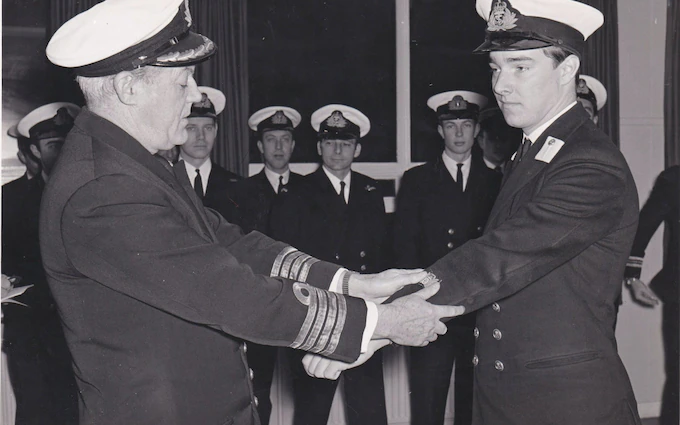
Commodore Barry Bryant, who has died aged 76, helped force the surrender of the Argentine submarine Santa Fe during the opening action of the 1982 Falklands campaign, and later spent 17 years running the Royal Navy’s principal charity.
In 1982 Bryant was flight commander and senior observer (i.e. navigator/tactical co-ordinator) in the frigate HMS Brilliant, part of the task group sent to retake the remote island of South Georgia, the first objective of the Falklands campaign. There, in an anti-submarine action fought and won largely by helicopters, he took part in the first engagement of its kind since the Second World War.
Airborne in a Lynx on the morning of April 25, Bryant was searching the sea north of the island when he heard the cry “Wolf!” – the codeword for a submarine caught on the surface, go out from HMS Antrim’s Wessex helicopter, and listened on the radio as it was attacked with depth charges. The submarine, Santa Fe, commanded by Capitán de Corbeta Horacio Bicain, was damaged but remained operational. Closing in, Bryant dropped a homing torpedo, set shallow – less in expectation of a hit, he later explained, than to discourage Bicain from diving, knowing what was lurking beneath him.
Circling back, Bryant’s crew opened fire on the submarine’s conning tower with a general-purpose machine gun, cobbled together earlier using an office swivel chair, in an attempt to disable the periscopes. As one of Santa Fe’s crew returned fire, Wasp helicopters from other ships pressed home attacks with air-to-surface missiles, and the submarine limped into Grytviken harbour, where the Argentine garrison surrendered later that day.
Bryant recalled with some relish that Brilliant, the only Type 22 frigate fitted with two Lynx, had been fortunate to be on hand – and had, as he put it, “a handsome young team eager for glory. We were quite surprised Galtieri didn’t give up at once.” When his pilot, Nick Butler, brought the helicopter down to land at King Edward Point, an Argentine officer steered them away from a minefield: that officer turned out to be Bicain.
The following night, in poor visibility and with the rotors perilously close to the cliffs, Bryant and his crew winched an SAS patrol, stranded and without supplies, to safety from the beach at Stromness.
A quieter moment followed when Bryant and Butler went aboard the captured submarine and liberated two bottles of Argentine brandy in the wardroom – a fair exchange, Bryant reckoned, given his later enthusiasm for Argentine wine.
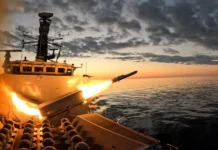
Brilliant went on to serve through the main Falklands campaign: on May 12 her Sea Wolf missiles claimed three Argentine Skyhawks in a single engagement; on May 16 an attempt to destroy the Argentine supply ship Bahía Buen Suceso at Fox Bay, using a beer keg packed with explosives, was abandoned under heavy fire; and on May 25 Brilliant picked up survivors of the Atlantic Conveyor from the freezing sea after she was struck by Exocet missiles.
Bryant and Butler were Mentioned in Despatches for their part in the campaign.
Barry William Bryant was born on November 25 1949 in Dorchester, where his father was a tax inspector, and was educated at Wymondham College, Norfolk, before entering Dartmouth in 1968.
He was awarded his Observer’s Wings while still a midshipman and joined 824 Naval Air Squadron, embarked in the fleet carrier Ark Royal. He was onboard on the evening of November 9 1970 when the ship’s company was ordered to stand by for a collision. Moments later came a heavy crunch as a Soviet destroyer scraped down Ark Royal’s port side. Within minutes Bryant was airborne on a search-and-rescue sortie, though no one was found in the water.
Over the next 10 years Bryant succeeded in increasingly responsible observer appointments: in the guided-missile destroyer Fife, 1971-73; in the cruiser Tiger (1973-75), where he gained his watch-keeping and ocean navigation certificates and transferred from the short-service list to the general list as a full career officer; in 737 Naval Air Squadron instructing new observers 1975-77; and service in Kent, RFA Tidepool, during a Cod War in 1976; and in Norfolk in 1977.
A shore appointment to the stone frigate HMS Dryad, the Navy’s centre for co-ordinated sea warfare, threw him back into the general-service mainstream. “I sometimes felt like a demigod and sometimes a fish out of water,” he wrote later. “I knew a lot about ASW [anti-submarine warfare] and helicopters, as far as the latter were concerned, a lot more than the Dryad staff, but not a lot about guns, missiles, diving and many other disciplines.”
Further sea time followed in the frigates Diomede and Achilles on a group deployment to the Far East, when he arrested the ship’s chief writer after it was discovered that he had diverted monies paid to “S O Achilles” (and intended for the supply officer of HMS Achilles) to a new account which he had set up in the false name of “Stanley Oliver Achilles”.
In early 1982, Bryant’s flight was on detachment from Avenger to Brilliant for a Nato exercise off Gibraltar when the Argentines invaded the Falklands.
After the Falklands, Bryant rejoined Avenger. There, on May 4 1983, in the Gulf, he was airborne when the tail rotor control failed and the Lynx struck the sea heavily. Bryant escaped through the port window.
Upon surfacing, there was no sign of the other aircrew or his passenger, the ship’s captain (and future vice-admiral) Peter Woodhead, until, to his relief, they popped up beside him. Bryant had cracked lumbar vertebrae, and was told afterwards how narrowly he had survived.
The hero of the crash was the aircrewman, Gary Stewart, who had re-entered the sinking aircraft to free Woodhead from entanglement inside the cabin before following him to safety.
Later, Bryant commanded the frigates Hermione and Jupiter (1986-88), served as commander sea training (1990-92) and commanded the ice patrol ship Endurance (1995-97), making the first visit by the White Ensign to Buenos Aires since the conflict 13 years earlier. Ashore, he was naval assistant to the First Sea Lord (1992-93), and, as a commodore, director of naval service conditions (1997-2001).
On leaving the Navy he became director general of King George’s Fund for Sailors, remaining in the post for 17 years. Though fundraising mattered, his own energies went chiefly into hosting the charity’s major events – including dinners at the Guildhall and various livery halls, and concerts by the Royal Marines Band – overseeing its finances, and managing its legal affairs.
His particular satisfaction lay in ensuring that some £3 million per year in grants was used to best effect, working with the Merchant Navy, trade unions, ship-owners and shipbrokers, and Trinity House to secure co-ordinated support across the sector. He also changed the charity’s name to Seafarers UK, and was appointed Commander of the Royal Victorian Order.
After retiring in 2019 he remained busy as president of the Chatham Naval Officers’ Association, of the Tunbridge Wells Sea Cadets, and of the HMS Jupiter Association, and as the Lord High Admiral of the UK’s representative governor of the Hospital of Sir John Hawkins in Chatham (an appointment and title created in Tudor times).
Throughout, Bryant’s wit and warmth always shone warmly, and he was a source of friendship, laughter and unwavering support.
In 1971 he married Veronica Ball, but the marriage was dissolved in 1992. In 1999 he married Commander Tracy Smith, who survives him together with twin daughters from his first marriage and a daughter and son from his second.
Commodore Barry Bryant, born November 25 1949, died August 8 2026.
This article was first published in The Telegraph is is republished with the permission of the author.