By John Seymour*
Australia’s decision to embark on the AUKUS agreement is among the most consequential defence commitments Australia has ever undertaken. An understanding of history is necessary if we wish to assess the implications of this decision: a review of the operation of Australia’s earlier naval alliances reveals dilemmas and difficulties likely to arise from Australia’s membership of a new alliance.
Background
Australia has long depended on alliances with powerful nations for naval defence. Initially it was accepted that the Royal Navy, the largest navy in the world, would safeguard all parts of the Empire. Stirrings of nationalism challenged this. Australia should display self-reliance and acquire “its own” warships. The British Admiralty viewed the colonies’ aspirations with disdain: it was self-evident that the seas are one and that therefore what was needed was a single homogeneous imperial navy.
In 1907 the Admiralty unexpectedly announced that its commitment to a single navy had been abandoned. Two years later, Britain undertook to establish the Eastern Fleet of the Empire, consisting of Royal Navy ships and dominion Fleet Units. Australia’s Fleet Unit, headed by HMAS Australia, arrived in Sydney in 1913.
By 1912 the Admiralty had reneged on the agreement to establish an imperial fleet in our region. The looming war with Germany was causing anxiety and Britain wished to concentrate its naval and dominion forces in home waters and the North Sea. The Commonwealth government was keenly disappointed by Britain’s failure to honour its undertaking. This was the first such disappointment that Australia would experience. It would not be the last.
The rise of Japanese naval power resulted in increased concern about Australia’s vulnerability. As early as 1908, the British Foreign Office had noted Japan’s “expansionist tendencies.” In 1913 the Australian Commonwealth Naval Board drew attention to the growth of the Japanese Navy. The Royal Navy was no longer able to make a significant contribution to the defence of the Pacific. The Board stressed the need to ensure that a Pacific Imperial Fleet would be established.
On the outbreak of World War I, Australia transferred all its naval vessels to Britain for the duration of the war. The RAN proved itself an efficient, effective fighting force. The Admiralty acknowledged that the RAN had rendered invaluable services to the Empire.
In 1918 the spectre of a single Imperial Fleet was revived. “A single Navy under the Admiralty’s control was needed to protect the Empire” A single navy had no room for independent Fleet Units.
The Prime Ministers of Canada, Australia, New Zealand and South Africa rejected the Admiralty’s proposal. They wanted navies under their own control. They agreed that advice on the future development of the Empirire navies would be welcomed. Admiral Jellicoe, recently retired as the First Sea Lord, was appointed to provide this advice.
He was sent on a mission to India, Australia, New Zealand and Canada. His 7-month stay in Australia in 1919 was an occasion for repeated demonstrations of imperial fervour. Devotion to the British Empire was at its highest. Jellicoe was a celebrity, another Nelson. A Viscount and Admiral of the Fleet, the hero of the Battle of Jutland, he was the next best thing to royalty. At numerous functions “Rule Britannia” was played amid cheers.
Jellicoe’s report, tabled in November 1919, emphasized the need to take account of the Japanese threat. He recommended the establishment of a Far Eastern Seagoing Fleet, to be based at Singapore. For Jellicoe, Singapore was “undoubtedly the naval key to the Far East.”
The proposed fleet included 8 battleships, 8 battlecruisers, 4 aircraft carriers, numerous cruisers, destroyers and submarines. Stephen Roskill, one of Britain’s leading naval historians, has described the Far Eastern fleet as “over-ambitious to the point of grandiosity.” Jellicoe’s scheme “bordered on fantasy.”
The 1920s and 30s were marked by economic depression and cut-backs on naval expenditure. The future strength of the Royal Navy could not be guaranteed. Until well into the 1930s, defence spending in Australia was a low priority. Australian scepticism about the Royal Navy’s willingness and capacity to defend the Pacific grew. John Curtin, then Leader of the Opposition in the Commonwealth Parliament, warned against dependence on assistance from Great Britain “which might or might not be available.”
In his view, “The dependence of Australia upon the competence, let alone the readiness” of Britain to provide forces was “too dangerous a hazard upon which to found Australia’s defence policy.” Later he went further: “The defence of this nation is best served by a policy of national self-reliance rather than one which embroils us in the perennial disputes of Europe.”
This was not the majority view. In 1933 George Pearce, the Minister for Defence, believed that the RAN should be an imperial service. “Australia’s Defence Policy must be to co-operate in the Imperial Defence Policy and to provide the maximum contribution she can afford to the Defence Forces of the Empire. To give effect to this policy, Australia’s primary aim should be the provision of an efficient squadron of ships able to co-operate efficiently with the Royal Navy.”
Yet as early as 1921 the Admiralty had recognized that it could not maintain a British fleet in the Pacific comparable with the Japanese fleet. The Admiralty was quick to distance itself from Jellicoe’s proposed Far Eastern Seagoing Fleet. Instead, it fell back on promises to dispatch capital ships to the Singapore base in time of need. The Admiralty admitted that up to two or more months might elapse before the ships would arrive.
British policy-makers regularly gave increasingly hollow assurances about the provision of the necessary capital ships. In 1937 the Admiralty re-affirmed that Singapore could hold out, and that a fleet would be available to cover Australia and New Zealand. “The dispatch of a Fleet to the Far East remains the operation upon which the security of the Eastern half of the Empire depends.” At the Imperial Conference of that year an Admiralty review stated that: “Singapore could hold out, that a fleet would be available for the Far East and that a fleet at Singapore would cover Australia and New Zealand.”
To quote Stephen Roskill again, the Admiralty’s assurances “came near to crossing the border line into outright deception.” The policy-makers were guilty of wishful thinking and still retained sublime confidence in Britain’s seapower. Roskill commented: “In Whitehall there seems to have been … a blind faith that, somehow or other, a ‘main fleet’ could be conjured up for the Far East, when the truth was that, whatever the possibility of sending out such a fleet in the 1920s, by 1935 it had become extremely remote.” In his view, “The mis-judgement over the type and scale of the forces needed to defend our interests in the Far East remains staggering.” By late in the 1930s, Singapore was to be revealed as “a base without a fleet and without prospect of one.”
Yet Australian prime ministers continued to rely on the Admiralty’s undertakings. In 1937, Prime Minister Joseph Lyons stated: “An adequate fleet would proceed to Singapore in an emergency. The necessary strength exists for this purpose.” Even after the outbreak of war, Prime Minister Robert Menzies told the House that, “Adequate assurances have been given to the Government with respect to the capacity and availability of the Royal Navy to give us protection against any major aggression.”
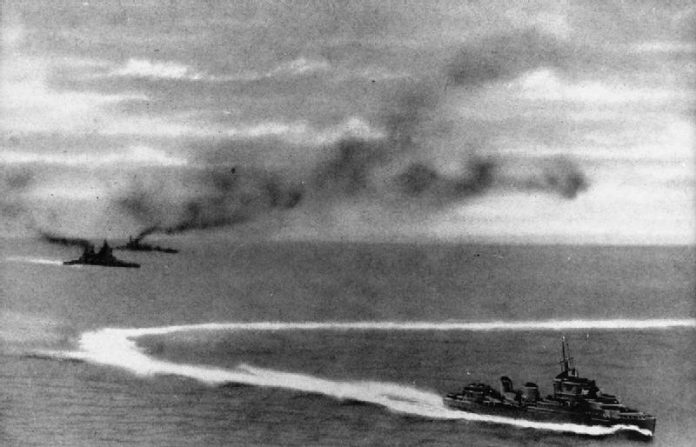
The dramatic events of 1941 and 1942 changed everything. HMS Prince of Wales and Repulse had been belatedly dispatched to the Far East. They lacked air cover. Both ships were quickly sunk in 1941 by Japanese aircraft. 800 lives were lost. In 1942 Singapore fell.
For the naval historian, the date of the sinking of Prince of Wales and Repulse (10 December 1941) was the day the British Empire died. After that date, Australia could no longer look to the Royal Navy for protection. Australia had to concentrate on the threats in its own backyard and pivoted towards a short-term alliance with the United States.
Nature of Alliances
What lessons are to be learned from this outline of past alliances? What questions do they pose as we contemplate the implications of the AUKUS agreement?
In an ideal world, the members of an alliance should share the values of their allies. They should respect their partners and identify with them. A defence alliance is an agreement to work together for shared goals.
Yet history demonstrates that the harsh reality cannot be ignored. In 1937 John Curtin, offered a warning about alliances in general. He said: “[H]istory teaches the disquieting lesson that covenants and treaties are adhered to generally only so long as their maintenance is in the interest of the contracting parties.”
All alliances are fragile. Before a member depends on a defence alliance, it must be understood that the needs, capacities and priorities of partners will inevitably change. Alliances can encounter head-winds. Unexpected events will confound the best-laid plans. Policy-makers must learn to expect the unexpected. Even the strongest alliance can crack under pressure.
Australia’s membership of AUKUS has been described as the adoption of a new role as “a sub-imperial power upholding a US-led imperial order.” AUKUS will be dominated by the United States. Australia and the United Kingdom will be minor players at the service of a powerful ally. The priorities of such an ally are unlikely to be the same as those of a middle power. A new form of dependence will arise, deeply embedding Australia in America’s future defence strategy. The earlier mantra – “the British Empire right or wrong” – might have to give place to “the United States right or wrong.”
Australia’s new relationship will be very different from that developed as a member of the British Empire. At least in its earlier stages, imperial sentiment was strong. Remember 1919 and crowds singing “Rule Britannia.” This might suggest a relationship in which values were shared. There is doubt whether a similar relationship with America has ever existed.
Complexity
Australia’s commitment to the AUKUS alliance will represent a massive and complex undertaking. It will span several decades and depend on the co-operation of three nations. It is the biggest single industrial project ever entered into by Australia. To state that there will be uncertainty about the possibility of fully implementing the agreement is to state the obvious.
Under the agreement, the United States will early in the 2030s build and provide three Virginia-class nuclear-powered submarines. In Australia there are doubts about which version of the Virginia-class submarine will be provided. Britain’s Barrow-in-Furness shipyard will assist Australia with the acquisition of five nuclear-powered SSN-AUKUS submarines, to be delivered in the early 2040s. The Rolls-Royce nuclear propulsion systems for the Australian boats will be provided by the United Kingdom. Under the resulting arrangements, the RAN will be required to operate two different types of boats, the Virginia-class and the SSN-AUKUS submarines.
While much attention has been focused on the Virginia-class submarines, it should not be overlooked that the provision of these boats will represent “a stopgap solution” pending the acquisition of the five SSN-AUKUS submarines. These submarines will be the centre-piece of the RAN’s submarine fleet. Implementation of this phase of the agreement will be extremely complex.
The five SSN-AUKUS boats will be built at the Osborne Naval Shipyard in Adelaide. The first step will be the design and development of a proto-type to be constructed in Barrow-in-Furness. The United Kingdom plans to build up to 12 SSN-AUKUS submarines. It is planned to deliver the first SSN-AUKUS submarines to the Royal Navy in the late 2030s. The Osborne Naval Shipyard will then begin to build the first of five boats, to be delivered to the RAN in the early 2040s. If the build schedule for the SSN-AUKUS falls behind, Australia has the option of purchasing up to two additional Virginia-class submarines.
The development of the Osborne shipyard will present challenges. The government has already made two billion-dollar down-payments; the final cost in 2038 will be $30 billion. The shipyard has no experience in building highly sophisticated nuclear-powered submarines. The base will need to recruit specially trained shipwrights with the skills to build and service these extremely complex boats. There is no guarantee that the workforce will master the necessary skills and will succeed in meeting the promised deadlines. The RAN in its turn must learn to operate and maintain new and extremely complex submarines.
Former Australian Foreign Minister described the decision to build submarines in Adelaide as “heroic.” He predicted that there would be enormous problems and cost blow-outs. It would become “a nightmare.” He added: “It’s just not going to happen.”
How will the RAN ensure the availability of a sufficient number of trained sub-mariners to crew their new boats? At present, the RAN has four aging Collins-class submarines and is experiencing difficulties crewing these boats. Some of these boats will be laid up in the dockyard for lengthy periods of maintenance and this will restrict the sea-time the existing crews need to gain experience.
The problem will be increased if senior RAN officers are unable to secure the sea-time needed to work their way to command. It might prove necessary to rely on senior RN officers to command the submarines in the way that RN officers were appointed to captain Australia’s larger warships in the 1920s and 1930s.
The words of Stephen Roskill about Jellicoe’s Far Eastern fleet come to mind. Is the AUKUS agreement “over-ambitious to the point of grandiosity.” Does it border “on fantasy?” AUKUS might reflect wishful thinking. The alliance is expected to remain in force for a long-period. Predicting events in the distant future will always be perilous. Needs and priorities of the partners will inevitably change. In spite of this, an agreement reached between the ministers for defence of the United Kingdom and Australia last year (known as the Geelong Treaty) provided that “this Agreement shall remain in force until 31 December 2075.”
Cost
The cost of Australia’s contribution to AUKUS has been estimated as $368 billion; this is no more than “a guestimate.” It seems certain to blow out. In the past, financial concerns have restricted naval expenditure, both in Britain and Australia. Rather than to the purchase of costly warships, the Commonwealth government might at some time have to confront demands to direct expenditure towards health, education, social welfare policies and the challenge of climate change. The current debate about NDIS expenditure may provide a foretaste. Will the financial commitment embodied in AUKUS be sustainable over the long-term?
The Character of War Can Change
The study of naval history teaches the importance of recognising changes in naval technology. In 1919 Jellicoe noted the need to take account of “advances in naval science,” such as the development of air power and submarines. Yet he remained a battleship man, as was seen in the composition of his proposed Far Eastern Seagoing Fleet. His view was widely shared. The Admiralty continued to identify battleships as the key to naval power. Yet in 1941 the vulnerability of these ships was quickly demonstrated.
Today’s weapons, including nuclear submarines, may be superseded, although knowledgeable supporters of nuclear submarines will assert that they will long remain Australia’s most powerful naval deterrent. Yet the success of Ukraine’s drones in sinking units of the Russian Black Sea fleet should be noted. The RN and BAE Systems are experimenting with uncrewed underwater vehicles. In Australia, the Ghost Shark Extra-Large Autonomous Underwater Vehicle (XL-AUV) and the MQ-28 Ghost Bat are already in production. The potential impact of drones, missiles and undersea weapons must be constantly re-assessed.
Reliability
Each of our two partners may prove unable to fulfil their obligations.
In the closing stages of World War II, the United States – unlike Britain – proved to be reliable ally. Australia owes a great debt to the United States Navy for its massive contribution to the defeat of the Japanese Navy.
Nevertheless, there is now uncertainty about the current commitment of the United States to Australia. The relationship is being re-assessed and expectations revised. A loss of trust has resulted from concerns about the current political turbulence. American defence policy is unpredictable.
The new emphasis on “America first” raises the question: How strong will America’s future commitment to the naval security of the far-distant Indo-Pacific region prove to be? Is its new policy consistent with engagement with other distant nations to pursue collective defence? Can Australia be confident that the USA will continue to be a reliable naval ally? Australia might have become a member of AUKUS (which will involve greater integration with the USN) at the very time America might become less dependable.
There is also a practical problem. American commentators on AUKUS have objected that it might prove impossible for US shipyards to make the Virginia-class submarines available to the RAN. The shipyards are having difficulty building a sufficient number of these boats to meet America’s own defence needs. There might be none to spare for Australia.
The full implementation of the AUKUS agreement will result in a fleet in which the Australia’s SSN-AUKUS submarines will be the centre-piece. Much therefore depends on Britain’s capacity to design, develop and support the building of Australia’s five SSN-AUKUS submarines
Britain might prove to be the weak link. In the past, Britain proved an unreliable partner. The RN’s engagement with the naval defence of the Pacific has been ephemeral. It cannot be asserted that Britain was guilty of wilful default. The rise of Germany in 1914, and of Germany and Italy in 1939, made it imperative to concentrate its naval forces in home waters. The Royal Navy lacked the resources to operate effectively in the Atlantic and the Mediterranean, as well as in the Far East. Britain’s naval priorities understandably changed. The choices Britain made were understandable.
The Admiralty can, however, be strongly criticised for its past conduct. The 1909 undertaking to establish an imperial fleet in our region was dishonoured, as were the repeated promises to base a fleet in Singapore or to dispatch capital ships in time of need. Here, the Admiralty, to repeat Stephen Roskill’s words, “came near to crossing the border line into outright deception.”
History has shown that, even in World War II, when the RN was far more powerful than at present, it was unable to operate substantial fleets both in home waters and in the Far East. It would be surprising to discover that the situation has now changed to the extent that Britain will be able and willing to demonstrate a new commitment to Australia’s naval defence.
The British economy is not strong, public debt is rising and productivity is declining. The funds available to increase defence expenditure are limited. British ship-building yards may lack the capacity to meet the obligations shouldered under the agreement. The recent resignations of the British Secretary for Defence and the Armed Services Minister do not inspire confidence. The present political instability of the United Kingdom government must cause concern.
A study of past history might prompt scepticism about Britain’s decision to join an alliance under which it will commit naval resources to safeguarding the security of the Indo-Pacific, rather than co-operating with NATO and focusing on potential threats in its own backyard. Have the lessons about the dangers of naval over-reach apparent in World War II already been forgotten? Professor Hugh White sees Britain’s commitment to the alliance as reflecting “imperial nostalgia.” He comments: “Britain still longs for something like the global role of its imperial heyday.”
In view of Australia’s earlier experiences with the Admiralty’s hollow assurances, can Australia now confidently rely on guarantees that the RN will display the willingness and capacity to play a part in ensuring peace and security in the Indo-Pacific?
Best Interests
A study of the history of Australia’s naval forces reveals that the focus continued to be on one question. Should Australia have an independent navy, or a navy operating as a unit of an imperial force committed to collective defence? If the latter, the RAN will inevitably be a junior partner. Subscribing to the AUKUS agreement is an emphatic endorsement of the need to remain part of an alliance. Dependence is to be perpetuated.
Is membership of AUKUS in Australia’s best interests? Will Australia be safer in the alliance than out of it?
It has long been accepted that Australia as a middle power must seek out powerful naval allies and is not able to go it alone. This conclusion suggests that, whatever the disadvantages arising from membership of an alliance, the price is worth paying. An alliance gives a feeling of security and the fear of abandonment will be a driving force. In the past, the majority of Australia’s politicians were in no doubt about the rightness of such attitudes. There was nothing to discuss: particularly in the days of the British Empire, it was widely accepted that it was in Australia’s interests to join in the pursuit of agreed and shared defence goals.
Can the same be said in 2026? What are Australia’s naval objectives in becoming part of AUKUS? The government has given little guidance. The need for nuclear-powered submarines has not been clearly explained. What role will they play? The press release accompanying the launch of the alliance states that commitment to AUKUS will “promote a free and open Indo-Pacific that is secure and stable.” This is a vague and inexact pronouncement. Some explanations identify the aims of maintaining and protecting the global rules-based order, and promoting regional stability. Are these realistic and achievable objectives to which the RAN’s nuclear submarines will be able effectively to contribute? Will it be in Australia’s best interests to give priority to the pursuit of these objectives?
Richard Marles, the deputy Prime Minister and Minister for Defence, has stated: “A key part of the 2026 National Defence Strategy is about building Australia’s self-reliance. We are doing this by strengthening our partnerships …” This might suggest dual aims, particularly as the NDS lists the Australian Defence Forces’ tasks in order, No. 1 being to “defend Australia and our immediate region” and No.4, “to contribute with our partners to the collective security of the Indo-Pacific.”
The statement by Marles identifies contradictory sentiments. The language of self-reliance is the language of independence, the focus being on the defence of Australia. The language of partnership is the language of collective defence/deterrence and underlines the RAN’s regional role.
There can be no complaint about the first task: our defence forces should defend Australia. This will involve the RAN concentrating on Australia’s naval defence needs, and operating as an independent force demonstrating self-reliance. The acquisition of nuclear submarines can be viewed as fulfilling this aim and demonstrating that the RAN will assume increased responsibility for Australia’s national security.
The AUKUS alliance is a partnership. While it may not be clear precisely how the RAN will in future contribute to the promotion of the security of the Indo-Pacific region, there can be no concern about a partnership designed to pursue shared objectives. Are these objectives shared? AUKUS may result in an unacceptable loss of autonomy in defence matters. Membership raises the spectre of participation in other peoples’ wars. Remember Curtin’s advocacy of “a policy of national self-reliance rather than one which embroils us in the perennial disputes of Europe.”
Is the risk of participating in other people’s wars a relevant factor in assessing AUKUS? The study of history reveals the part played by the RAN in World War II. The rise of Japan had presented a new challenge, this time in Australia’s own backyard. The threat to Australia was real and immediate. The RAN played a significant and distinguished role in the war against Japan.
The need for the RAN to join the war against Japan was clear. No such threat faces Australia today. Instead, the focus is on the probability of a conflict arising sometime in the future in the Indo-Pacific. Many commentators believe that China poses a threat in the Indo-Pacific. This threat may explain the government’s emphasis on the contribution of AUKUS to ensuring the collective security of the Indo-Pacific. If such a threat exists, the question to be asked is whether Australia should be prepared to meet it.
I am not competent to express an opinion on the likelihood of China engaging in a war in the Indo-Pacific, or on the size and composition of the fleet that might be needed to meet the perceived risk. I leave these matters to defence analysts.
If war occurs, it might result from America opposing China’s wish to bring Taiwan back under its control. Some Australian politicians have explicitly stated that Australia would have no alternative but to line up militarily with the United States in the event of war with China. Marles has commented that “the consequences of a US-China conflict over Taiwan are so grave that we cannot be passive bystanders.”
Two questions can be posed. First, while it was accepted that it was in Australia’s best interests to participate in an alliance with the United States to defeat Japan, can the same be said of an alliance that might involve it in a war with China? The answer will depend on the assessment of the nature of the risk posed by China. Secondly, could the obligations assumed by Australia under AUKUS be viewed as serving America’s interests rather than Australia’s regional interests? Might such a war be seen as America’s war? Australia it must be recalled, is a “a sub-imperial power,” and hence a minor player answerable to the United States, the dominant member of AUKUS.
To conclude. After its attachment to the British Empire came to an end, and a brief interlude in which Australia allied with the United States, we may now be witnessing the acceptance of membership of a new empire. My submission looks to the past. To understand the implications of Australia’s commitment, we must study the lessons that history teaches about the uncertainties and pitfalls that lie ahead.
*Dr John Seymour is the author of Australia’s Naval Alliances: Lessons of History, Cambridge Scholars Publishing, 2025.