
By Nick Tate*
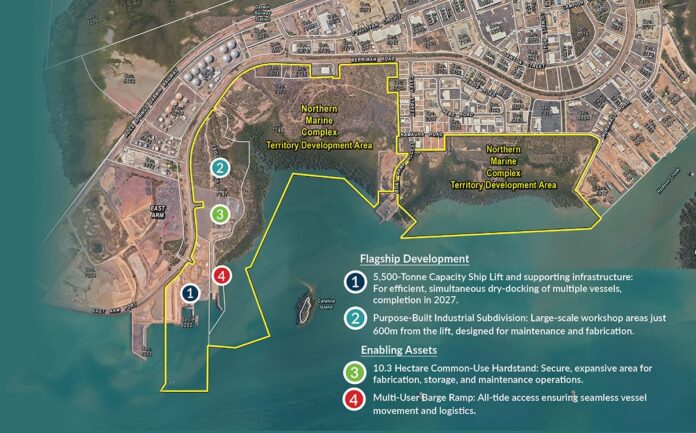
Recent commentary has positioned the Northern Marine Complex in Darwin as a test of northern Australia industrial capability.1[1] That may prove correct. The more important question is whether it delivers capability, or simply infrastructure. Australia has not struggled to build infrastructure. The challenge has been turning that infrastructure into sustained operational output.
This is not a test of construction. It is a test of whether Australia can generate enduring industrial capability in the north.
Infrastructure alone is not capability
Facilities are often delivered to a high standard, but struggle to achieve sustained utilisation. Over time, they become well-built but underutilised assets rather than part of an operational system.
Recent analysis of northern posture reflects this pattern, pointing to infrastructure that exists without the operational mass required to sustain it.2[2]
Infrastructure is essential to delivering capability. It is as fundamental as ships or aircraft. But infrastructure alone is not capability. A warship alongside without crew, sustainment and logistics does not generate operational effect.
In Defence terms, capability is generated through the integration of the Fundamental Inputs to Capability (FIC). Infrastructure is one of these inputs. It provides the physical foundation for:
- maintenance and sustainment
- training and certification
- logistics and supply chains
- workforce enablement
A marine complex becomes meaningful when it is integrated with the other FIC and used persistently to support operations. Without that integration, it remains necessary but insufficient.
Where the debate now sits
The question is no longer whether to invest. It is how capability is generated and sustained.
One view assumes infrastructure will attract industry and workforce. That model is appealing, but rarely holds in northern Australia. Without sustained activity, utilisation does not follow.
Another view seeks to place Defence as the anchor tenant. Defence is the only entity capable of providing long-term demand certainty. But if it is expected to sustain utilisation, it effectively assumes responsibility for the commercial viability of the precinct. That is neither its role nor a sustainable basis for industrial development.
A third view favours distributing capability to achieve resilience. In practice, with a constrained workforce, this approach spreads effort too thinly and prevents scale from forming.
Each view contains elements of truth. None resolve the problem on their own.
The demand signal problem
Industrial capability requires confidence. Confidence comes from continuity of work.
Without sustained demand:
- workforce will not consolidate
- industry will not invest
- supply chains will remain shallow
The Northern Territory already has a base level of marine capability. Its ability to scale depends on continuity rather than episodic activity.3[3]
Defence has a role in providing that demand signal, but the boundary must be clear.
Defence should act as a demand shaper, providing predictable, programmatic work that enables industry to invest and workforce to stabilise. It should not be expected to guarantee utilisation or underwrite the commercial model of the precinct.
This aligns with the intent of the Darwin Ship Lift and broader marine precinct as a multi-user environment, not a Defence-dominated one.4[4]
There is also an opportunity to better align Defence demand with that generated by foreign naval presence operating in northern Australia. Visiting and rotational forces already utilise sustainment facilities in the north. More deliberate coordination of maintenance and support activity would strengthen utilisation, deepen workforce experience and reinforce the demand signal required to sustain industry.
Concentration versus fragmentation
A practical constraint sits within Darwin.
The existing synchrolift and maintenance capability at HMAS Coonawarra is limited in scale and throughput. The workforce is also constrained.
This creates a choice.
Maintenance activity can be distributed across sites, preserving flexibility but diluting workforce and utilisation. Alternatively, it can be concentrated at the Northern Marine Complex to build scale.
In the current environment, distribution risks locking in sub-scale capability. Infrastructure exists, but not at a level that enables sustained output.
Concentration allows:
- workforce aggregation
- repetition and productivity
- effective use of infrastructure
- clearer signals to industry and training providers
There is a strong case for the Northern Marine Complex to become the primary maintenance hub, with <em> Coonawarra </em> focused on operational support and contingency roles.
There are also hard physical constraints. The synchrolift at <em> Coonawarra </em> cannot be readily adapted to support Offshore Patrol Vessel maintenance, nor does it provide suitable capacity for cyclone storage of other larger vessels. These are not marginal issues. They directly affect the Navy’s ability to sustain and protect its fleet in the north.
The requirement extends beyond Navy. Army’s LAND 8710 Phase 1 Littoral Manoeuvre Capability, including medium and heavy landing craft, will add further demand. This reinforces the need for greater lift capacity, hardstand and integrated precinct support.
This aligns with the intent of Plan Galileo and the development of Regional Maintenance Centres in the north, which seek to establish persistent, locally supported sustainment capability rather than episodic deployment-based support.
The Northern Marine Complex is therefore not simply an efficiency measure. It is required to meet baseline operational needs.
Fitting within the national sustainment network
The Northern Marine Complex cannot be considered in isolation. It must function as part of a national sustainment network, alongside east and west coast infrastructure, commercial dockyards and emerging regional maintenance centres.
That network is already constrained. Dry berth capacity is limited, workforce depth is uneven, and critical infrastructure remains exposed to environmental risks, particularly in northern Australia where cyclone resilience directly affects availability.
Within this context, the Northern Marine Complex provides forward maintenance capacity in the north, reduces reliance on southern transit, and supports sustained operational presence.
Its design must reflect more than steady-state demand. It must support:
- surge in operational tempo
- contingency repair following damage or failure
- redistribution of load when other parts of the network are constrained
This requires scalable capacity, protected hardstand and integration with national maintenance planning.
Redundancy is not achieved by duplicating sub-scale capability. It must be designed across the network, with each node able to absorb demand when required.
Managing concentration risk
Concentration introduces risk. A single node creates exposure.
The current system is not resilient. It is fragmented and sub-scale.
Resilience cannot be achieved by distributing insufficient capability. It must be built deliberately:
- establish viable, integrated capability
- expand to create redundancy over time
Redundancy in critical naval infrastructure must be designed and sequenced. It does not emerge from distributing limited resources across multiple locations.
Governance and commercial reality
Recent experience with the Darwin Ship Lift has also shown that poorly structured commercial arrangements can undermine otherwise sound infrastructure investments. Capability will only emerge where infrastructure, demand and operating models are aligned.
Defence and Territory alignment
Delivery will depend on alignment between Defence and the Northern Territory Government.
This includes:
- workforce development
- land use and precinct planning
- training pipelines
- infrastructure sequencing
- demand scheduling
This is not coordination at the margins. It requires operating as a single system.
Defence already engages with state and territory governments through established mechanisms, including consultative forums led by Commander Joint Logistics and engagement with Security and Estate Group representatives. These arrangements provide useful coordination at a program and stakeholder level.
However, they are not structured to support the level of integration required for precinct-scale capability. They do not align planning, demand, infrastructure and workforce decisions into a single operating model.
In practice, Defence continues to engage state and territory governments at a level more consistent with external stakeholders than long-term capability partners. In a similar vein to the Henderson Defence Precinct in WA, for developments of this scale in the north, that approach is insufficient.
Territory governments control land, enable workforce growth and shape the broader industrial base. Treating them as delivery partners, rather than consultative stakeholders, is necessary to align investment with capability outcomes.
If alignment fails:
- infrastructure arrives without workforce
- workforce exists without sustained demand
- industry does not scale
Beyond the project mindset
Precinct-scale developments do not align with traditional project delivery models.
Fragmented contracting approaches can deliver individual packages, but fail to produce an integrated outcome.
The Northern Marine Complex must be treated as a system, not a collection of projects delivered in sequence.
Northern sustainment analysis has already pointed to the need for adapted delivery models, rather than applying approaches developed for southern Australia.7[7]
What is required is:
- integrated planning and delivery
- alignment across design, construction and operations
- governance focused on system outcomes
A test of intent
The Northern Marine Complex is a test of whether Australia can align:
- infrastructure
- demand
- workforce
- governance
Strategic emphasis on northern posture will not translate into operational effect without sustainment capability.
This is where future strategic direction matters. A National Defence Strategy 2026 would be well served by explicitly linking northern posture to sustainment infrastructure, workforce development and industrial capacity, and by recognising the role of a national sustainment network able to support surge and contingency operations.
To achieve a clear path forward:
- Defence must provide a credible, programmatic demand signal
- Activity must be concentrated to build scale
- Infrastructure must support surge, contingency and environmental resilience
- The network must deliver deliberate redundancy across locations
- Governance must shift to integrated system delivery
The requirement for a higher-capacity, integrated marine precinct in the north is not discretionary. It is driven by platform, workforce and environmental realities already in play.
If these elements are aligned, the Northern Marine Complex will deliver capability.
If not, it will remain necessary infrastructure that does not fully translate into operational output.
Footnotes
- [1] John Coyne, ‘New marine complex is a test for achieving Northern Territory industrial capability’, The Strategist (ASPI), 10 April 2026.
- [2] Australian Strategic Policy Institute, The Northern Engine: Building Australia’s Northern National Defence Ecosystem, 2026.
- [3] Northern Territory Government, Statement of Capacity: Marine Services Industry in the Northern Territory, 2023.
- [4] Infrastructure Pipeline, ‘Darwin Ship Lift Facility’.
- [5] Australian Strategic Policy Institute, ‘This doesn’t add up: as strategy looks north, Defence workforce shifts south’.
- [6] Northern Territory Legislative Assembly, Inquiry into the Darwin Ship Lift Project, October 2025.
- [7] Australian Strategic Policy Institute, Northern Sovereign Maritime Sustainment, 2022.

*Nick Tate is a retired captain of the Royal Australian Navy with senior experience in defence infrastructure and sustainment. He now works in industry, focusing on capability delivery and the integration of estate, logistics and workforce into operational readiness.