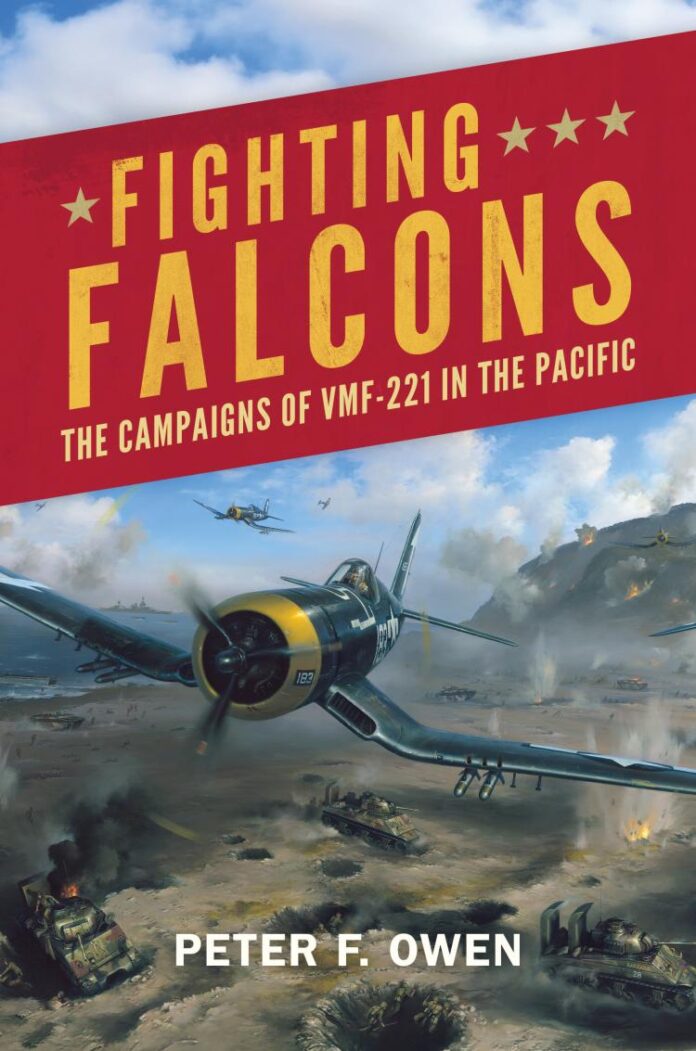
The Campaigns of VMF-221 in the Pacific

0
244

Fighting Falcons. The Campaigns of VMF-221 in the Pacific. By Peter F Owen. Naval Institute Press, Annapolis, Maryland, 2026. ISBN     978-1-68247-823—3 (Hardcover). ISBN   978-1 68247-841-7 (eBook).

Reviewed by David Hobbs

Peter F Owen is a former US Marine Corps infantry officer who studied history at the US Naval Academy and later gained a PhD in war studies from the Royal Military College of Canada.  His first book To the Limit of Endurance: A Battalion of Marines in the First World War received a prestigious award from the Marine Corps Heritage Foundation.

He lives in Fairport, New York, with his wife.

Fighting Falcons offers more than a simple history of one particular USMC fighter squadron; the author uses his intimate knowledge of the Corps together with extensive research to produce a work that combines operational analysis with the progress made by a specific unit.  Readers who, like me, study Pacific operations between 1941 and 1945 will therefore find this to be an interesting book that has links to a wider range of operations that were carried out by the RAN, British Pacific Fleet and the RAAF.  VMF-221, is well chosen as the theme that runs through this book; it was formed in July 1941 and went on to operate with different aircraft in different areas of combat, ending the war embarked in one of the US Pacific Fleet’s fast carriers.  If the periods spent reforming in the USA are included, the squadron played a part in four distinct elements of the Pacific War and the author uses them to illustrate how Marine Corps aviation progressed both in terms of its operational role and the capabilities it demonstrated to achieve it.

The book is divided into three sections.  In the first of these VMF-221 flew Brewster F2A Buffalos from Midway Island at a time when the Corps’ primary role was the defence of advanced bases in the Pacific during 1942.  Its part in the Battle of Midway is described and analysed.  In the second section the squadron’s operations equipped with Grumman F4F Wildcats at first and then Chance Vought F4U Corsairs operating from airfields in the Solomon Islands is described, illustrating how the Pacific Fleet and its Marine Force began to go onto the offensive against the Japanese.  The third section describes the squadron’s operations flying Corsairs as part of the USS Bunker Hill’s air group in strikes against mainland Japan, defending the fleet from enemy attacks and supporting the Marines units that assaulted Iwo Jima and Okinawa.  Periods when the unit was refitted and re-equipped whilst away from front line operations are described within the appropriate section but have their own unique analysis.

Each section begins with a summary of the Fleet Commander’s intentions for the campaign in question, current fighting doctrine and the training that evolved from it before describing the squadron’s activities and the limits placed on them by logistical re-supply or the lack of it.  The author’s descriptions of personalities allow the reader to form an impression of their individual impact on the squadron and its effectiveness.  The rapid expansion of Marine Corps aviation was a remarkable achievement that Owen describes with clarity.  In mid-1939 the USMC had only 8 squadrons in 2 Marine Air Groups, MAG, one each in the Atlantic and Pacific fleets.  Only one squadron in each group operated fighters.  By 1941 MAG-21, the Pacific group was based at Ewa Field on Oahu with squadrons deployed forward to island bases.  When VMF-221 returned to California in early 1944 to be retrained for embarked operations, it was just one of 7 squadrons that did so.  A further 26 squadrons remained in action in the Pacific flying from shore bases to support the ‘island hopping’ advance towards Japan and there were 15 recently formed Marine squadron in the USA awaiting orders.  The USMC literal had more fighters in the Pacific Fleet Marine Force than it could immediately use but this gave it sufficient mass to withstand attrition.

Rapid expansion had its problems, however.  The most obvious was an early lack of aircraft and spares.  In 1941 pilots were given no operational training after gaining their Navy Wings and had to be taught the rudiments of fighter combat after arrival in VMF-221 and the other Fleet Marine Force Units.  The pressure of operational flying and the lack of both aircraft and spares meant that there was too little time to train them adequately before they were thrown into action at Midway.  Prior to 1941 maintenance marines hafollowed the then-standard USN practice of being trained ‘on the job’ within operational squadrons; joining them with no prior aircraft type training, qualification or specific skills.  With the added pressure of combat operations this soon became intolerable and the Corps eventually benefitted from the USN’s vast expansion of aviation training establishments.  In the Solomons the squadron’s pilots were separated from their own maintenance personnel in what was thought to be a flexible arrangement but it proved to be one which did not work well in practice.

Owen pays particular attention to the way in which fleet commanders expected their fighting squadrons to operate, explaining the fleet document USF-74 Current Tactical Orders and Doctrine US Fleet Aircraft before evaluating how effective fighter squadrons were in achieving its aims.  Each section ends with a chapter describing VMF-221’s effectiveness when compared with its orders and expectations and from these it is possible to see how its operations fitted into the overall conflict in the Pacific theatre.  Owen concludes the final chapter by observing that there are relevant lessons that can be drawn from VMF-221’s experience which still apply in the twenty-first century.  Aircraft numbers and pilot skill are still likely to give the side possessing them an edge.  The Pacific is still vast and logistics are more important than ever but it has to be acknowledged that a rapid expansion in numbers of Navy/Marine pilots, aircraft and the ships to carry them is unlikely ever to be replicated in the way it was between 1941-1945.  Future wars are, therefore, likely to be fought with the personnel and equipment available at their outset and transformation on the scale achieved by VMF-221 would be implausible.

In summary, this is a thoughtfully written book about the war in the Pacific which explains how the expansion of one element of the USN’s fighting arms played its part in the overall victory.  A single Marine fighter squadron, typical of many others, is the central theme but not exclusively so and its aims and achievements make interesting comparisons with others that fought in the Pacific including the RAN and BPF.  It is written in a very readable style and I thoroughly recommend it.

LEAVE A REPLY

Please enter your comment!
Please enter your name here