Maritime security a constant concern

0
49

By Sean Andrews*

A retired senior naval wag once quipped that Australia behaves as if it is “girt by beach”, not sea – a neat barb tied to the lyrics of the national anthem that captures the country’s enduring inability to think about the oceans as anything more than a holiday backdrop. Yet in 2026, maritime insecurity is no longer peripheral to national security. It sits at the intersection of great-power contestation, systemic maritime crime, sanctions evasion, fragile supply chains, and eroding resource security. (From: The Interpreter. The Lowy Institute.)

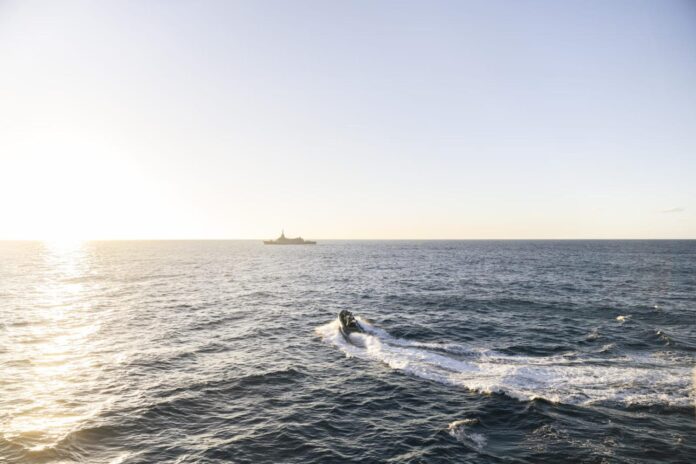
Recent industry assessments suggest that instability at sea is no longer cyclical but common. Houthi attacks in the Red Sea have driven a sustained degradation in Suez transits, normalising longer routes via the Cape of Good Hope and higher freight costs, while Russia’s war has pushed the Black Sea and Baltic into laboratories for sabotage, limpet mines, electronic interference, and merchant shipping risk. At the same time, an expanding dark fleet now trades sanctioned oil through spoofing identification systems, opaque ownership, and false flagging, corroding the integrity of the maritime data that underpins insurance, freight pricing, and compliance.

This is not a distant spectacle for Australia. Around 99% of Australian trade by weight moves by sea, through the same global networks now being reshaped by sanctions, tariffs, and grey-zone contests.

Maritime security is not a secondary theatre. It is a permanent condition of national life.

The deeper problem is that Australia still tends to conceptualise maritime security as a niche border-management function rather than a persistent strategic condition. Such an attitude is increasingly untenable. Australia’s exclusive economic zone is larger than its landmass, and its maritime search-and-rescue region spans about 53 million square kilometres. To put it comparatively: the maritime patrol effort to ensure on-water security and sovereignty equates to about 50 police cars for the whole of Australia. The point is not simply one of numbers, but of political imagination: Australia has never fully internalised that security at sea is a constant policing problem as well as a wartime naval one.

Across both hemispheres, the maritime domain is being reshaped by converging pressures that blur the line between traditional and non-traditional security. In the north, the collapse of the boundary between “hard” and “soft” maritime threats is visible in the targeting of undersea cables, offshore infrastructure, and the manipulation of data streams by spoofing identification systems and other grey-zone techniques. In the southern hemisphere parallel vulnerabilities are revealed: climate‑driven degradation of maritime spaces, contested resource governance, transnational crime, and the growing exposure of fragile economies to cyberattacks, corruption, and external interference.

Together, these dynamics show that maritime insecurity is no longer confined to naval competition or chokepoint disruption; it now spans climate impacts, data integrity, criminal networks, and geopolitical rivalry, all interacting across the same oceanic system. The persistent strategic risk is that Australia’s maritime environment is becoming simultaneously more contested, more brittle, and more interconnected – leaving little margin for error in how access is protected and the rule of law upheld at sea.

Australia’s own maritime scholarship reminds us that today’s constabulary turn at sea is less a novelty than a rediscovery. Policing, enforcement, and maritime governance have always underpinned good order at sea, yet they remain chronically undervalued in national strategy – treated as peripheral not because they are minor, but because governments still struggle to see their full weight. The Indo-Pacific sharpens this challenge. The UN Convention on the Law of the Sea (UNCLOS) remains the closest thing to a constitution for the oceans and was never designed to contend with intersecting threats such as terrorism, cyber disruption, lawfare, sanctions evasion, and state-backed grey-zone coercion. Distant-water fleets and maritime militias exploit legal and enforcement gaps, blurring the lines between civil, constabulary, and military domains. As a result, the old boundary between constabulary operations and naval diplomacy is dissolving. Routine enforcement has become a means by which states assert jurisdiction, signal resolve and contest the regional order in ways that fall short of war.

For Australia, three policy implications follow.

First, maritime security should be treated as a persistent national security mission, not an adjunct to border protection. Continuous, layered presence across the exclusive economic zone and key approaches – surface, air, and information – should be planned and funded as a baseline requirement.

Second, Australia must think beyond the “domestic sea”. Threats at sea are not constrained by political boundaries: dark fleets in the Indian Ocean, Red Sea disruption, fisheries depletion in the Pacific, and illegal ship-to-ship transfers in Southeast Asia all have downstream effects on Australian prosperity and regional stability.

Third, Canberra should lean into the data revolution in maritime awareness. Commercial platforms that fuse satellite imagery, radio-frequency emissions, and behavioural analysis can radically extend the reach of a finite patrol force and make maritime enforcement smarter, not merely larger.

The larger strategic point is simple. Australia cannot continue to act as though it is merely “girt by beach” while relying on global seaborne trade, regional maritime order, and fragile offshore infrastructure for its prosperity and security. Maritime security is not a secondary theatre. It is a permanent condition of national life, and Australian policy needs to start treating it that way.

*Dr Sean Andrews, CSC, PhD, is a former Australian naval Captain and command qualified warfare officer, now a Senior Research Fellow at the Changing Character of War Centre, whose work focuses on maritime strategy, naval power, and Indo Pacific security.

LEAVE A REPLY

Please enter your comment!
Please enter your name here