
By Thomas Hazel*
Allied navies deployed in the Indo Pacific need to undertake Maintenance Repair and Overhaul (MRO) activities if they wish to sustain their forward presence. Australia has proven to be a trusted partner, as part of a resilient regional security architecture, that is strategically located to safely deliver quality services to meet this need. Should primary service hubs become denied or inaccessible, due to either a contested environment or proximity to harm from a strategic adversary, Australia’s geographic position and intrinsic industrial capabilities o er a compelling alternative.
The question that needs to be answered therefore is; how can we collectively prepare now, to ensure we have developed the ability to provide increased and aligned support in the future? Testing and adjusting as required, to ensure we have processes and procedures established, should allied navies no longer seek to return to Singapore, Guam, Japan or Hawaii.
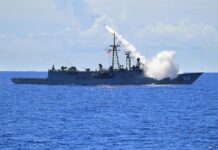
With the exception of Submarine Rotation Force-West, allied navy visits to Australia tend to be driven by participation in Regional Exercises such as the bi-annual Talisman Sabre or Kakadu. While over 20 vessels may visit Australia, their duration tends to be less than a week and limited in scope for maintenance.

Figure 2 – Australia has seen a consistent upward, if episodic, increase in allied navy visits
Not dissimilar to the empty shelves of a supermarket after an aircraft carrier has been in town, the local sustainment supply chain will be briefly overwhelmed due to the temporary spike in activity but will soon recover. Therefore, while they are a fleeting opportunity for the Australian Defence Industry, they do not justify regional hub infrastructure investment. This is because the allied visit demand is episodic and concentrated.
Should allied navies wish to truly capitalise on undertaking MRO in Australia, establishing redundancy sustainment locations, then behavioural changes are needed. Maintenance activities in Australia should be scheduled as the operational objective, with the certainty and regularity required for the Defence Industry to adapt to meet their specific demands. Otherwise, they will receive the level of support reflective of the sovereign defence requirement.
While allied navies do not meaningfully contribute to a viable business case to develop infrastructure to support, it does indicate that Australia needs a skilled workforce that is agile and able to surge to support.
Within Australia, the Defence Industry is primarily aligned to meet the sovereign demand. Where there is the certainty of pipeline, this can support increased investment. Where there is not certainty, the Defence Industry will deliver the Minimal Viable Product. This applies in terms of not only infrastructure, but also development of the workforce and resilience in the supply chain. This represents a stark discrepancy between strategic objectives and financial realities. For example, in Darwin, the Marine Industry Precinct (MIP) represents a significant capability in a strategically important location, yet the number of vessels scheduled to be sustained does not justify investment in a permanent presence within the MIP. Put simply, allied surge is the dividend of sovereign demand. Sustained certainty in sovereign demand is what makes the network, and its surge capacity for allied navies, possible.

However, given changing operational needs and budgetary considerations, being the anchor tenant for any regional hub expenditure may not align with Defence priorities. Rather, their preferred modus operandi tends towards use it once it’s there when needed. In this way, they will take the path of operational expenditure, rather than being locked into capital expenditure. With the pivotal role Defence plays in these hubs, and their lack of commitment, it presents a conundrum for those seeking to invest in increasing the capacity of existing Regional Sustainment hubs
Herein lies the opportunity. Combining the assumptions that allied navies seek to undertake episodic sustainment activities in Australia over the next 5 years, and that Defence do not want to commit to being tied to any fixed agreements, there is an option that can meet allied navy sustainment requirements in dispersed locations across Northern Australia without necessitating significant capital expenditure.
By using existing commercial ports visiting navies can make use of infrastructure at geographically tactical locations i.e. closer to the intended Area of Operations, with the Defence Industry surging from across Australia to support. This means they do not significantly detract sustainment capability away from ongoing sovereign demand in established Defence hubs. An additional benefit is that it de-risks the activity, through providing dispersed locations. This is a practice that Austal have been successfully delivering, through providing flyaway teams to support the sustainment of Guardian Class Patrol Boats in the Pacific Island Countries. Utilising Subject Matter Experts from across Australia, they have worked with the local workforce to deliver maintenance and repair activities to deliver operational capability. This can negate the requirement for a lengthy transit to Perth or Sydney, which also reduces the demand on limited berth space.
In summary, until there is a certainty in demand from allied navies for consistent sustainment in Australia, it is unlikely that regional sustainment hubs will be enhanced to support them. Rather, the Defence Industry will surge to support as required. The real opportunity, that is available to seize, is to stand-up temporary Defence hubs in preferred geographic locations serviced by a blend of skilled fly-away teams and the local workforce. This means support can be provided both where and when needed.
Australia has unrealised potential in the contribution to global security, through the provision of sustainment from geographically significant and safe locations. However, if we wish for this to become a legitimate capability rather than a compelling concept, continuous sustainment must be held in the same regard as continuous shipbuilding.
*Thomas Hazel is a former Royal Navy Officer with 15 years of experience as a Warfare Officer and Mine Clearance Diving Officer, with deep technical and operational expertise across complex naval environments. Following his military career, Tom transitioned into industry as General Manager at Franmarine, where he honed his commercial acumen and continued to lead high-performing teams. Joining Austal in 2026 as Business Development Manager for In-Service Support, Tom brings a practitioner’s understanding of naval operations to his role — and a genuine passion for keeping vessels in service and at sea, delivering on their operational mission.