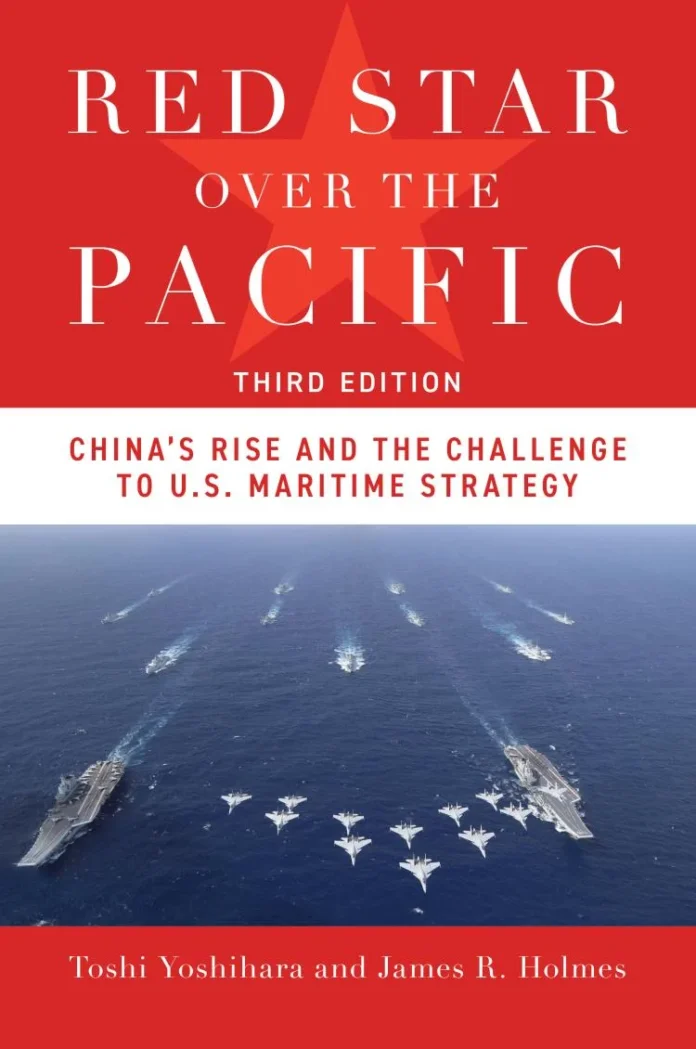
Red Star Over the Pacific – Third Edition. China’s Rise and the Challenge to US Maritime Strategy. By Toshi Yoshihara and James R Holmes. Naval Institute Press, Annapolis, Maryland, 2026
Reviewed by Tim Coyle
Kaiser Wilhelm II of Germany reputedly ‘devoured’ Alfred Thayer Mahan’s great opus: ‘The Influence of Seapower on History 1660 – 1783’ when it was first published in 1890. The book opened vistas of maritime power potential which Wilhelm seized on as substance for his dreams of a burgeoning capital ship battle force to challenge the hegemonic sea power, the peerless Royal Navy.
A powerful Imperial High Seas Fleet would combine with Germany’s formidable army to set Germany as the premier European power under Wilhelm’s tutelage. To mandate enthusiasm in the fleet, the kaiser ordered a copy of the book be placed in every wardroom for his officers to imbibe the Mahanian gospel.
Mahan was a godsend to Wilhelm and, together with his powerful navy minister, Grand Admiral Alfred von Tirpitz, sponsored the 1898 Naval Law through the Reichstag mandating the construction of 19 battleships.
Red Star over the Pacific is similarly a book which should be ‘devoured’. It objectively examines and analyses the most significant maritime strategic influence in the Asia-Pacific with global overtones: the People’s Republic of China’s (PRC) holistic sea power ambitions and capabilities across naval, constabulary and maritime militia strategies, operations and tactical developments.
It delineates the maritime assets, capabilities and political-military influences which comprise the quaintly named ‘pacing challenge’ to the United States.
As such, it is not only a study of contemporary geo-strategic challenges to the US, but it is equally applicable to US allies and partners in the Asia-Pacific region.
Authors Yoshihara and Holmes hold prestigious academic appointments which include tenures at the US Naval War College. They collaborated on the previous two editions of Red Star Over the Pacific.
Sources include extensive use of People’s Liberation Army-Navy (PLAN) academic writings. The authors emphasise the extent of maritime war theory analysis which, unsurprisingly draws heavily on Mahanian lore. This is evidenced by creation of a four-pronged maritime establishment comprising the PLAN, the China Coastguard (the world’s largest), the vast fleet of ostensible fishing craft comprising the People’s Maritime Armed Militia and the enormous Chinese mercantile fleet, supported by a vast shipbuilding industry which produced 1700 ships in 2025 (the PLAN received 30 new warships in 2025).
The authors’ theme is the achievement of the ‘China Dream’ – the basis of Xi Jinping’s strategy for China to regain its former greatness, destroyed in the ‘century of shame’ – the 19th and the first half of the 20th centuries. This was perpetrated by rapacious European, Japanese and United States depredations which subjugated the millenniums-old Chinese civilisation to servitude, leading to decades of brutal civil war from which the Chinese Communist Party emerged triumphant in 1949. The China Dream’ will culminate in the retaking of Taiwan and forging beyond the First Island Chain to give the PLAN unfettered access to the wider Pacific as well as controlling the South and East China Seas and contiguous waters. The ultimate achievement will be the PRC demonstrably a claimant to the position of the world’s most powerful country.
To attain this zenith, the People’s Republic of China seeks to diminish the alliances the US enjoys with Japan, the Philippines, South Korea, Australia and others and progressively weaken regional US influence.
Red Star Over the Pacific accomplishes its aim of illustrating the ‘challenge to US Maritime Strategy’ through a ruthlessly objective analysis of how the PLAN reached the apogee of ‘pacing challenge’ to the US, its Grand Strategy, and how the US should meet and neutralise the emergent hegemon. The book extensively uses lessons from maritime history from the early 20th century against the Imperial Japanese Navy and Gorshkov’s Soviet navy through the 40-year Cold War. Under the overall theme of ‘China’s Dream with Chinese characteristics’ the authors make their case through:
- Mahan’s Lingering Ghost
- The Economic Geography of Chinese Sea Power
- The Strategic Geography of Chinese Sea Power
- China’s Strategic Will to the Sea
- Fleet Building with Chinese Characteristics
- Fleet Tactics with Chinese Characteristics
- Chinese Sea Power in the Missile Age
- US Maritime Strategy in Asia.
In the final chapter – China Dreams On – the authors summarise their arguments. They offer the Key Takeaways as: ‘… the job of US maritime strategies is to temper the malign aspects of China’ bid for greatness without squashing its benign aspects. US leaders must understand China’s maritime strategy while adapting to the new circumstances to which it has given rise’.
However, it is not just US leaders who need to adhere to this advice; it applies equally to Asia-Pacific allies and partners. Two prominent allies – Japan and Australia – have forged a close diplomatic and military relationship in meeting the China challenge. Red Star Over the Pacific is therefore a work to be ‘devoured’ by regional governments and military strategists – including the states of South-East Asia and the South Pacific. This is even more salient as the current US Administration has made it clear that regional countries must provide more for their own security in dealing with the People’s Republic of China and its ‘pacing challenge’.
Red Star Over the Pacific is a work which will not stop at the Third Edition. Its relevance is immediate and grave.