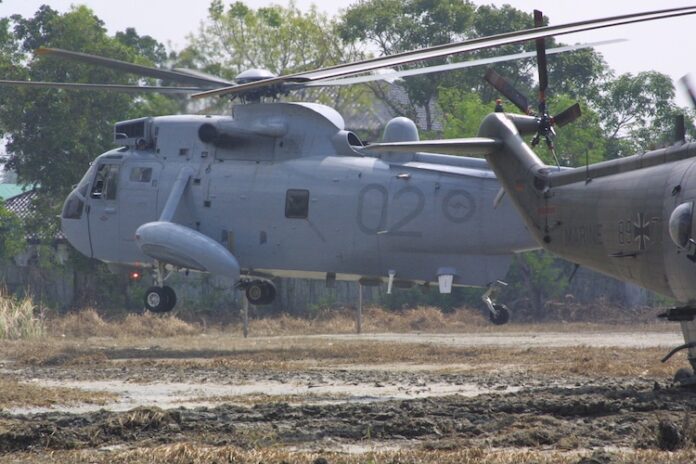
One of the most significant ADF peacetime disaster relief operations was its response to Boxing Day 2004 Indian Ocean tsunami. It is estimated nearly 227,900 people were killed across 14 countries. Particularly hard hit was the island of Sumatra. The naval task group commander, Commodore Peter Leschen gave an account of the RAN’s contribution in the Summer 2006 of the ANI’s journal, which was the first edition under the new name of Headmark.
Operation Sumatra Assist
On 26 December 2004, a major earthquake off Sumatra created a tsunami that devastated many of the coastal areas of Northern Sumatra, as well as other nations around the Indian Ocean rim. In Sumatra the tsunami caused massive devastation, loss of life and a major humanitarian disaster. In response, government, non-government and military forces from many countries launched international disaster relief (DR) and humanitarian assistance (HA) efforts.
As part of the Australian assistance to the Government of Indonesia, the ADF immediately commenced Operation Sumatra Assist (the ADF component of the Whole of Government Operation Tsunami Assist). On 27 December, Combined Joint Task Force 629 (CJTF 629) was established to provide transport of humanitarian aid, health and engineering support in Northern Sumatra. The Task Force comprised Headquarters, Maritime, Engineer, Health Support, Air, Joint Force Support and Communications groups.
The Maritime group role was to provide medical support to all CJTF 629 personnel, provide sea transport, resupply and sustainment support to the engineer group, and provide direct support to humanitarian aid operations, including health support to the local population and provision of transport for humanitarian aid stores. To achieve this, the Maritime Group, designated TG 629.1, included:
- the Amphibious Transport (LPA), HMAS Kanimbla (Commander Steve Woodall RAN),
- the embarked Primary Casualty Reception Facility (PCRF),
- two LCM-8 landing craft,
- two SK.50 Sea King helicopters,
- a Deployable Geospatial Survey Team (DGST), and
- a Clearance Diving Team (CDT) detachment.
After recalling most personnel from leave, Kanimbla sailed from Sydney for Darwin on 31 December with most of these elements embarked. Enroute to Sumatra, she stopped in Darwin for a hectic 28 hours to embark the 1 CER Engineer Group (1 Bde) and their equipment, and remaining PCRF personnel. Having been farewelled by the Governor-General and Minister for Defence, the ship sailed for Banda Aceh, where she arrived on the morning of 13 January 2005.
Concurrently, a Maritime Component Commander (MCC) and staff was formed, including myself as MCC and ten Amphibious Task Group and DJFHQ(M) personnel, in order to support the Commander CJTF 629, Brigadier David Chalmers. Some MCC staff embarked in Kanimbla to conduct planning with the engineer group, while the remainder deployed to Medan to commence work in the headquarters there.
On 12 January, Brigadier Chalmers and I, together with staff, Indonesian Army liaison officers and members of the media, embarked in two Sea King helicopters in Medan to join Kanimbla. Arriving off Banda Aceh the next day, the ship went to anchor off the mouth of the Banjir Kanal, and immediately commenced preparations for offloading 1 CER and equipment. The Survey Team and divers found that the proposed landing sites in the canal were too shallow to get an LCM8 up to the shore. This caused some delay, but they conducted surveys closer to the mouth of the Banjir Kanal, and by mid-afternoon they had found a site suitable for LCM8 operations at all states of tide. It did, however, require repairs to the canal banks and roadway to provide access to the town, as the tsunami had washed away portions of the bank.
The beach landing team and equipment were landed to the site to improve it and repair the banks and roadway. This was completed on 14 January, with a first offload of vehicles being landed and driven to the ADF work/accommodation areas in Banda Aceh that afternoon. Additionally, some personnel and stores were flown ashore in the Sea King during the day. The next day, Saturday 15 January, the main offload of vehicles by LCM-8 progressed rapidly and, with the exception of two unserviceable vehicles, was completed by that evening.
Once the offload was completed, the focus of Maritime Component operations shifted to establishing routines to support the forces ashore with fuel and water, hot food, laundry, and the opportunity for personnel to rotate through Kanimbla for temporary respite from the difficult living and working conditions ashore. Additionally, opportunities to use the Sea Kings for distribution of humanitarian aid, PCRF capabilities to support the ANZAC Field Hospital ashore, and Kanimbla working parties ashore were investigated, developed and implemented. During this period, Kanimbla‘s Sea Kings also conducted a lot of utility flying, moving the Commanders and a string of VIPs around, including the Prime Minister, Minister for Defence and Defence Chiefs.
Periodically, Kanimbla proceeded to sea to make water, and to fuel and store from US ships, which were in the area to support the relief operations of the USS Abraham Lincoln Carrier Strike Group and the USS Essex Expeditionary Strike Group.
By early February, the immediate disaster relief and humanitarian assistance tasks had been met or were being assumed by the UN and Non-Government Organisations. Planning for rotation/return to Australia of CJTF 629 forces was progressing. Commander George McGuire took command of Kanimbla from Commander Steve Woodall at the end of January and on 7 February I handed over MCC duties to George McGuire and returned to Australia.
After my departure, Kanimbla continued operations and participated in the planning to extract ADF elements and return them to Australia. She managed a brief respite visit to Penang in late February, commenced reloading equipment from 8- 23 March, and proceeded off station on 24 March to return to Australia via Singapore. Subsequently, of course, a second major earthquake struck Nias, and Kanimbla was turned around to provide support. Once again she did a superb job, while also having to cope with the crash of Sea King 02, and the tragic loss of nine lives. She eventually returned home to Sydney on 30 April, after four months away.
Reflections
I first saw conditions on the ground in Banda Aceh and down the west coast of Sumatra on 9 January, and last saw them on 05 February, just before departing the Area of Operations. While the total devastation of some areas was still obvious, the most striking difference over the month was that huge areas that had been badly damaged and almost completely devoid of people were now busy. Formerly deserted roads now had constant traffic, and people were working in large numbers to get badly damaged homes and businesses going again, and to clear away debris.
This was not, of course, solely the result of the ADF effort, which has been small in relation to the enormous scale of the disaster. Nevertheless, in the areas where ADF efforts had been concentrated, major changes had been wrought. The hospital was running and rapidly approaching the point where it could transition back to Indonesian staff; whereas very few Indonesians had been working around the hospital in early January, there were now many of them working to clean up the remaining mud and debris. The engineers had cleared and reclaimed significant areas, as well as producing much of the clean water that was so essential in preventing the spread of disease. The use of ADF helicopters to transport HA stores was being minimised, both because the requirement had reduced and there were now other means of transport, by road, sea and civil helicopters to meet remaining tasking.
Throughout the operation, the ADF force elements involved performed exceptionally well, and the levels of joint cooperation and support were very good. With respect to the Maritime Component, the initial deployment, load-out in Darwin, and subsequent offload at Banda Aceh was a major success, achieved in the face of considerable challenges caused by the devastation of the coastline at Banda Aceh. Subsequently, Kanimbla and embarked elements did a sterling job of supporting the ADF elements ashore, and made a considerable direct contribution to the HADR effort through the provision of work and PCRF parties ashore, and the delivery of HA stores by the Sea Kings.
Operation Sumatra Assist has been a highly successful operation that achieved its HADR objectives. There is, of course, a massive amount of reconstruction work still to be done in Sumatra, but that is the province of the Indonesian Government and commercial contractors, not foreign military forces. The ADF can look back with great pride on what was achieved, without ever losing sight of the terrible destruction and human tragedy that occurred in Indonesia, and around the Indian Ocean that made the operation necessary, or forgetting the tragic loss of nine of the fine young ADF people who made the operation possible.
About the Author
Commodore Peter Leschen joined the Royal Australian Naval College in 1974. He subsequently specialised in navigation. He received training in several RAN and RN ships; worked in Navy Office; and served on the staffs of the RAN and Joint Services Staff Colleges and the USN Naval Doctrine Command, before taking command of HMAS Brisbane. His shore and sea appointments included Director Maritime Combat Development; Director Sea Power Centre – Australia; Chief Staff Officer to Chief of Navy; Commander Australian Surface Task Group/Deputy Commodore Flotillas; Deputy Maritime Commander and Chief of Staff Maritime Headquarters and Director General Command and Control Implementation Team in Australian Defence Headquarters. Peter Leschen retired from the RAN in 2010.