



Maritime scholarships for women
End of financial year funding available: women's leadership development
Women & Leadership Australia is administering a national initiative to support the development of female leaders...
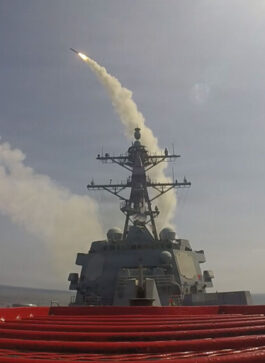
Three hard questions of US maritime strategy
 By Frank T. Goertner*
From the White House to the Pentagon, the message is clear. The world of 21st Century great power competition has arrived, and it is distinctly different from the one today’s U.S. national security enterprise was designed to confront. Now is the time for every agency, department, and service in the executive branch to ask itself hard questions and consider decisive change.
By Frank T. Goertner*
From the White House to the Pentagon, the message is clear. The world of 21st Century great power competition has arrived, and it is distinctly different from the one today’s U.S. national security enterprise was designed to confront. Now is the time for every agency, department, and service in the executive branch to ask itself hard questions and consider decisive change. Will Australia defend the ‘rules-based order’ in Asia?
Nick Bisley and Benjamin Schreer: China has become the most formidable challenge to Asia’s regional order, and to Australia’s stake in that order, since the days of Japanese imperialism. It’s not just its growing economic and military power but increasingly Beijing is experimenting with order building and it’s plainly trying to exert political influence beyond its borders.
China’s robust challenge to RAN freedom nav
China’s military issued “robust” challenges to three Australian warships as they travelled through the South China Sea to Vietnam earlier this month. Defence sources...
Future Submarine trial win for Bisalloy and BlueScope
Aussie steel makers Bisalloy and BlueScope have had yet another win after a new contract was signed with Naval Group Australia to produce up to 250 tonnes of specialised steel. The steel produced will be tested to determine whether it meets the specification for the pressure hull of our new Future Submarines, which is an essential safety requirement.
Appointment of first Australian Defence Export Advocate
 David Johnston has been appointed as the first Australian Defence Export Advocate. This role will provide international advocacy on behalf of local defence industry to help secure export sales and contracts. The Minister for Defence Industry, Christopher Pyne, congratulated Mr Johnston on his appointment and looked forward to working closely with him to help secure export successes for Australia’s defence industry.
 RAN ships complete visit to Malaysia and the Philippines
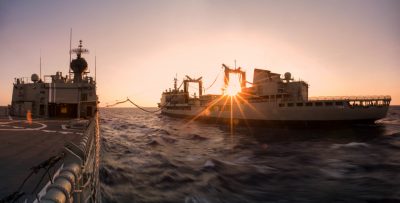 Royal Australian Navy’s HMA Ships Anzac, Toowoomba and Success have completed concurrent port visits to Malaysia and the Philippines, as part of a three month South East Asia deployment.
 France and Australia; where tradition meets the future
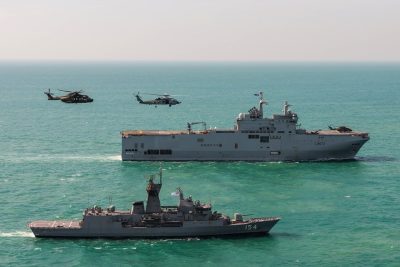 With the forthcoming opening of the Sir John Monash Centre in northern France next week by Prime Minister Malcolm Turnbull, and the second visit to Australia of a French President, Emmanuel Macron, in early May, Nicole Forrest Green speaks with France’s Chief of Navy, Admiral Christophe Prazuck in Paris.
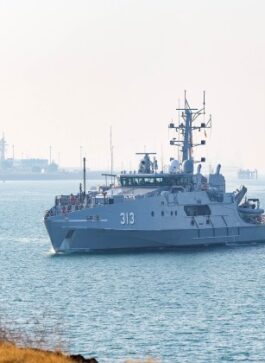
 Patrol Boats to be given to Timor
As part of Australia's strong commitment to regional maritime security, Australia will gift Timor-Leste two new patrol boats following the finalisation of the shipbuilding...
Is China changing the ‘rules’ in the Pacific Islands?
Joanne Wallis: The report this week that China is in talks to build a military base in Vanuatu has generated consternation in Australia. Regardless of whether the report was accurate, it’s undeniable that China has significantly increased its aid to, and engagement with, the Pacific Islands.