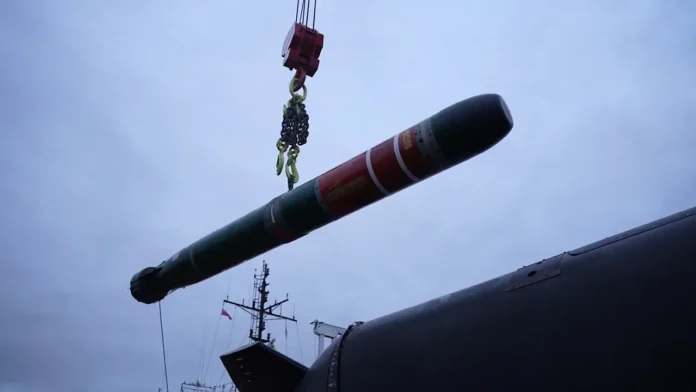
The U.S. and U.K. test launched a torpedo from a Royal Navy extra-large unmanned underwater vehicle earlier this month as a proof of concept trial for AUKUS Pillar 2, the U.S. Navy announced, US Naval Institute News reports.
On Sept. 13, the Royal Navy’s experimental XLUUV XV Excalibur launched a U.S. Mk 48 Heavyweight Torpedo while at the British Underwater Test & Evaluation Centre in Scotland, reads the U.S. Navy release. The milestone was achieved under Project Broadsword and Trial Iron and marked a major operational achievement for AUKUS Pillar 2.
The event validated the mechanical, electrical and software integration of a U.S. kinetic payload onto an allied autonomous vessel, proving that allied forces can rapidly achieve weapon interchangeability.
“This successful test marks a historic first for allied undersea warfare,” Adm. Daryl Caudle, Chief of Naval Operations, said in the news release. “Proving that we can seamlessly launch a U.S. heavyweight torpedo from a Royal Navy autonomous underwater vehicle validates our shared vision for true interchangeability. By integrating weapons, payloads, and mission architectures across allied platforms, we are increasing the flexibility, scale, and combat power of our combined forces and ensuring they are ready to meet the strategic demands of tomorrow.”
Vice Adm. Rob Gaucher, Director, Submarine Programs, said that Project Broadsword is a great example of how AUKUS Pillar II drives interoperability across the alliance and that the demonstration launch is an important early step in developing lethality in AUKUS undersea autonomous systems.
Project Broadsword was approved in February 2026 by the Department of the Navy Rapid Capabilities Office (DONRCO) and executed in less than seven months through collaboration among the DONRCO, OPNAV N97, the Royal Navy, the Defense Innovation Unit (DIU), Naval Undersea Warfare Center Keyport and industry partners, with DONRCO co-managing the initiative with the Navy’s Direct Reporting Portfolio Manager for Robotic and Autonomous Systems.
“This effort is proof that the DONRCO and our mission partners are fundamentally redefining how defense technology is accelerated,” said Navy Vice Adm. Seiko Okano, director of the DONRCO. “We are not waiting 10 years for a single bespoke platform; we are pioneering a modular, software-defined, open-systems approach that integrates allied hardware with commercial innovation to rapidly scale distributed lethality.”
According to the news release, following the successful deployment of the Mk 48 from Excalibur, the Navy and its international partners will continue aggressive follow-on acceleration with Project Cutlass. The project will utilize the Anduril Dive-XL platform. The next phase will tackle advanced payload integration data, command and control architectures, and tactical employment scenarios to further mature uncrewed undersea capabilities.
Anduril announced on March 12 that the Defense Innovation Unit and the U.S. Navy had selected the defense contractor to participate in the Combat Autonomous Maritime Platform Project (CAMP) to address the sea service’s need to deploy large payloads across extended ranges underwater.
The 12-meter-long, 41,887-pound Excalibur was handed over to the Royal Navy on May 15, 2025, having spent three years in development under the Project Cetus program. The project trialled an XLUUV for the Royal Navy with the drone conducting two years of sea trials and experimentation.
The U.K. Ministry of Defence Submarine Delivery Agency, which developed Excalibur, said that the XLUUV took part in exercise Talisman Sabre held in Australia in August of 2025. The Royal Navy controlled Excalibur in U.K. waters from a remote operating center in Australia with the event being part of AUKUS Pillar 2.
AUKUS Pillar 2 involves the development of shared advanced capabilities for Australia, The U.K. and the U.S. There are eight known working groups under Pillar 2, consisting of six involved in technological areas – namely undersea capabilities, quantum technologies, artificial intelligence and autonomy, advanced cyber, hypersonic and counter-hypersonic capabilities, and electronic warfare – and two groups addressing areas of innovation and information sharing.
A number of activities have been carried out under Pillar 2 since it was announced in 2021 but only this year was a signature Pillar 2 project announced. It was announced on May 30 the three countries would develop cutting-edge payloads and enabling systems for AUKUS partners’ Uncrewed Undersea Vehicles (UUVs), with delivery starting in 2027.
“This project is intended to significantly enhance AUKUS partners’ ability to protect critical national seabed infrastructure; deploy cutting edge surveillance, reconnaissance, and strike capabilities; conduct logistics operations; and bolster superiority in anti-submarine and anti-surface warfare, mine countermeasures, electronic warfare, and contested littoral maneuver,” reads the statement, which was released during the AUKUS Defense Ministers Meeting held on the sidelines of the Shangri-La Dialogue in Singapore.
A U.S. Defense Department fact sheet on the signature project stated that the payloads and enabling systems developed will be able to be used across each country’s different UUV types.