By Tom Sharpe*
For most of my naval career I was relaxed about undersea cables. I knew they were there and what they did, and I spent time commanding a frigate keeping Russian submarines away from them.
But the sheer number of cables, and the redundancy that implied, made me think of each cable as important rather than vital. The doomsday scenario, where Russia cut them all at once, always struck me as too difficult to achieve.
But I talked recently with some people who knew more than I do, and that led me to look into the matter properly. I now think I was wrong.
One of the best summaries of the current situation is last September’s report by Parliament’s joint committee on the National Security Strategy.
Around 64 data cables come ashore in Britain, 45 of them international, at landing stations dotted from Cornwall round to Suffolk.
This is not the resilience-through-numbers that I assumed.
It gets worse. The committee found that just two of these cables carry 75 per cent of our transatlantic capacity, and both land at Bude: most likely Google’s Grace Hopper and Meta’s Amitié.
Seven of the cables account for 93 per cent of our traffic, and nine of them share one landing station at Bude. A ship sailing from Land’s End to Aberystwyth would cross about 20 cables.
Out in the Atlantic they lie on the seabed at three or four thousand metres down, no thicker than a garden hose and unburied, because burying costs more.
Nor do you necessarily need a ship or a submarine to get at them. Security at the landing stations varies from site to site, the committee found, and “some could be rendered inoperable by sabotage”.
Now the threat.
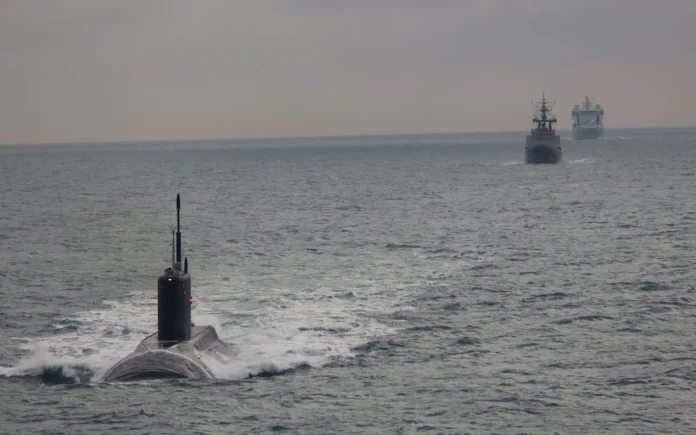
In April the Government revealed that a Russian Akula-class nuclear attack submarine and two ships from GUGI – Russia’s secret deep-sea force, separate from the regular navy – had spent a month prowling over our Atlantic cables, shadowed by HMS St Albans and P-8 maritime patrol planes.
John Healey, then Defence Secretary, told them “we see you”. Last week Nato disclosed that GUGI had spent the spring off Svalbard rehearsing with a weapon officials would describe only as “sophisticated and destructive”, and designed to leave no trace of who used it.
On Wednesday the First Sea Lord stood up at Admiralty House and said Russia was “probing, testing and mapping” with submarines that we find ever harder to track. That is the pattern of a state that has finished mapping and maybe finished tapping. Before getting ready for the third thing you can do to a cable: cutting it.
Could they do it?
Working at 3,000m is harder than working in space: no light, no GPS, no radio, 300 atmospheres of pressure, everything done by sound or down a tether.
Yet that is what GUGI is for. It has several small nuclear-powered subs in the same class as the well-known Losharik, crewed mostly by senior, highly skilled officers, and able to reach 6,000m.
And you don’t need this sort of cutting-edge capability to cause trouble. The Royal United Services Institute (RUSI), the military think tank, believes that a small, cheap unmanned vehicle could deliver an explosive cutting charge to a cable at 1,000 to 2,500m with “almost impunity”.
Triggering the charge is the harder problem. You cannot use timers for a war you haven’t scheduled, so the devices must be command-detonated. Sending simultaneous acoustic signals across a thousand miles of ocean would require a lot of transmitting platforms.
But of course you might have not merely placed a charge next to the cable. You might have tapped into the cable to read its traffic – this has been done in the real world – which raises the possibility of sending a firing signal to the charge through the internet via the cable itself.
You might also be using the cable’s own power line to parasitically run your device, giving it long-term endurance. Doing this kind of work at depth undetected would not be simple, but again it is what GUGI is for, and such things are known to have been done. It’s easy by comparison to make such a device tamperproof, so that anything sent down to remove it sets it off anyway.
So what happens if the cables all go at once?
The first thing you notice is that WhatsApp has stopped. For our purposes, it lives in Ireland. Within minutes the routers that steer traffic round the world are hunting for paths that no longer exist.
The committee’s scenario outlines what follows: DNS and routing fail, and with them “cascading” failures in things you thought were British. The bank’s app is up, but the login check bounces off an American server, so nobody can get in. Card payments go patchy.
Netflix, which caches its films inside British networks, carries on regardless, so millions will sit watching television with no idea anything had happened.
By close of business in the City, Swift has gone and with it London’s share of the ten trillion dollars (£7.4tn) a day that moves over these cables. New York cannot see London. The four o’clock fix doesn’t happen. This is likely to be the most damaging part.
London is the largest foreign exchange market in the world, particularly for dollars. CLS, which settles those trades so that neither side pays out without being paid, moves more than $6.5tn (£4.8tn) a day across 18 currencies.
An American bank, supervised by the Fed, with its members’ business booked here. Both legs settle, or neither does. A clean stop is survivable. A cut mid-session is not: it recreates the settlement risk the system was built to abolish after Bankhaus Herstatt collapsed in 1974 and took the market’s nerve with it.
Then the hidden part. Five Eyes is a data relationship before it is anything else, and it runs along the same seabed, as does Nato’s transatlantic command and control, and the reachback from our HQ at Northwood to the US one at Norfolk, Virginia.
Isolating Britain from America severs the alliance’s nervous system at the moment it would be needed most. Which is probably the idea.
Next morning 999 still works; the committee is clear on that. A great deal behind it does not. Then come the slower failures the committee calls “payment and supply chain failures”, airline systems, port manifests, the just-in-time ordering that puts fuel in forecourts and food on shelves. We saw that during Covid, and it quickly became ugly.
And that is just the data. Three-quarters of our gas comes down pipelines from Norway and 10 gigawatts of electricity through cables from the Continent, with nothing like the same level of redundancy. In March we had a day and a half of gas in reserve. If the pipelines and the interconnectors went at the same time we’d be in real trouble.
How long to fix? The two repair consortiums we belong to have three ships each. Each ship can mend one break at a time: a week for an Irish Sea fault, a fortnight mid-Atlantic, a month in bad weather. The only repair ship based in the UK, CS Sovereign, was built in 1991 and will retire around 2030.
“We do not have any UK-owned repair capability,” the committee wrote. Sixty breaks at once would take the rest of the year, if nobody cut them again.
And all this would be deniable. Balticconnector, Estlink 2, the cable off Helsinki that was cut on New Year’s Eve: ships were detained, ships were inspected, charges were dropped, nothing was proved. Ask what we would do and the honest answer is strong words from Ed Miliband, if we dared attribute at all.
What we have on their cables, I guarantee, is nothing. The committee’s phrase was that our deterrence was “too timid”.
So what should we do? RFA Proteus, our one seabed-warfare ship, is a commercial rig tender bought for £70m; the promised second vessel is in “concept phase” with no delivery date.
The Chancellor who told the Russians “we see you” now decides whether we can afford to act on what we saw. We need delivery of the sovereign repair ship the committee wanted by 2030 to be accelerated, and a way of finding and neutralising charges at serious depth by remote vehicle. This seems expensive, until you price up what being offline would cost.
That last part is doable but far from simple. Cable-tracking autonomous underwater vehicles exist and the cable industry routinely uses them, but the numbers are not encouraging. The best long-range vehicle out there, Kongsberg’s HUGIN Endurance, covers 1,400 miles in a fortnight.
A transatlantic cable is 3,900 miles: that’s three sorties and six weeks for a single inspection of one of the 64 we need to be watching. Unless somebody in a lab is developing something new, we cannot patrol our way out of this.
It would be far better to let the cable listen for itself. As I wrote here recently, an undersea fibre can be turned into a microphone along its own length, detecting anchor drags and trawls and potentially fingerprinting a passing ship even with its AIS off.
Range used to run out at 60 miles, useless mid-Atlantic: it has now been demonstrated extend through repeaters out to 1,384 miles. Fewer than 1 per cent of the world’s cables carry any sensing at all. Had ours been listening these past five years, we would have a recording of everything that loitered over them.
We have the beginnings of the rest: the Royal Navy’s “Atlantic Bastion” plan at £1.5bn will give us a much better picture of what’s happening in our area. But our counterstrike options – our nuclear attack submarines – are all parked up and have been for more than 100 days. I guarantee that our offensive options to do the same back unto others have withered on that vine.
I will add this. If we find a device on a cable or a pipeline, we should not just quietly lift it. We should pre-position the repair equipment, detonate it ourselves, and tell the country what it was and who put it there. Foiling attacks in secret lets the public live in a world that doesn’t exist.
That is not warmongering, I’d argue. It is preparing the nation to face reality. It is putting our game faces on. That is something we have largely forgotten how to do, and if we do not learn again, the chance of war becomes all but a certainty.
*Tom Sharpe OBE served for 27 years as a Royal Navy officer, commanding four different warships
This article was first published in The Telegraph and is republished with permission of the author