Many of younger ANI members would find it hard conceive of a RAN without half of its major surface fleet based on the west coast. Arguably the Two Ocean Basing Policy is one of the most significant developments in the RAN’s history. It is therefore interesting to read the thoughts of one of the ANI’s members early in its implementation. Commander (later Rear Admiral) Davyd Thomas wrote ‘The Effects of Two-Ocean Basing’ for the August-October 1994 edition of the Journal of the Australian Naval Institute.
The Effects of Two-Ocean Basing
In the 1987 Defence White Paper the government enunciated the Two Ocean Basing (TOB) Policy which sought to homeport up to half the fleet at Fleet Base West (FBW). The measure of the implementation of this policy is seen by many through the homeporting of ships and the development of facilities at HMAS Stirling. However, TOB is much more than this. It has implications both in the Navy and the wider defence community. This article seeks to provide an insight into the implementation of the TOB policy and its effects.
The Past
Historically, Navy culture has been centred around an east coast base with personnel having a fair likelihood of being able to spend the majority of their seagoing career east of the Great Divide. Ships worked up and maintained their standards primarily from their homeport in the East Australian Exercise Area (EAXA) and resources and defence assets were provided with that end in mind. Fleet publications also focused on the operation of a Fleet based in Sydney, although there were small elements of Navy in the outports of Cairns, Darwin and Fremantle, with the local commander exercising control of various areas.
Announced seven years ago, the TOB policy is about half way towards its maturity. The west currently boasts eleven homeported units, including two FFGs, the Navy’s Destroyer Escorts, a tanker, a survey ship, two patrol boats, a trials ship and a submarine. The build up of shore infrastructure in support of these and other units is part of a well planned three stage development project. This development is in full swing with Stage II well underway. Stage II includes, inter alia, construction of a new fleet pier, torpedo support facility, helicopter support facility and rifle range. The Submarine Squadron headquarters is in the process of transferring its centre of operations to a recently completed facility on the west coast and the Submarine Training Systems Centre now conducts regular courses at FBW in support of the new Collins class submarine, In due course the software centre will also move to the west coast.
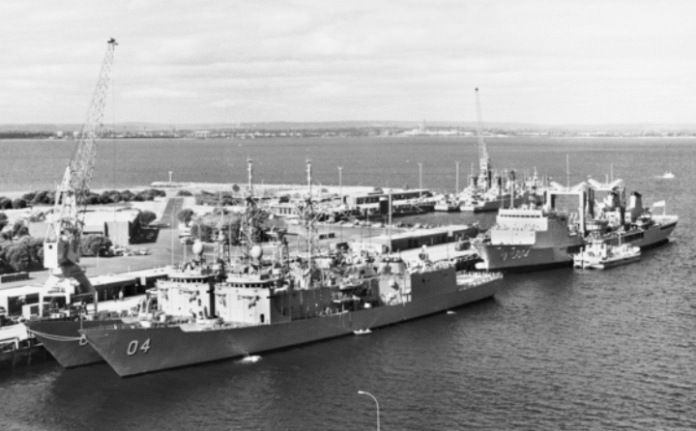
Situated on Garden Island 50 km south of Perth. Stir-ling was a grcenfteld site developed by Navy for Navy. Work commenced in 1978. Remote from the mainland and connected by a causeway, it is the ‘jewel’ in the Navy’s environmental crown.
From an operational facilities perspective a number of significant events of interest have occurred recently. These are primarily associated with the preparations for the Collins class but have implications for the surface fraternity as well. New infrastructure includes the Underwater Tracking Range (UWTR), Magnetic Measurement Range and Magnetic Treatment Facility. All these have applications for warships and provide a quantum leap on current installations. To seaward, the West Australian Exercise Areas (WAXAs) have been expanded and ships can now also look to exercise areas and support in the North West, exploiting Learmonth, as an escape from the harsh winter conditions of the Southern Ocean.
Training facilities are also being constructed. In particular, a Damage Control and Fire Fighting facility is now in place. This includes a helicopter training module for helo-capable ships as well as an accredited Disaster Relief Training site.
Effects
It can be argued that TOB has created a climate for change. The magnitude of change created is vast but for the purposes of this article three areas – culture, operational support and personnel – will be addressed.
Culture
One of the most difficult hurdles TOB has to overcome is resistance to change. The formal recognition of such a policy overtakes the previous era of a Fleet based in Sydney with small numbers in other outports. TOB necessitates a change in culture and challenging of our fundamental philosophy, and could be seen as one of the biggest challenges facing Navy for the remainder of the decade. TOB is everyone’s business and is more than a simple belief that it simply involves homeporting ships or constructing buildings at HMAS Stirling. An overall strategy, outlining guiding principles, has recently been developed within Navy Office in consultation with other commands, and it is this strategy that now will be put into practice to guide further planning.
There are also more subtle ways of inculcating hearts and minds, such as changing publications to reflect TOB. Recently fleet operating orders, MARORDS, were amended to relied instructions which were relevant independent of location. This removed examples such as the Fleet Gym opening times to the Dental hours at Kuttabul. This change also illustrates the one fleet ethos that has arisen from the basing major warships outside Sydney. One Navy – Two Oceans I
Although the vision of a mature TOB policy has not yet been enunciated, this could be seen as being a worthwhile venture so that the policy’s progress along the path to maturity can be measured. A comparison between the vision and reality would provide a ready performance indicator. It would also help monitoring changing attitudes. For example, one indicator of the progress towards acceptance of changing culture could be the point at which signals, memos and the like no longer aim their contents at an east coast readership, but consider a national audience as a matter of course. Another would be the conduct of the majority of a ship’s workup from the homeport – more specifically those elements which do not rely on unique facilities on either coast.
Operational Support
TOB should drive Navy’s operational support requirements. This is becoming so through a process of evolution. Many of the resources necessary for ships to maintain operational standards are either available in, or can be deployed to, the west. This will allow west coast ships’ workups to be conducted from the homeport, as is the case for east coast ships. One shortfall being addressed by HQADF is the provision of fast jet support in the West. Whilst 25 Squadron can provide limited-speed aircraft, fast jets must currently deploy to WA to support maritime activity and this incurs a penalty in dead time during aircraft transit across the country.
Efforts are underway within Maritime Headquarters to provide ships with access to combat system simulation training on the west coast. In the future, much more emphasis may need to be placed on simulation packages as a real alternative to access to live fast jet hours. This is not to suggest fast jets are not required; rather that these hours could be more efficiently realised if restricted to major exercises and other dedicated activity periods throughout the year.
The TOB policy has contributed to a rethink of Navy’s approach to the provision of target services, in particular the replacement Jindivik. A project team is now looking at a deployable and portable target, capable of operating both east and west. This arose after an original plan to enhance the fixed facility at Jervis Bay was excluded as an option. The outcome will be the ability to fire medium range missiles in the West (or many other places).
With regard to sea training, the Sea Training Group (STG) has addressed the problem of its support to an expanding Navy located on two coasts. In order to maintain consistency of standards and ‘one Navy’, the accredited sea riders concept has been developed. This entails formal accreditation of suitably qualified personnel (primarily personnel from FBW) to be employed as members of the STG, under Commodore Flotillas. Not only will this alleviate the burden on other members of STG, it will also enable wider coverage of ships on both coasts simultaneously.
At FBW, the Operations Room is now connected electronically to Maritime Headquarters in Sydney and serves as the contingency computer site and alternate Joint Operations Room. This means that there is now some form of built in backup to the MHQ information network.
Maintenance aspects of operational support have also developed. A large FIMA organisation is now capable of working on all classes of ships from patrol boats to submarines. Local defence industry infrastructure has also improved with a prime indicator, the first FFG refit, conducted in WA in 1993. In 1996, all three west coast FFGs will undergo Depot Level Maintenance (DLM) in the West. Standby for Anzac in 1998! Stores support has also improved and matches the east coast in customer service in every way.
There is little doubt that operational support in the West is evolving. Although a complete set of combat system qualification trials (CSSQT) and workup has not yet been conducted in the west, the successful completion of such an event will be a yardstick for operational support of TOB and is a worthwhile goal. The conduct of standard EAXA-type activity such as Principal Warfare Officer (PWO) sea weeks in the west also provides a measure of TOB implementation and helps redress a natural tendency to transit ships east for operational support. In fact, the final outcome might be a split workup on both coasts with east coast ships transiting to the west to exploit unique non-deployable facilities such as the UWTR and magnetic treatment facility. The pendulum may swing towards the west.
Personnel
There are a number of complex personnel issues created by TOB. Principal among these is the uncertainty of back to back postings due to the lack of posting opportunities ashore in the West. Understandably, a number of personnel are reluctant to move their families to the West for a relatively short period. There is also the real problem non-West Australians experience with the lack of extended families and potential loss of spouse income created by a move to the West. The result is the potential emergence of a permanent ‘commuter Navy’, with personnel returning to the east at every opportunity. The problem could be partially redressed by transferring; whole activities to the west and this is under investigation in a number of areas at present. Increased communication by marketing of lifestyle in the West and Stirling facilities (and benchmarking it with the opportunities in the east) may also help sell the product. An alternative could be to accept the commuter issue as an outcome of TOB, with perhaps special packages being set in place as an offset to alleviate the burden of family separation. Whilst it may not be the panacea, better reunion opportunities through increased financial support to assist transportation of families to the West for leave may Ire a worthwhile endeavour. Financial offsets may be realised through a particular member not electing to take a removal to WA during a posting. This also has the advantage of the Ship’s CO remaining in WA for longer, during periods his ship is alongside FBW.
The Future
This article has highlighted that TOB involves more than homeporting ships and constructing buildings. The policy also raises a number of cultural, operational and personnel issues. In time, a large majority of Navy personnel will serve in Western Australia or be directly affected by the policy. The magnitude of new activity and the complexity of some of the causes and effects of TOB present a challenge now and in the future. Noting the cultural change the Navy faces, there could be seen to be value in formalising responsibility for the implementation of the policy. This could include procedures for the formal measurement of Navy’s progress towards TOB maturity. At the end of the day, this should provide warships on the west coast that are better prepared, in all respects, to carry out their primary roles and functions.
As a final thought, if ships had to vacate Fleet Base Fast what would happen? Could Navy operate effectively from somewhere else? In the longer term that somewhere else may well be FBW. We owe that ability to TOB.
About The Author
In 1974 Davyd Thomas joined the Royal Australian Naval College from Newcastle as a Cadet Midshipman. He first called into a still developing HMAS Stirling when XO of HMAS Aware in 1978. He completed his Principal Warfare Officer’s course in the UK in 1983 and subsequently served in HMA Ships Vampire and Perth. After completing the RAN Staff Course in 1987 he became the Surface Weapons Trials Officer at RANTAU prior to serving as XO of HMAS Adelaide in 1989-90. He then was posted as the Operations Officer at Stirling, before assuming command of the FBW-based FFG HMAS Darwin, for which he was later awarded the Conspicuous Service Cross. As a captain, he commanded HMAS Newcastle for Operation SLIPPER deployment in the Persian Gulf, for which he was awarded the Commendation for Distinguished Service.
Davyd Thomas was promoted to Commodore in 2002, and his senior appointments included Commodore Flotillas, Maritime Commander (later re-named Commander Australian Fleet), and Commander of the Australian Defence College. Rear Admiral Thomas is a graduate of the US Naval Command College and has completed a Masters of Science (Management) at Salve Regina University. He was made a Member of the Order of Australia (AM) in 2002 and promoted to an Officer of the Order of Australia (AO) in 2009. Rear Admiral Thomas was appointed as the Deputy Chief of Navy in 2008 and retired from RAN in 2011 during that final naval appointment he was also President of the Australian Naval Institute.
Among his many post-naval activities from 2012-2024 Davyd Thomas served as Vice President Defence for the shipbuilder Austal.
Photo caption:
HMA Ships Darwin, Adelaide and Success alongside HMAS Stirling prior to sailing for the Persian Gulf in 1990 (source RAN)