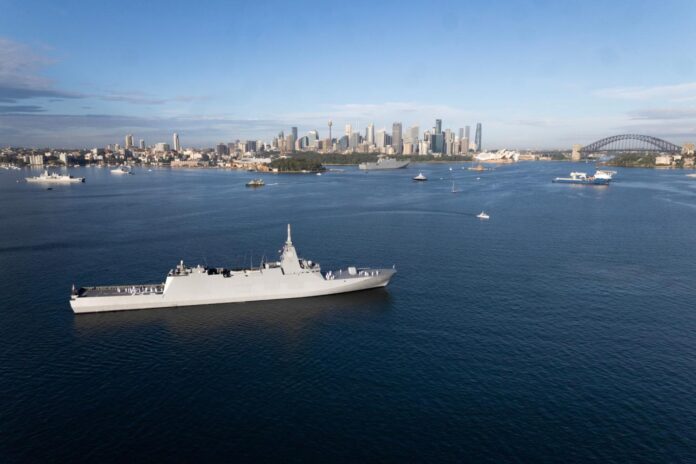
Last month’s signing aboard JS Kumano of contracts for Mitsubishi Heavy Industries (MHI) to build the first three Mogami-class frigates for Australia was rightly celebrated as a major step in the bilateral relationship. But anyone who follows defence procurement knows the hard work starts here. Canberra will need to give as much attention to sustaining the relationship behind the program as to building the ships themselves. (From: The Interpreter. The Lowy Institute.)
Mogami presents an opportunity for Australia to trial a new model for foreign procurements.
Both Australian Deputy Prime Minister Richard Marles and Japanese Minister of Defense Shinjiro Koizumi described the deal in strategic terms, making the Mogami deal an act of statecraft as well as naval procurement. It is therefore a test of whether Australia and Japan can preserve the relationship needed to deliver the program through political cycles, economic pressures, and strategic shocks. Canberra is not naïve about the risks of sourcing naval capabilities from overseas. But the scale and simultaneity of Australia’s naval procurement plans – AUKUS, the Hunter-class frigate, and the Mogami program will all run at once – introduces further risk.
When considering what is required to make these projects work, discussion defaults to skilled trades rather than asking whether industry and government have the relationship skills to operate across these different policy, navy, industry and partner networks at once. While the labour gap will continue to cause headaches, that task is at least measurable and politically visible at the Henderson and Osborne shipyards. The relational side of the deal is harder to locate in public, with few visible milestones and no single owner. It remains the least developed part of the equation, yet perhaps the most consequential. It will take as much sweat as the labour in the shipyards.
Canberra is no doubt standing up mechanisms to oversee the Mogami program. While creating a sizeable agency like the Australian Submarine Agency that oversees AUKUS would be overkill, Mogami presents an opportunity for Australia to trial a new model for foreign procurement. Think of it as a strategic translation function: people able to operate credibly across the navy, Defence, DFAT, and industry, while also knowing Japan’s institutions and policy machinery. Language skills would be useful, but how many English-Japanese bilingual people with maritime, defence-industry and strategic literacy does Australia have? While translation technology and AI may reduce language friction, the corporate and cultural differences still require education and experience.
Since it is a critical point of failure, someone needs to own the relationship side of the Mogami program. It requires a dedicated liaison function across Defence, Navy, industry and DFAT. It must have a clear home and protected budget. Its value should be judged by whether it prevents misunderstandings from becoming irritants, keeps Tokyo and Canberra aligned during inevitable cost pressures, and reduces risk in the transition from the Japanese built-ships to the Australian build.
Japanese institutions value persistent relationships. The function of this agency would be to give Tokyo and MHI one consistent touch-point amid the constellation of Australian actors (Navy, Defence, DFAT, Austal, state governments and ministers’ offices). Dedicated staff would provide the continuity expected in Tokyo, even if Australian staffing systems do not always make that easy. Such a function could outlive Mogami itself by building a cadre of people steeped not only in Australia-Japan relations but skilled in the practical work of defence-industrial cooperation with other like-minded states.
Without this strategic translation function, naval programs like Mogami remain simply procurement contracts. With it, they become practices of statecraft.
The stakes are high – Mogami is Japan’s most significant arms export since the 2014 reforms – so Australia must not take the Japan relationship for granted. The failed 2016 Sōryū-class submarine bid may still rankle in Tokyo, but Japan has decided that its strategic alignment with Australia is worth the effort. Mogami is not only a solution for the RAN, but a test of whether Japanese defence-industrial cooperation can operate at scale with a close partner.
Canberra also needs to be clear with Tokyo about Australian sensitivities, especially the need to maintain program credibility at home. As Mogami moves through the same crowded system as Hunter and AUKUS, the performance of shipyards across and within each program will inevitably be compared. The most obvious pressure point within Mogami is the transition between ships 3 and 4. If MHI delivers the first three Japanese-built hulls on time, Austal will be under immediate pressure to prove that the local build can follow without a loss of momentum.
Operationally, the Mogami project means deepening navy-to-navy mechanisms through which trust becomes routine: exercises, training, education and regular operational contact. Strategically, it means creating an enduring structure of political and institutional support based on continued alignment of interests. The strategic messaging should be direct: the Mogami deal delivers the fighting capabilities the RAN needs, and naval capabilities carry value beyond the “thunder of battle”. Fielding effective sea power and building partnerships gives Australia a legitimate say in shaping the contours of its own neighbourhood. Rather than barracking from the sidelines about the fraying international order, Australia is instead on the playing field and paying its dues.
Without this strategic translation function, naval programs like Mogami remain simply procurement contracts. With it, they become practices of statecraft: strategically embedded, politically defended, and harder to unwind.
*Paul Chamberlain is a PhD candidate at the Australian National University, completing a thesis on “Sea Power as Statecraft in the Contemporary Indo-Pacific” that examines how Australia, Japan, and Singapore use sea power to shape strategic relationships and the regional order. He is the Research Fellow for Indo-Pacific Sea Power at the Yokosuka Council on Asia Pacific Studies (YCAPS) and was recently a Visiting Research Fellow at Japan’s National Institute for Defense Studies (NIDS) in Tokyo.