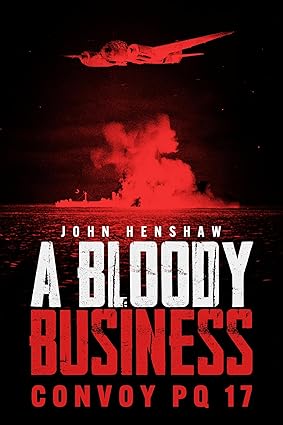
A Bloody Business – Convoy PQ 17. By John Henshaw. Casemate Publishers, Havertown PA, USA, and Barnsley, UK, 2025. ISBN 978-1-63624-607-9 (hardback edition) ISBN 978-1-63624-608-6 (digital edition).
Reviewed by David Hobbs
Australian naval historian John Henshaw is a prolific writer with a distinctive style that will have become familiar to ANI members as well as the wider international audience interested in the specific ships and events he has described. The stand-out features of his work are his own excellent line drawings of ships and aircraft.
In this instance there are 47 ship, submarine and aircraft drawings spread throughout the 171 pages of text supported by 75 carefully-chosen black and white photographs and two maps, all of which help the reader to form a very clear visual impression of the subject matter. I was delighted to see on page 10 that Henshaw refers to The Allied Convoy System 1939-1945published in 2000 by my friend and RN Historical Branch colleague, the late Arnold Hague, as the ‘most authoritative work on World War II convoys’; it would be my starting point for any study of a wartime convoy. Arnold Hague and American historian Bob Ruegg collaborated to produce an earlier book, Convoys to Russia 1941-1945, in 1999. Both are listed with other titles in this book’s bibliography.
Henshaw’s method is to study a wide range of secondary sources and then conduct a forensic, day-by-day analysis of the events identify errors and inconsistencies. Interestingly he found several, including RFAs intended to refuel escorts that were not, therefore, part of the convoy itself, ships that turned back for various reasons and genuine misunderstandings that must have been carried forward from errors in original source documents. This book’s title is drawn from the verbal message passed by megaphone from Commander Jack Broome RN in the destroyer Keppel who commanded the close escort to the convoy commodore, Dowding, shortly after the disastrous order from Admiral Pound, the First Sea Lord, that the convoy was to scatter, signalled at 2136 on 4 July 1942.
The text begins with a description of how the system of convoying war supplies to North Russia was established in 1941 before looking in detail at the disaster that befell PQ 17. A chapter is devoted to events in the Admiralty’s Operational Intelligence Centre in the hours before Admiral Pound decided, against advice, to order the convoy to scatter because he feared that the German battleship Tirpitz was about to attack it. In fact it was not close to the convoy although the order to scatter led to two thirds of the merchant ships being destroyed by aircraft and U-boats. The order to scatter PQ 17 meant that there was no need for Tirpitz to fight its way through covering forces to get at it and it returned to harbour well before ever reaching the ‘killing zone’. Subsequent chapters describe the aftermath, the successful passage of subsequent convoys and Soviet reluctance to acknowledge the valuable material assistance provided by their allies’ convoys.
As a single-point reference on the subject, this book stands out because of the quality of the drawings and images together with 33 pages of appendices which list every ship and aircraft type involved with lists of their technical details. Everything needed to understand the tragedy of PQ 17 can be found within this book’s covers but it is only fair to point out that there is another recent book that covers PQ 17, inter alia. This is Andrew Boyd’s outstanding Arms for Russia & the Naval War in the Arctic which I reviewed for ANI at the end of October 2024. It has 500 pages of text, much of it reflecting the author’s extensive research into newly released primary sources in both Russian and western archives. Although it has a significantly wider focus it also devotes a chapter to the events in the Operational Intelligence Centre in the fatal hours before the signal to scatter PQ 17 was released and another on the catastrophe of the convoy’s destruction. As might be deduced from its primary title, Boyd describes the uses made by the Soviet armed forces of the material supplied by the allies and his book has, therefore, a significantly wider scope. John Henshaw and Andrew Boyd were probably writing at the same time without either being aware of what the other was doing.
John Henshaw’s A Bloody Business is focused on PQ 17 and his drawings help to create a book that, more than any other, makes the reader aware of the individual ships’ appearance and how they performed in this, the most difficult of situations. It is a concentrated source for ‘what, where and when’ data relating to PQ 17. There is, therefore, room on my bookshelf for A Bloody Business and I recommend it.