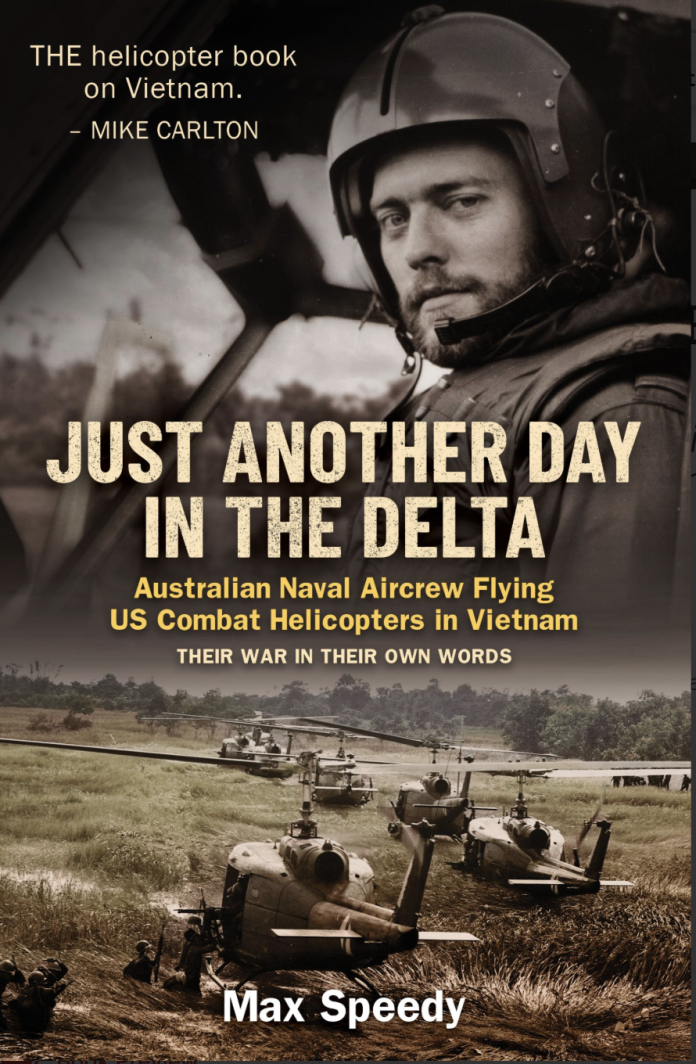
Just Another Day in the Delta. By Max Speedy. Big Sky, softback, 410 pages, $36.99
Reviewed by Tom Lewis
In a rather strange aspect of the Vietnam War, the Royal Australian Navy Helicopter Flight Vietnam was integrated into the United States Army’s 135 Assault Helicopter Company. Because of the unusual nature of the combination, they were known as the Experimental Military Unit – and therefore rather aptly, EMU Flight.
Just Another Day in the Delta, written by one who was there, takes a two-fold approach. The first half is an analysis of why, when, who and where. The second half is more anecdotes – some personal accounts from Max Speedy, the author – and many others who he has sourced.
Max’s own source material is quite unique. The author wrote:
I still have my flying logbook. It is a practical document rather than a diary. Yet, it still tells a story. Against each day, there is little more than the number of flying hours, whether they were flown by day or night, and the name of my co-pilot. Some pilots also recorded their crew chief or gunner. Sadly, I did not.
What surprises me now is not what it contains, but what it leaves out. There are days recorded in a single line during which helicopters were shot down, crews rescued under fire and aircraft returned riddled with bullet holes. On one occasion, my own aircraft was shot down and nine days later, I had an engine failure. On another, we were fortunate simply to fly home at all. Most of this did not seem important enough to record. Nearly 60 years later, that seems difficult to explain.
A more unusual flying day example, which saw the pilot – and this diary extract writer – Geoff Vidal awarded a Mention in Despatches. A medical evacuation helicopter was sent out with two more supplying gunfire support to allow it to get in; winch out a patient; fly him to hospital, and then repeat the operation.
…with other Albatross aircraft as cover went to an area still in heavy contact and did [the] first Stokes Litter winch [of a casualty]. Raced back to Coolah to change him over to faster H-model to get him to Vung Tau. He died as they lifted him out of our aircraft.
On second hoist had some trouble as crewman quite upset and co-pilot not any help at all. Second patient was transferred over OK and got to hospital alright. Aircraft providing cover were lucky not to get hit as they had a heavy fire-fight going.
I think [co-pilot] Downs was new in country and found it all a bit hard to manage a lot of radio work with Army on the ground and other aircraft while I had my hands full flying.
Crewman was Corporal Greg Love who was distressed at the first death, a bit overawed at the task of again getting [the aircraft] down through the [100–150 foot] canopy far enough for our [90 foot] winch cable to reach the ground and pretty anxious about the tracer flying around at the time. After this, a few beers in the bar and early night. Had excellent steak as late tea.
Another entry outlines the necessary everyday approach:
People sometimes ask whether we realised how dangerous it all was. The answer is yes and no. Of course, we knew the risks. Every pilot, observer, crew chief and gunner understood that a routine troop lift could become a desperate fight for survival within seconds. Aircraft were hit so frequently that damaged helicopters returning to base scarcely raised an eyebrow. Friends were wounded. Friends were killed. We attended their memorial services, climbed back into another aircraft and flew again the following morning. That was simply the nature of the war we fought.
Although the enormous amount of names, times, technical details and so on are impressive, for this reviewer the book was at its best in the middle chapters of personal anecdotes, alarming stories, and humorous tales. There are plenty of photographs and also a middle section of coloured pictures.
Three hundred and sixty pages of this accounting are complemented by another 50 pages of helpful appendices and explanations. Some of it relates to sourcing of records. There is also an index. One of the Appendices – F – is even a week -by-week listing of In-Theatre Records and Statistics. All of this will be most useful to scholars putting together the still-incomplete story of the tens of thousands of Service personnel who served in the long bitter defeat that was Vietnam – and beyond into its civilian residue.
Highly recommended.
Dr Tom Lewis OAM is a military historian. His latest work is The Battle of the Coral Sea Explained, from Avonmore Books.