By Tilla Hoja and Justin Bassi*
Australia and its AUKUS partners are cooperating in oceanographic research with China that helps it develop the very submarine capabilities they’re spending billions to counter.
One Chinese military university is already converting international ocean observations into products useful for underwater warfare planning. (From: The Strategist. The Australian Strategic Policy Institute.)
As Australian Director-General of Security Mike Burgess said in 2021, ocean-temperature modelling is useful for climate understanding, but ‘it’s also great if you’re a submariner.’ Five years on, technological developments have only made the data more useful for military purposes, including submarine warfare.
One program deserving scrutiny is Argo, an international ocean-observation network established around 1998 and widely regarded as an essential scientific program for understanding climate change and improving ocean and weather forecasts. But Argo’s oceanographic information also has significant military value, as better ocean knowledge can mean the difference between submarines being concealed or detected.
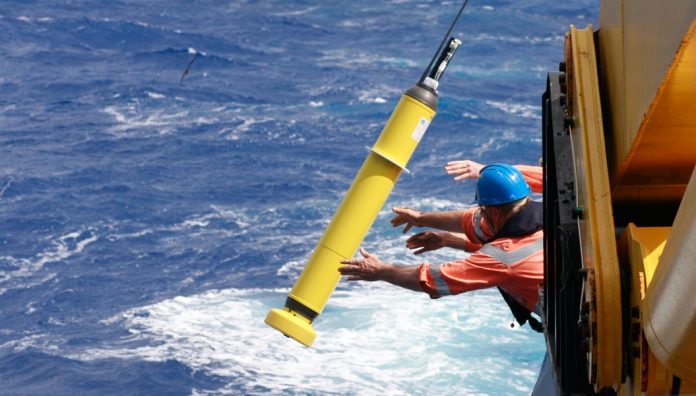
Argo, built on the foundation of the World Ocean Circulation Experiment, is supported by roughly 30 countries, including Australia, the United States, France and Britain. It uses thousands of autonomous floats to measure ocean temperature, salinity and pressure. Standard Argo floats profile the upper 2,000 metres of the ocean, while newer Deep Argo floats can reach down 6,000 metres. The conditions they measure all influence how sound travels underwater, so understanding them helps both to identify favourable submarine operating depths and to predict sonar performance.

The issue isn’t scientific cooperation with China itself, and defence involvement in Argo is not unique to China. Defence agencies in Australia, the US, Britain and France also participate in ocean research.
But China is not just an economic or scientific partner. It is a strategic, military and technological rival, and AUKUS nations should not be helping an adversary’s military development.
Official Chinese records document direct links between ostensibly civilian ocean research and People’s Liberation Army organisations developing military-relevant capabilities.
When China joined Argo in 2001, its military interests were soon evident, but Western nations seemingly ignored them to avoid upsetting economic relationships. For example, just a year into China’s membership, Argo’s 2002 coordination group included representatives of the PLA General Staff, naval navigation authorities and China’s intelligence service, the Ministry of State Security.
Twenty-five years later, China’s military connections run through the data pipeline.
The dual-use value of oceanographic data is in no doubt. Even the 2024 annual report of the China Argo office, called a station, says the country’s Argo observation network has civilian and military uses.
The same station had routed observations from the global Argo network through several Chinese institutions, including Unit 61741, which is associated with the PLA Battlefield Environment Support Base. The unit’s chief engineer served on the station’s academic committee, and in 2024, at the Dalian Naval Academy, the station’s director lectured on Argo and the use of data from underwater gliders.
The National University of Defence Technology and Shanghai Ocean University jointly developed a high-resolution, day-by-day map of ocean temperature, salinity and sound speed in the western Pacific. A user manual hosted on China’s Argo website shows how the three-dimensional map was built using machine learning to combine international Argo observations, satellite observations and other data. It covers depths reaching 2,000 metres in the western Pacific, including around Taiwan, and would help naval planners assess submarine concealment, operating depths and sonar effectiveness.
Another civil-military joint study uses the same map to support modelling of underwater sound and operational simulations. A related preprint, still under review, explicitly identifies military oceanography as an application.
Chinese defence researchers have gone further by adapting Argo float technology into underwater listening platforms. A 2021 study by the PLA Navy Submarine Academy and Qingdao laboratory described experimental floats fitted with BeiDou satellite antennas and underwater microphones that can tell which direction a sound comes from. Trials of the microphones in the South China Sea in August 2019 detected a surface vessel 13.8 km away and estimated its bearing.
The deeper 6,000-metre Argo floats give China further strategic value. China’s first Deep Argo deployment in the Southern Ocean in 2017 used a French-made float. However, consistent with a strategy of reducing dependency on Western technology, China has gradually replaced Western-supplied floats with Chinese models. China’s 2026 national report for Argo shows an increasing number of deployments of Chinese Xuanwu 6000-metre deep-sea floats in 2025, with plans to deploy 50 more each year until 2030.

China is using this data to strengthen its military capabilities and identify Western countries’ vulnerabilities. In 2026, China’s deep-sea Xuanwu floats, owned by Laoshan Laboratory, were launched by the polar vessel Xuelong 2 and by Dong Fang Hong 3 and Kexue. Reuters has placed Dong Fang Hong 3 within a broader Chinese mapping and sensor campaign that naval experts assess could support Chinese submarine warfare.
Australia keeps an eye on China’s oceanographic vessels. The Australian Defence Force monitored Tan Suo Yi Hao, a deep-sea survey vessel, on a mission south of Australia in 2025. But there is a difference between monitoring a research vessel’s location and identifying what the research is being used for.
Australia and its AUKUS partners should therefore scrutinise institutional cooperation. By looking closely at what work China has been interested in, they should see clues to what it has wanted data for.
Some evidence suggests there has been such scrutiny before. In 2017, the Commonwealth Scientific and Industrial Research Organisation (CSIRO) established a Hobart-based oceans research partnership with Qingdao National Laboratory for Marine Science and Technology (the predecessor of Laoshan Laboratory). The CSIRO decided not to renew the partnership beyond June 2022 – interestingly, just months after Burgess’s warning.
Australia should lead an urgent AUKUS audit of oceanographic research partnerships involving Chinese institutions. It should examine funding, military affiliations, access to sensitive technologies, research end-users and data-sharing arrangements. Cooperation that presents military technology-transfer risks or lacks transparency should be restricted or terminated. The foreign affairs minister has the power to terminate foreign arrangements against the national interest, and in August two science-related agreements with Chinese institutions, one by the Australian National University and another by the University of Queensland, were terminated.
This does not mean abandoning Argo.
In fact, ensuring AUKUS nations keep access to the Argo stream of research data is a security imperative. Australia needs to work with the US, whose reported consideration of reducing funding for Argo could enable Beijing to extend its influence over the whole system. The last decade has seen increased political attention on the national security implications of China’s objective to expand its influence over international institutions such as the World Intellectual Property Organization and the International Telecommunication Union. It is urgent that democratic nations pay attention to both China’s use of and sway over Argo.
China can access Argo data regardless of Western partnerships. But access to Argo’s public scientific observations is different from joint partnerships involving specialised expertise, advanced sensor technologies and non-public data of direct relevance to China’s military capabilities.
Paying for our own defence capabilities is expensive enough. Let’s not pay for the capability of our strategic adversary.