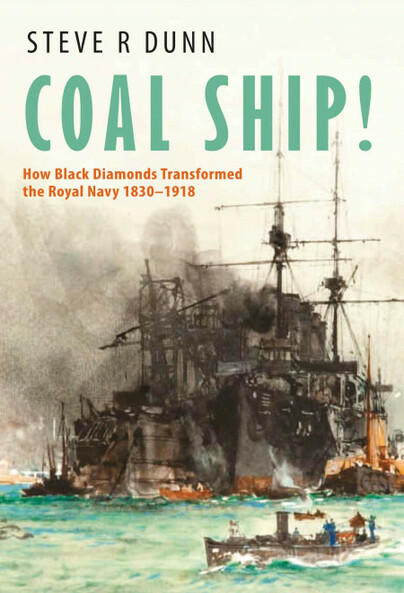
Coal Ship! How Black Diamonds Transformed the Royal Navy 1830-1918. By Steve R Dunn. Seaforth Publishing, an imprint of Pen & Sword Books, Yorkshire and Philadelphia, 2026. ISBN 978 1 0361 9236 5 (Hardback). ISBN 978 1 0361 9238 9 (Epub).
Reviewed by David Hobbs
This is another excellent book by Steve Dunn. It focuses on a specific aspect of the early twentieth century Royal Navy in forensic detail: coal as a source of motive power. Previous writers have described the importance of coal to British industry and trade as well as the RN but, as far as I am aware, none have covered the naval significance of coal and the logistic implications of its procurement, supply and use in such analytical detail.
Dunn covers every aspect of the impact of coal powered steam propulsion as well as explaining how the industries of First World War allies including France and Italy relied on the import of enormous tonnages of British coal to expand and sustain their output. German forces had overrun many of the French coalfields in 1914 and, arguably, it was British coal that sustained the total war effort.
The description of how various types of coal differed, the areas in which it was mined in the UK and the way in which it underpinned the industrial revolution are all explained but the parts of this book that fascinated me the most were the author’s descriptions of how the Royal Navy used coal. The Royal Commission on coal supplies, the establishment coaling bases around the world and that most hated of evolutions, coaling ship, are all described with a clarity that captures the reader’s imagination. Dunn’s focus is on the Royal Navy but his coverage applies equally to coal fired Australian warships including the battlecruiser HMAS Australia which served with the Battlecruiser Fleet based at Scapa Flow in the Orkney Islands and later in the Firth of Forth at Rosyth. She had bunkerage for 3,140 tons of coal augmented by 840 tons of furnace fuel oil which could be sprayed onto the burning coal in her boilers to increase maximum speed by about a knot. The fleet primarily used Welsh steam coal, the best there was, which was mined in the valleys of South Wales. At the Grand Fleet’s peak there were 160 warships in Scapa Flow many of which, including most of the battleships and battlecruisers, relied on coal although oil was used on a increasing scale by the newer types as the war progressed.
It was of fundamental importance that the fleet refuelled as quickly as possible when it returned from operations in the North Sea so that it would not be caught unprepared by a surprise movement of the German High Sea Fleet. No coaling facilities had been built at Scapa to prepare it for use as a naval base and so it was necessary to have sufficient fully loaded colliers ready with bagged coal to transfer it to every ship that needed refuelling in one massive evolution. Most previous histories have simply said that the fleet was refuelled on returning to the base but none have described what this actually meant. Dunn provides scale and numbers which place this vast logistical organisation into context. By October 1914 the Grand Fleet had the exclusive use of 163 colliers to service its bases at Scapa, Cromarty and Rosyth. A further 124 were deployed around the world. Within days of mobilisation, however, rail movement added to shipment in colliers as a means of providing coal for the fleet. In the first two weeks of August 1914, forty-one coal trains contracted by the Admiralty left the Cardiff area for Grangemouth on the Firth of Forth where it was bagged and transferred to colliers tasked with supporting the fleet.
It took 300 ten ton railway coal wagons to refuel HMAS Australia once and by September 1915 there were 200 coal trains a month moving from South Wales to Grangemouth to provide coal for the Grand Fleet, rising to 585 a month in September 1918. In total the Admiralty organised 13,631 coal trains to provide fuel for the fleet during the Great War which shifted over five millions tons of coal.
This book to adds considerable contextual detail to the historiography of the early twentieth century RN and RAN. The author covers the strategic impact of having vast quantities of steam coal in the valleys of South Wales, the establishment of world-wide coaling stations and the undisputed dominance they gave the British fleet together with Britain’s ability to use coal to sustain allied industries and as a weapon against their common enemies. Many pages provide details of the human impacts of coal’s use; the filth and grime of coaling ship, deaths that happened in bunkers as coal was poured into them while men inside were still trimming previous loads with sledgehammers. The skills of stokers as they sought to get the best performance from their boilers, spreading new coal over the white hot fires with shovels and raking out ash while others dragged heavy skips full of coal from bunkers to the boiler are brought to life by Dunn’s vivid descriptions. Coal from bunkers nearest the boilers was soon used up in high-speed action and skips had to be dragged over greater distances to reach the boiler fronts.
In summary, this outstanding book adds so much to our understanding of the coal fired warships that fought the First World War that I would put it in the ‘must have’ category for anyone with an interest in this period or, indeed, in the technical developments that preceded our own era. It gives us the most comprehensive description yet written about every aspect of coal fired steam propulsion and what that meant. I thoroughly recommend it.
Dunn covers every aspect of the impact of coal powered steam propulsion as well as explaining how the industries of First World War allies including France and Italy relied on the import of enormous tonnages of British coal to expand and sustain their output. German forces had overrun many of the French coalfields in 1914 and, arguably, it was British coal that sustained the total war effort.
The description of how various types of coal differed, the areas in which it was mined in the UK and the way in which it underpinned the industrial revolution are all explained but the parts of this book that fascinated me the most were the author’s descriptions of how the Royal Navy used coal. The Royal Commission on coal supplies, the establishment coaling bases around the world and that most hated of evolutions, coaling ship, are all described with a clarity that captures the reader’s imagination. Dunn’s focus is on the Royal Navy but his coverage applies equally to coal fired Australian warships including the battlecruiser HMAS Australia which served with the Battlecruiser Fleet based at Scapa Flow in the Orkney Islands and later in the Firth of Forth at Rosyth. She had bunkerage for 3,140 tons of coal augmented by 840 tons of furnace fuel oil which could be sprayed onto the burning coal in her boilers to increase maximum speed by about a knot. The fleet primarily used Welsh steam coal, the best there was, which was mined in the valleys of South Wales. At the Grand Fleet’s peak there were 160 warships in Scapa Flow many of which, including most of the battleships and battlecruisers, relied on coal although oil was used on a increasing scale by the newer types as the war progressed.
It was of fundamental importance that the fleet refuelled as quickly as possible when it returned from operations in the North Sea so that it would not be caught unprepared by a surprise movement of the German High Sea Fleet. No coaling facilities had been built at Scapa to prepare it for use as a naval base and so it was necessary to have sufficient fully loaded colliers ready with bagged coal to transfer it to every ship that needed refuelling in one massive evolution. Most previous histories have simply said that the fleet was refuelled on returning to the base but none have described what this actually meant. Dunn provides scale and numbers which place this vast logistical organisation into context. By October 1914 the Grand Fleet had the exclusive use of 163 colliers to service its bases at Scapa, Cromarty and Rosyth. A further 124 were deployed around the world. Within days of mobilisation, however, rail movement added to shipment in colliers as a means of providing coal for the fleet. In the first two weeks of August 1914, forty-one coal trains contracted by the Admiralty left the Cardiff area for Grangemouth on the Firth of Forth where it was bagged and transferred to colliers tasked with supporting the fleet.
It took 300 ten ton railway coal wagons to refuel HMAS Australia once and by September 1915 there were 200 coal trains a month moving from South Wales to Grangemouth to provide coal for the Grand Fleet, rising to 585 a month in September 1918. In total the Admiralty organised 13,631 coal trains to provide fuel for the fleet during the Great War which shifted over five millions tons of coal.
This book to adds considerable contextual detail to the historiography of the early twentieth century RN and RAN. The author covers the strategic impact of having vast quantities of steam coal in the valleys of South Wales, the establishment of world-wide coaling stations and the undisputed dominance they gave the British fleet together with Britain’s ability to use coal to sustain allied industries and as a weapon against their common enemies. Many pages provide details of the human impacts of coal’s use; the filth and grime of coaling ship, deaths that happened in bunkers as coal was poured into them while men inside were still trimming previous loads with sledgehammers. The skills of stokers as they sought to get the best performance from their boilers, spreading new coal over the white hot fires with shovels and raking out ash while others dragged heavy skips full of coal from bunkers to the boiler are brought to life by Dunn’s vivid descriptions. Coal from bunkers nearest the boilers was soon used up in high-speed action and skips had to be dragged over greater distances to reach the boiler fronts.
In summary, this outstanding book adds so much to our understanding of the coal fired warships that fought the First World War that I would put it in the ‘must have’ category for anyone with an interest in this period or, indeed, in the technical developments that preceded our own era. It gives us the most comprehensive description yet written about every aspect of coal fired steam propulsion and what that meant. I thoroughly recommend it.